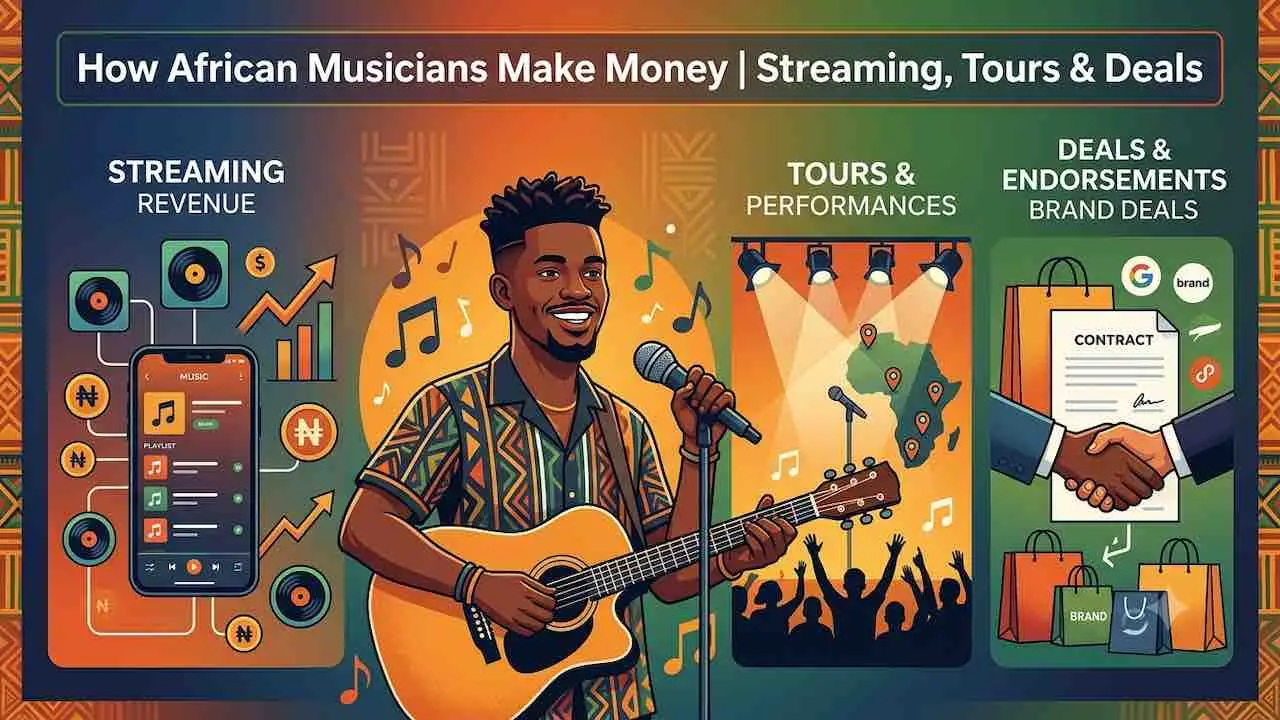
African musicians make money through 9 proven revenue streams: streaming royalties, live performance fees, brand endorsements, sync licensing, music publishing, merchandise, fan subscriptions, TikTok and social media income, and music catalog ownership. Nigeria’s top 10 artists combined earned a verified $73 million in a single year by stacking all of them. Sub-Saharan Africa’s recorded music revenues hit $120 million in 2025, growing 15.2% year on year per the IFPI Global Music Report 2026. Tubidy Africa covers the business, trends, and artist stories behind this growing economy. This guide breaks down every income channel with exact figures, named artist examples, platform-specific data, and what separates artists who earn from those who only stream.
The African Music Economy: Industry Numbers That Define the Opportunity
Before breaking down individual income streams, the macro picture shows why how African musicians make money is now a global business question, not just a regional one.
| Metric | Verified Figure | Source |
|---|---|---|
| Sub-Saharan Africa recorded music revenue (2025) | $120 million (+15.2% YoY) | IFPI Global Music Report 2026 |
| South Africa share of Sub-Saharan revenue | 78.1% (~$93.7 million) | IFPI 2026 |
| Spotify royalties to Nigerian artists (single year) | $43.8 million (+15% YoY) | Afro Soundtrack / Spotify |
| Spotify royalties to South African artists (same year) | $26 million | Afro Soundtrack |
| Nigeria top 10 artists combined estimated earnings | $73 million (12 months) | Pulse Nigeria |
| Afrobeats streams on Spotify (annual) | 14+ billion | Spotify Loud & Clear |
| TikTok contribution to African music streams | 30% of all streams | WorldMetrics / CISAC |
| African music market projected size | $10 billion by 2025 at 8.3% CAGR | Industry forecast |
Sub-Saharan Africa was the joint second-fastest growing music region globally in 2025, alongside MENA and just behind Latin America’s 17.1% growth. This is the economic context inside which African music’s growth facts keep accelerating. The income opportunity is real, large, and expanding. The artists who capture it understand all 9 channels below.
Full African Musician Revenue Breakdown: All 9 Streams at a Glance
| Revenue Stream | Monthly Income Potential | Primary Platforms / Channels | Best Artist Tier |
|---|---|---|---|
| Streaming Royalties | $500 to $100,000+ | Spotify, Apple Music, Boomplay, Audiomack, YouTube | All tiers; scales with catalog size |
| Live Performance Fees | $2,000 to $1,200,000+ per show | Local shows, diaspora tours, festivals | All tiers; biggest earner at mid to top level |
| Brand Endorsements | $10,000 to $5,000,000+ per deal | Telecom, beverages, fashion, fintech | Mid to top tier |
| Sync Licensing | $1,000 to $100,000+ per placement | Nollywood, global TV, ads, games | Songwriters who own masters and publishing |
| Music Publishing and PRO Royalties | Variable; passive income on catalog | MCSN, SAMRO, MCSK, CISAC member societies | Songwriters and producers |
| Merchandise | $500 to $30,000+ per drop | Concert tables, online stores | Artists with emotionally connected fan bases |
| Fan Subscriptions | $500 to $20,000+ recurring | Patreon, YouTube Memberships, Ko-fi | Independent artists with loyal communities |
| TikTok and Social Media Income | $200 to $10,000+ monthly | TikTok Creator Fund, Instagram Reels, YouTube Shorts | Viral and content-active artists |
| Music Catalog and Publishing Assets | Lifetime passive income | Catalog sales, neighboring rights, private copying levy | Established artists with owned masters |
Stream 1: Streaming Royalties from DSPs
Streaming royalties are the most visible income source for African musicians, but rarely the largest. Digital Service Providers (DSPs) including Spotify, Apple Music, Boomplay, Audiomack, Deezer, and YouTube pay per stream, but the per-stream rate varies sharply by platform, listener geography, and subscription tier. A stream from a US Apple Music Premium subscriber pays more than a stream from a Nigerian Boomplay free-tier listener. That geography gap is one of the central financial realities for African artists building global audiences from African homes.
Per-Stream Payouts: Platform by Platform Comparison
| DSP Platform | Average Payout Per Stream | African Strength | Key Note for African Artists |
|---|---|---|---|
| Tidal | $0.013 | Highest per-stream globally | Low African user adoption; earns most from diaspora listeners |
| Apple Music | $0.01 | Premium payout globally | Growing African base; strong diaspora earnings |
| Boomplay | $0.0064 | 90 million+ African users; dominant in Nigeria, Ghana, Kenya | Volume beats rate; quarterly payout with target thresholds |
| Spotify | $0.003 to $0.005 | Editorial playlists; global discovery engine | Paid $43.8M to Nigerian artists; growing African premium base |
| Audiomack | Ad-share via AMP program | Top discovery platform in Nigeria, Ghana, Kenya | Low payout per play; massive early-career exposure value |
| YouTube Music | Ad revenue + Content ID earnings | Largest video platform across Africa | Content ID earns on ALL user-generated video using the song |
| Deezer | $0.0064 | Active in francophone Africa | Strong in Ivory Coast, Senegal, and DRC markets |
What These Numbers Mean for Real Earnings
250,000 Spotify streams earn $750 to $1,250. 1 million Apple Music streams generate $7,000 to $10,000. These figures apply before distributor cuts (typically 10 to 20%), label cuts (if applicable), and management fees (15 to 20% of gross income). By the time Spotify’s pool is divided among platforms, labels, distributors, publishers, and managers, the artist often receives a fraction of what the headline royalty number suggests.
Nigerian R&B artist Mannywellz put it plainly after millions of streams: “The math just doesn’t math.” Virality does not automatically produce viability. This is why the most financially stable African artists build income from all 9 streams simultaneously, with streaming acting as a reach engine rather than a primary income source.
Why Boomplay and Audiomack Are Not Optional for African Artists
Boomplay’s 90 million active users across Nigeria, Ghana, Kenya, and Tanzania represent the most concentrated African music audience on any single platform. Audiomack crossed 20 million monthly active users with the bulk in African and US urban markets. Both platforms serve a critical role that global DSPs cannot: they are where African songs build first momentum before crossing to Spotify and Apple Music. DJ reposts, editorial playlists, and community sharing on Audiomack drive the discovery that later converts into Spotify streams and brand deal interest. Read the full comparison of Boomplay vs Audiomack vs Spotify payouts to understand which platform earns most at each career stage.
YouTube Content ID: The Income Most African Artists Leave on the Table
YouTube Content ID is an automated system that matches any user-uploaded video using a licensed song and routes ad revenue back to the rights holder. For Afrobeats, Amapiano, and Bongo Flava artists in high-viral genres, Content ID income from dance challenges, DJ sets, fan compilations, and reaction videos often exceeds direct music video ad revenue. This income requires zero additional work from the artist after the initial Content ID registration through a YouTube Certified distributor. Artists who skip this step permanently forfeit every naira, rand, and shilling earned from thousands of fan videos using their music. Learn more about how streaming works in Africa across all major platforms and what each one offers African rights holders.
Choosing the Right Distributor: African-Specific Options
Distribution is the gateway to all DSP income. The distributor an artist chooses determines which platforms they reach, how quickly they get paid, and how much they keep. Key options for African artists include:
- Africori handles direct relationships with Boomplay and Mdundo plus publishing administration, neighboring rights, and sync licensing; acquired by Warner Music Group in 2020
- DistroKid serves as the default for independent African artists needing maximum global reach at minimum cost
- TuneCore and DistroKid both ship to 220+ DSPs including all major African-specific platforms
- Mayvibe Africa pays in Naira directly, removing dollar conversion friction for Nigerian artists
- Streamlivr pays in USDC with withdrawal to M-Pesa, GTBank, or crypto wallet, built specifically for African creators
Artists who distribute through services without direct Boomplay relationships miss the African platform where 90 million listeners actually stream. Getting on Spotify, Apple Music, and Boomplay requires choosing the right distributor from day one.
Stream 2: Live Performance Fees
Live performance fees are where African musicians make the most money, especially from mid-tier upward. Burna Boy, Wizkid, Rema, and Davido each command booking fees between $750,000 and $1,200,000 per show. Wizkid received $3 million to headline the AIA Sound Festival in Denmark, the highest single-show fee ever documented for an African artist. Asake books at $500,000. Black Coffee commands $300,000 per DJ set globally. These are single-night performance guarantees, not annual totals.
Africa’s Verified Live Performance Booking Fees
| Artist | Country | Performance Fee Per Show | Primary Markets |
|---|---|---|---|
| Burna Boy | Nigeria | $750,000 to $1,200,000+ | Stadium shows globally; Grammy-driven premium |
| Wizkid | Nigeria | $750,000 to $3,000,000 (peak festival) | O2 Arena, Rolling Loud, diaspora circuits |
| Rema | Nigeria | $1,000,000 | International festivals; “Calm Down” global wave |
| Davido | Nigeria | $600,000 to $1,000,000 | USA, UK, Africa, Middle East diaspora |
| Asake | Nigeria | $500,000 | UK, USA, African festivals |
| Olamide | Nigeria | $200,000 to $500,000 | Nigeria, diaspora |
| Black Coffee | South Africa | $300,000 | Ibiza, global DJ circuit |
| Kizz Daniel | Nigeria | $200,000 | Africa, diaspora shows |
| Amr Diab | Egypt / North Africa | $170,000 | Arab world, North Africa, diaspora |
What a Full Booking Actually Costs the Promoter
The headline fee is only the first line item. A full Wizkid booking includes chartered flights with one business class and six economy seats, a penthouse suite plus 10 standard hotel rooms, $300 daily per diem for the artist, $200 for the manager, $100 per crew member, and full ground transport and security covered by the promoter. These rider costs add 15 to 30% on top of the performance fee. Understanding this structure is key for African artists negotiating their first international bookings, as each rider line item is negotiable and directly affects the artist’s net income per show.
Diaspora Markets: The Income Engine Most Artists Miss
Nigerian artists normalized international summer tours as a structured income strategy. Davido, Rema, Burna Boy, Fireboy DML, and Ayra Starr performed across North America, Europe, and Asia in one summer, each turning live performance into a primary income driver while simultaneously boosting streaming numbers in premium-payout markets.
The diaspora market accesss a pricing tier that local African shows cannot match. An artist who earns $5,000 for a Lagos show may earn $50,000 for a theater show in London, Toronto, or Houston, where the African diaspora pays premium ticket prices for cultural connection. This income gap is why Davido and Wizkid built sustainable global careers from diaspora community shows before headlining international festivals. For artists at mid-tier level, the diaspora tour is the single fastest path to five-figure monthly performance income.
Revenue Hidden Inside Live Shows
Tours create multiple monetizable touchpoints beyond ticket sales. High-margin revenue layers inside a single show include:
- Merchandise tables at venues, where limited items sell at 3 to 5 times their production cost
- VIP and meet-and-greet packages priced at $200 to $2,000 per person, stacked above the ticket price
- After-show events and private performances, typically added to international tour stops
- Brand-sponsored dinners and hospitality events wrapped around the concert date
- Sync licensing deals triggered by live exposure pushing songs into film and TV placement queues
A single stadium night combining ticket revenue, merch, VIP packages, and brand sponsorship can generate more income than 6 months of streaming for the same catalog. For Amapiano acts like Kabza De Small and DJ Maphorisa, the performance-first income model has produced sustained high earnings that streaming alone could not replicate at their scale.
Virtual and Livestream Concerts: The New Revenue Layer
Live streaming has become a structured income source for African artists targeting global fans without the cost of physical touring. Artists monetize virtual performances through ticketed events, exclusive content subscriptions, brand partnerships, YouTube Super Chat donations, and Twitch tips. A well-promoted virtual show reaching 10,000 paying fans at $10 per ticket generates $100,000 in one night at near-zero logistics cost compared to a physical tour. Rising African artists with global social media followings are using this format to build international income before they can afford to tour.
Stream 3: Brand Endorsements and Deals
Brand endorsements are the income multiplier that separates mid-tier African artists from wealthy ones. The deals have evolved far beyond simple Instagram posts. Wizkid holds endorsements with Pepsi, Nike, MTN, and Flutterwave. Tiwa Savage’s brand portfolio includes Pepsi, Tecno, and telecom partnerships estimated between $20 million and $40 million in total career endorsement value. Tems joined Omega as a brand ambassador and became the first African female to hold a stake in an MLS ownership group, as a Club Partner with San Diego FC. These are equity-level arrangements, not promotional posts.
Brand Deal Categories and Income Ranges
| Brand Category | Typical Annual Deal Value | African Artist Examples |
|---|---|---|
| Telecom (MTN, Airtel, Glo) | $250,000 to $1,000,000 | Wizkid x MTN, Davido x Glo |
| Beverage (Pepsi, Guinness, Heineken) | $200,000 to $2,000,000 | Tiwa Savage x Pepsi, Burna Boy x Guinness |
| Fashion and Sneakers (Nike, Puma) | $100,000 to $1,500,000 | Wizkid x Nike, Davido x Puma |
| Fintech (Flutterwave, Opay, Paystack) | $50,000 to $500,000 | Wizkid x Flutterwave |
| International Luxury (Omega, high fashion) | $500,000 to $5,000,000+ | Tems x Omega |
| Food and FMCG | $100,000 to $500,000 | Regional campaign deals across Nigeria, SA, Kenya |
Brand deals scale directly with streaming numbers and social media reach. An artist with 500,000 engaged Instagram followers and 50 million Spotify streams attracts regional telecom deals. An artist with Wizkid’s 11 billion+ career streams attracts global luxury brands. The pathway from the first local telecom deal to an international luxury partnership follows a predictable progression tied to streaming milestones and cultural reach. Successful African female artists like Tiwa Savage, Tems, and Ayra Starr have set a new standard for what brand partnership portfolios can look like for African women in global entertainment.
Stream 4: Sync Licensing
One sync placement in a major TV ad campaign can deliver more income than 6 months of streaming from the same song. Sync licensing is the placement of music inside a film, TV show, commercial, video game, or digital ad in exchange for a sync fee and ongoing performance royalties. It requires clearing two separate licenses: the sync license for the musical composition and the master license for the recorded track.
Sync Income Ranges by Placement Type
| Placement Type | Typical Sync Fee | African Market Context |
|---|---|---|
| Local Nigerian/South African TV ad | $1,000 to $15,000 | Telecom, bank, FMCG brands running campaign ads |
| Nollywood feature film | $500 to $5,000 | Scene usage, theme songs, score elements |
| Netflix Africa original series | $5,000 to $50,000+ | Growing pipeline of African streaming originals |
| Global brand campaign | $20,000 to $100,000+ | International FMCG, fashion, automotive campaigns |
| Video game license | $2,500 to $20,000 | Sports games, mobile games using African soundtracks |
| YouTube and Instagram ad content | $500 to $5,000 | Brands running digital-only campaigns |
For Nigerian artists, sync is one of the fastest-growing and most underdeveloped income streams simultaneously. Every Nigerian brand running a TV commercial needs licensed music. Every Nollywood production needs a score. And Every telecom, bank, and FMCG brand running digital ads needs licensed audio. That is a live licensing market currently served largely by generic international production libraries rather than Nigerian composers who could fill that space directly.
Why Independent Artists Win Sync Deals Faster
Independent artists who own both their master recording and their publishing clear sync deals in days. Major label artists often lose the same placement because label approval cycles take weeks. Production schedules do not wait. This structural advantage is one of the strongest financial arguments for staying independent, particularly for producers and songwriter-artists who generate catalog consistently. The full breakdown of music publishing in Africa covers how to structure your rights for sync readiness from the first release.
Stream 5: Music Publishing and PRO Royalties
Performance royalties account for 35 to 50% of global music publishing revenue, yet most African artists do not collect everything they are owed. Every time a registered song plays on radio, TV, at a live venue, or on a streaming platform, a performance royalty is generated and collected by a Performing Rights Organisation (PRO). Without registration, that income accumulates unclaimed inside what the industry calls the “black box,” money sitting in the system waiting for someone to claim it.
African PROs and Collection Societies
| Country | PRO / Collection Society | What It Collects |
|---|---|---|
| Nigeria | MCSN (Music Copyright Society of Nigeria) | Performance royalties from radio, TV, live venues, streaming |
| South Africa | SAMRO | Composition performance royalties; affiliated with CISAC |
| Kenya | MCSK (Music Copyright Society of Kenya) | Radio, TV, public performance royalties |
| Ghana | GHAMRO | Performance and reproduction rights |
| Tanzania | COSOTA | Copyright and neighboring rights collection |
| All African PROs | CISAC (global umbrella body) | Reciprocal royalty collection across 150+ countries |
Every Royalty Type an African Artist Should Collect
- Master royalties from the recorded track, paid by DSPs through the distributor
- Composition performance royalties from radio, TV, live performances, and streaming, collected via the national PRO
- Mechanical royalties from the composition being reproduced on streaming platforms; collected via mechanical licensing agencies
- Neighboring rights for performers and producers on sound recordings, separate from the composition royalty
- Sync fees and broadcast performance royalties triggered when a synced track airs on TV or digital video platforms
- Private copying levy income collected from device manufacturers on behalf of creators; globally this generated €379 million annually per CISAC
- TikTok royalties via platform licensing agreements, now growing sharply per Afro Soundtrack Q2 data
Artists who register correctly collect from all 7 channels. Those who skip PRO registration and publishing administration see only their master royalty after distributor and label cuts. The gap between the two can represent thousands of dollars per month for any artist with active radio play or live performance history. Read the full guide on copyright and royalties for African artists and how to register for every collection channel available.
TikTok Royalties: Africa’s Newest Growing Income Source
A TikTok contributed 30% of African music streams. TikTok royalties appeared for the first time as a significant income source for African artists in Q2 of the most recent reporting year and continued growing sharply, per Afro Soundtrack platform data. This growth comes through TikTok’s licensing agreements with distributors and publishers, not directly from the Creator Fund, which remains inaccessible to most Africa-based creators. Nigerian and South African artists whose songs go viral on TikTok earn licensing royalties through their distributor’s TikTok agreement, separate from any creator account monetization. Burna Boy and CKay’s Love Nwantiti both benefited financially from TikTok virality through this licensing channel, earning royalties from the hundreds of millions of videos using their music.
Stream 6: The 360 Deal vs. Independent Path: The Honest Numbers
A $100,000 label advance at a 20% royalty rate requires 375 million to 500 million streams before an artist earns a single royalty dollar from recorded music. Most signed African artists never reach that recoupment threshold. This is the financial reality driving the push toward independent music careers across Nigeria, South Africa, and Ghana. Understanding this math before signing anything is non-negotiable.
What a 360 Deal Takes From Every Revenue Stream
A 360 deal means the label takes a percentage from every income source the artist generates, not just recorded music. That includes touring income, merchandise revenue, publishing rights, brand endorsements, and sync fees. Labels moved to this model after streaming reduced their recording revenue to a fraction of the physical era. Before signing any 360 deal, an African artist must model every revenue stream the label will touch across a 5 to 10 year projection.
Independent vs. Major Label: Income Retention Comparison
| Revenue Source | Independent Artist Keeps | Signed Artist Keeps (After Label + Recoupment) |
|---|---|---|
| Streaming Royalties | 80 to 100% | 5 to 25% (after recoupment; label keeps 75 to 85%) |
| Touring Income | 85 to 100% (minus 15 to 20% management) | 60 to 80% (360 deal cut applied) |
| Merchandise | 100% | 50 to 75% (360 deal) |
| Brand Endorsements | 80 to 85% (minus management fee) | 50 to 70% (360 deal) |
| Sync Licensing | 100% (both master and publishing) | 50% or less (label controls master; slow to approve) |
| Publishing Royalties | 100% of writer and publisher share | 50 to 75% (if label controls publishing) |
The Mavin Records model and YBNL Nation both demonstrate that label infrastructure and artist-friendly splits can coexist. Mavin Records signed Rema and Ayra Starr to deals that gave them label marketing support while preserving sharply better royalty terms than traditional major label structures. Olamide’s YBNL Nation generates consistent catalog income for the label while giving signees income from touring and brand deals largely intact. These models show a middle path between full independence and traditional 360 deal structures.
Stream 7: Merchandise
Merchandise has moved from a secondary afterthought to a core income pillar for African artists with strong fan communities. Merch works best when fans feel emotionally connected to the artist, not just passively aware of a song. Artists like Burna Boy and Master KG sell merchandise as cultural identity items, not just product. That emotional layer is what allows 3 to 5 times production cost markups at concert tables without resistance from buyers.
Merchandise Revenue Channels for African Artists
- Concert merch tables, where limited-edition drops move at premium prices during the emotional peak of a live show
- Online stores through Shopify or similar platforms, reaching diaspora fans who cannot attend African shows
- Limited edition album-linked drops that create scarcity-driven demand and pre-save momentum simultaneously
- Collaborative drops with African fashion brands that bring new audiences to both parties
- Merch bundles with streaming pre-saves and fan subscription tiers
Amapiano artists in particular have built strong merchandise ecosystems alongside performance culture. South African female amapiano artists are building merchandise revenue alongside growing international audiences in the UK and USA. Superfan data from Spotify’s research shows the top 2% of listeners drive over 18% of streams and more than 50% of merch purchases. That 2% is the merchandise buyer target for every African artist.
Stream 8: Fan Subscriptions and Direct-to-Fan Income
Fan subscription platforms give African artists recurring monthly income completely independent of DSP algorithms, playlist placements, and label marketing cycles. Patreon crossed $10 billion in lifetime creator payouts and now hosts hundreds of thousands of active creator businesses. An artist with 10,000 fans paying $5 monthly generates $50,000 per month in predictable income. That income does not fluctuate with Spotify’s algorithmic changes or Boomplay’s quarterly targets.
Direct-to-Fan Platform Comparison
| Platform | Platform Fee | Best For | African Artist Fit |
|---|---|---|---|
| Patreon | 10% (new creators post August 2025) | Monthly membership tiers with exclusive content | Artists with diaspora fan bases who engage regularly |
| Ko-fi | 0% on donations; 5% on memberships | One-off and recurring fan support; no commitment required | Early-stage artists building first direct income |
| Bandcamp Subscriptions | 15% (drops to 10% past $5,000 in sales) | Music-first artists selling albums and subscriptions together | Strong for catalog-heavy artists selling directly to collectors |
| YouTube Memberships | 30% (Google/Apple take); 70% to creator | Artists with active YouTube channels and live stream culture | Very strong for African artists with high YouTube followings |
African artists with active diaspora fan bases in the UK, USA, and Canada are best positioned for fan subscription income. Fans in diaspora markets have both the payment infrastructure (credit cards, PayPal) and the emotional motivation to pay monthly for exclusive access to an artist from their home culture. New African artists building international followings through social media before they tour internationally can use fan subscriptions to monetize that audience immediately.
Stream 9: Music Catalog Ownership and Passive Asset Income
Catalog ownership is the difference between an income and a wealth asset. A song catalog generates income from every stream, radio play, sync placement, and performance, forever, without the artist performing a single additional task. Wizkid’s catalog including Made in Lagos generates millions in passive royalties annually. Don Jazzy’s Mavin Records catalog with Rema and Ayra Starr produces consistent income that compounds as those artists grow. Olamide earns from catalog through YBNL Nation independently of any new release.
Neighboring Rights and Private Copying Levy
Two income streams that almost no African artist currently collects are neighboring rights and the private copying levy. Neighboring rights pay performers and producers every time a sound recording plays on radio or TV, separate from the songwriting performance royalty. Globally, private copying levy income generated €379 million in one year, collected from smartphone, tablet, and hard drive manufacturers on behalf of music creators. African artists whose music circulates internationally are entitled to neighboring rights income in every territory where their recordings play on broadcast media, but only if they are registered with the appropriate collecting societies. The detailed guide on IP protection losses for African artists shows exactly how much is being left uncollected.
Country-Level Income Realities: Nigeria, South Africa, and Kenya
Nigeria: Africa’s Largest Music Revenue Market
Nigeria drives the continent’s biggest music income. Spotify alone paid Nigerian artists $43.8 million in one year. The broader Afrobeats economy produced an estimated $73 million for just the top 10 artists in 12 months. Wizkid’s estimated net worth sits at $89 million. Burna Boy’s ranges from $60 to $180 million across multiple verified estimates. Davido stands at $65 to $80 million. These figures come from the stacked income model, where touring, streaming, brand deals, and publishing compound annually. Nigeria’s music-to-revenue conversion advantage comes from Afrobeats’ global commercial appeal. Read more about how different African music genres compare in their global earning power.
South Africa: Performance-First, Catalog-Growing
South Africa generated approximately $93.7 million of the $120 million Sub-Saharan total in 2025, making it the continent’s largest single recorded music market at 78.1% of the regional share. Its income structure is heavily performance-driven. Amapiano’s performance culture has made South African DJs and producers among the highest-paid artists on the continent through live shows alone. Black Coffee’s $300,000 per DJ set reflects what authentic, globally sought South African sound commands. The township house to amapiano timeline shows how South Africa’s performance income culture developed from local roots into global commercial power.
Kenya: East Africa’s Fastest-Growing Music Economy
Kenya’s music economy is growing fastest in East Africa. Properly distributed East African artists earn between $5,000 and $20,000 monthly from streaming alone when releasing consistently on all major DSPs. Boomplay and Audiomack dominate discovery in Kenya, while Spotify and Apple Music are growing rapidly as smartphone penetration and internet access expand. Radio airplay through MCSK generates performance royalties that supplement DSP income meaningfully for artists with strong Kenyan radio presence. Central African breakthrough artists are following the Kenya template: build regional streaming presence on African DSPs first, then target diaspora audiences in Europe and North America for live income. Bongo Flava from Tanzania follows a similar regional-to-global income arc.
IP Protection: The Silent Drain on African Artist Income
Income gaps for African musicians often come from rights problems, not popularity problems. Unregistered songs, missing metadata, unclear ownership, unsigned co-writing splits, and unregistered ISRC codes leave money sitting in digital black boxes permanently. Billions of dollars in music royalties go unclaimed globally each year simply because rights holders did not register correctly. African artists face a disproportionate share of this problem due to limited access to publishing administration services and rights management education.
5 Things Every African Artist Must Register Before Releasing
- PRO membership in their home country (MCSN, SAMRO, MCSK, GHAMRO, or COSOTA)
- ISRC codes for every master recording; these track plays across all DSPs
- ISWC codes for every composition; these connect to PRO collection systems globally
- Written co-writer splits signed and agreed before any collaborative track releases
- Publishing administration agreement with a service that registers works in 150+ countries
Missing any of these steps means forfeiting royalties currently generating from radio plays, streaming sessions, and public performances happening right now. The guide to African CMOs and music royalties explains the complete registration process by country and what each collection society actually pays.
How African Artists Build the Full Income Stack by Career Stage
| Career Stage | Active Income Sources | Monthly Income Range | Priority Action |
|---|---|---|---|
| Emerging (0 to 2 years) | Audiomack, Boomplay, local shows, social media content | $200 to $2,000 | Register with PRO; distribute to all African DSPs; build local live history |
| Rising (2 to 5 years) | Spotify, diaspora shows, first brand deals, Patreon, merch | $2,000 to $20,000 | Lock in publishing admin; set up Content ID; pitch for editorial playlists |
| Established (5+ years) | Global DSPs, international tours, major brand deals, sync, publishing | $20,000 to $200,000 | Retain catalog ownership; negotiate brand deals in USD; build fan subscription base |
| Superstar | Stadium tours, catalog royalties, global endorsements, label equity, catalog assets | $500,000 to $5,000,000+ | Catalog monetization; equity deals; neighboring rights registration across all territories |
The income habits built at the emerging stage determine how much money flows when the audience grows. An artist who owns their masters, registers with a PRO, and distributes to Boomplay, Audiomack, Spotify, and Apple Music from the first release collects from every channel simultaneously from day one. An artist who skips these steps rebuilds rights infrastructure later at significant cost and with permanent gaps in historical royalty collection. Read the full breakdown of how African music income works across the full career arc.
FAQs: How African Musicians Make Money
Monthly streaming income ranges from $200 for emerging artists to $200,000+ for established acts. Spotify alone paid Nigerian artists $43.8 million and South African artists $26 million in a single year. Actual earnings depend on platform mix, listener geography, and whether the artist collects both master and publishing royalties.
Apple Music pays $0.01 per stream and Tidal pays $0.013, the two highest per-stream rates. Boomplay and Audiomack deliver the highest total stream volume across Africa. YouTube Content ID income from user-generated videos regularly exceeds direct stream payouts for Afrobeats and Amapiano artists.
No. Independent artists consistently out-earn signed artists at similar stream counts. A $100,000 advance at a 20% royalty rate requires up to 500 million streams before royalty income begins. Most signed African artists never reach that threshold. Distributors like Africori and DistroKid give independents full control of all 9 income streams.
Live performance fees are the largest single income source at mid to top tier. Burna Boy, Wizkid, Rema, and Davido each command $750,000 to $1,200,000 per show. Nigeria’s top 10 artists earned a combined $73 million in 12 months, with live shows and brand deals outpacing streaming royalties for all of them.
Distribute to Audiomack and Boomplay first, then add Spotify, Apple Music, and YouTube. Register with your national PRO on release day. Enable YouTube Content ID through your distributor. Build a local live performance record before targeting diaspora markets. Brand deals follow consistently once social engagement passes 50,000 active followers.
The African music industry generated $120 million in recorded music revenue in Sub-Saharan Africa alone in 2025, growing at 15.2% annually. That number does not include live performance income, brand endorsements, sync fees, or direct fan income, which collectively dwarf recorded music revenue for the continent’s top artists. African musicians who earn sustainably build all 9 income streams in sequence. Streaming opens doors. Live shows pay today’s bills. Brand deals multiply existing income. Publishing and sync create passive earnings. Merch and fan subscriptions build direct community revenue. Catalog ownership builds lasting wealth. For more on the full business behind African music, explore African music industry growth data, the Afrobeats vs Afrobeat commercial distinction, and how individual artists like Diamond Platnumz built East Africa’s most commercially successful music career by mastering every income stream available.