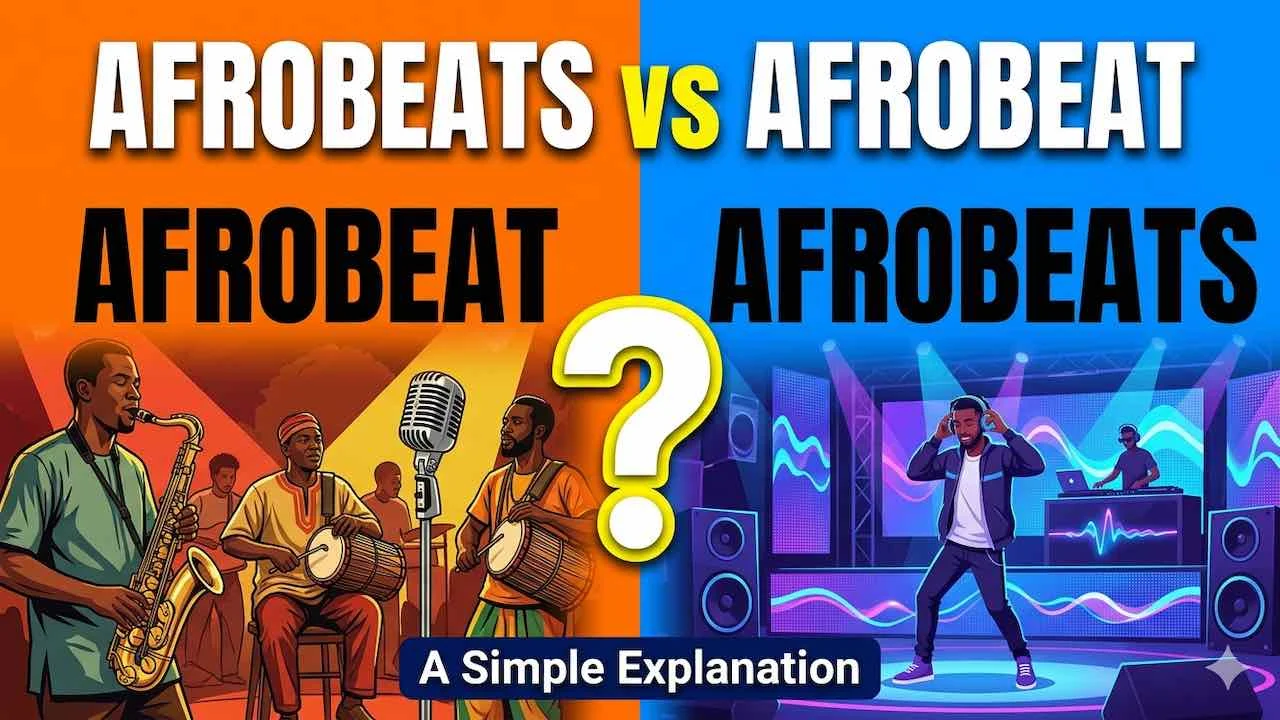
Afrobeats vs Afrobeat: What Is the Difference? A Simple Explanation

Afrobeat and Afrobeats are two completely different music genres. One letter separates them: the “s.” Afrobeat is a 1960s political genre born in Lagos, Nigeria. Afrobeats is a modern West African pop movement that gained global reach from the 2000s onward. Both share West African roots but differ sharply in era, sound, structure, and purpose.

Many music fans use both words as if they mean the same thing. That is a mistake. Calling Burna Boy or Wizkid an “Afrobeat artist” is as inaccurate as calling a hip hop star a blues musician. The roots connect. The music does not.

The One Letter That Changes Everything

Adding “s” to Afrobeat completely changes which genre you are referring to. Afrobeat without the “s” points to Fela Kuti’s specific political genre from the late 1960s. Afrobeats with the “s” refers to a wide umbrella of contemporary West African pop that emerged in the 2000s. Both words look almost identical, but they describe sounds that are decades apart in style and intent.

Getting this distinction right matters in music writing, playlist curation, streaming metadata, and African music news. Getting it wrong signals unfamiliarity with African music history. Getting it right shows real respect for two distinct cultural movements that deserve their own recognition.

Afrobeat: The Original Sound by Fela Kuti

Afrobeat is a genre created in Nigeria in the late 1960s by musician and activist Fela Anikulapo-Kuti, widely regarded as its founding father. It fuses West African highlife, Yoruba rhythms, jazz, and funk with politically charged lyrics. Songs regularly ran between 10 and 20 minutes. Afrobeat was never just music. It was a protest movement with a rhythm.

The Birth of Afrobeat in Lagos and Los Angeles

Afrobeat took its final shape when Fela Kuti visited the United States in 1969 with his band. While studying in London earlier, Kuti had formed a group called Koola Lobitos. The band played a blend of Ghanaian highlife and jazz. The 1969 US tour changed everything for him.

In Los Angeles, Kuti met Sandra Izsadore, a musician and civil rights activist. She introduced him to the Black Power movement and the writings of Malcolm X. This encounter pushed his lyrics away from apolitical themes and toward sharp social commentary. Back in Nigeria, Kuti renamed his band Africa 70. Songs now attacked military corruption, colonial legacy, and injustice across Nigeria and the wider African continent.

Fela himself credited the track “My Lady Frustration” as the moment Afrobeat truly started. From there, the genre became one of the most politically powerful music movements Africa had ever produced. Albums like “Zombie,” “Water No Get Enemy,” and “Coffin for Head of State” each targeted Nigerian military rule and colonial exploitation with no apology.

Tubidy.africa :   Top Tiwa Savage Albums Showcasing the Queen of Afrobeats' Vocal Mastery

The Sound of Afrobeat

Afrobeat songs are long, horn heavy, and built on dense polyrhythmic drumming that can hold a single groove for over 15 minutes. A full Africa 70 performance featured over 20 musicians on stage at once. Key sonic features include:

  • Saxophone and trumpet arrangements layered over complex live percussion
  • Call and response vocals between Fela Kuti and his ensemble of singers
  • Long repetitive grooves stretching across 10 to 20 minutes per track
  • Yoruba music phrases blended with highlife guitar lines rooted in Ghana
  • Direct, confrontational lyrics targeting military governments and colonial power
  • Fuji music elements rooted in Yoruba Islamic tradition

Afrobeat demanded a full live band. The music was designed as a communal, political event, not background entertainment or dancefloor fodder.

Tony Allen: The Backbone Behind Afrobeat’s Groove

Tony Allen was the drummer and musical director of Africa 70, and his polyrhythmic drumming defined Afrobeat’s groove more than any other element. Fela Kuti himself declared: “Without Tony Allen, there would be no Afrobeat.” Allen developed a drumming technique where each limb worked independently. This created a layered, flowing rhythm that held sprawling Afrobeat compositions together for up to 20 minutes at a time.

Allen and Kuti together recorded over 30 albums with Africa 70, building a catalog that influenced jazz, electronic music, hip hop, and African pop for generations. Allen left Africa 70 in the late 1970s over royalty disputes. He later collaborated with artists like Damon Albarn, Hugh Masekela, and Charlotte Gainsbourg across Europe. Tony Allen died on April 30, 2020, in Paris at the age of 79. His rhythmic legacy continues to shape African and global music today.

Afrobeats: The Modern Sound of West Africa

Afrobeats is a broad, 21st century umbrella term for contemporary pop music from West Africa and the African diaspora. It draws from hip hop, dancehall, R&B, highlife, jùjú music, house music, soca, Naija beats, and more recently amapiano. This is the genre of Wizkid, Burna Boy, Davido, Tems, Rema, and Asake. These artists produce short, digital, streaming optimised tracks built for global dancefloors and playlists.

How DJ Abrantee Named Afrobeats in 2011

British Ghanaian DJ Abrantee coined the term “Afrobeats” when he launched a dedicated radio show on Choice FM in London on April 16, 2011. The programme was called Afrobeats with Abrantee, and it became the world’s first dedicated Afrobeats show on UK radio. DJ Abrantee later moved the show to Capital XTRA, where it grew into a major platform for West African pop music in the UK.

DJ Abrantee explained his thinking clearly: “For years we’ve had amazing hiplife, highlife, Nigerbeats, juju music, and I thought: you know what, let’s put it all back together as one thing again, and call it Afrobeats, as an umbrella term.” The name stuck fast. By the early 2010s, global music media had adopted it widely.

Tubidy.africa :   Leon Thomas III Latest Music: MUTT Deluxe HEEL Album, Grammy Wins & Brown Sugar Cover

Some artists rejected the label. Burna Boy preferred “Afro-fusion.” Davido used “Afropop.” But Afrobeats remained the name the world chose. It is now the most widely recognised genre tag for West African pop music globally, used by Billboard, the Grammy Recording Academy, Spotify, and Apple Music.

The Sound of Afrobeats

Afrobeats tracks are short, digitally produced, and built for streaming platforms and club nights. Most run 3 to 4 minutes. Producers build them inside digital audio workstations, not on live stages with full bands. Key sound features include:

  • Electronic drum patterns influenced by hip hop, dancehall, and disco rhythms
  • Melodic, hook driven vocal lines sung in English, Yoruba, Pidgin, or Twi
  • Digital bass lines and synthesised textures built from African pop production kits
  • Heavy influences from soca, house music, and amapiano log drum patterns
  • Strong pop song structures built around verses, hooks, and bridges
  • Collaborative features from American, Caribbean, and European artists

Afrobeats rhythms are less complex than Afrobeat rhythms. They prioritise accessibility and mass streaming over political depth. The purpose is global reach, not protest politics.

Afrobeats Artists Who Changed Global Music

Wizkid, Burna Boy, and Davido are the 3 most globally recognised Afrobeats artists of their generation. Wizkid became the first African artist to surpass 10 billion streams on Spotify. Burna Boy won the Grammy Award for Best Global Music Album for his album Twice As Tall. Davido sold out the O2 Arena in London in 2019. These 3 artists, together with Tems, Rema, Asake, and Ayra Starr, drove Afrobeats into mainstream Western pop culture and onto international charts.

The Grammy Recording Academy created a dedicated Best African Music Performance category as a direct response to Afrobeats’ global streaming power. Billboard launched a dedicated US Afrobeats Song Chart. Both moves confirmed the genre’s place in global music history and its commercial scale.

Afrobeat vs Afrobeats: Side by Side Comparison

FeatureAfrobeat (no “s”)Afrobeats (with “s”)
EraLate 1960s to 1980s2000s to present
Geographic OriginLagos, NigeriaNigeria and Ghana; popularised in London, UK
Creator or Origin StoryFela Anikulapo-Kuti and Tony AllenNamed by DJ Abrantee on April 16, 2011
Typical Song Length10 to 20 minutes per track3 to 4 minutes per track
Production StyleLive full band, 20 or more musicians on stageDigital studio production, DAW based
Main InstrumentsSaxophone, trumpet, live drums, highlife guitarElectronic drums, synths, digital bass
Lyrical ThemePolitical protest, opposition to colonialism, corruptionLove, celebration, lifestyle, diaspora identity
Core Musical InfluencesJazz, funk, highlife, Yoruba music, fujiHip hop, dancehall, R&B, soca, amapiano
Primary PurposePolitical protest and social movementDancefloor entertainment and global pop reach
Song StructureExtended improvisation over a repeating grooveVerse, chorus, bridge pop format
Key ArtistsFela Kuti, Tony Allen, Femi KutiWizkid, Burna Boy, Davido, Tems, Rema

Why People Confuse These Two Genres

Most people confuse Afrobeat and Afrobeats because the two words look almost identical and both have roots in West Africa. The majority of global listeners discovered Afrobeats first through streaming platforms and radio. When they later learned that Afrobeat existed, they assumed the two were the same genre or that Afrobeats was simply an updated version of the original sound.

Tubidy.africa :   Burna Boy: The Unstoppable Force Redefining Global Music

Culture journalist Ivie Ani addressed this confusion directly to REVOLT Media: “Afrobeats is the name people chose to go with and it is very different from Afrobeat. People should look at Afrobeat as the genre that came way before Afrobeats. Afrobeats is more of an amalgamation of Afrobeat, hip hop, dancehall, and all the older sounds from Nigeria and Ghana like Highlife and Fuji.”

The relationship between the two genres is not like punk evolving into post punk. It is much closer to the relationship between blues and R&B. Same deep African roots, very different trees. Afrobeat was a deliberate, politically radical creation by one artist and his collaborators. Afrobeats grew from an entire generation of West African artists producing pop music for a global audience.

As music platform Orphiq described it: the relationship is “more like blues to R&B than like punk to post-punk. Same roots, different trees.” That comparison gets it exactly right.

Afrobeat and Afrobeats: Key Artists at a Glance

GenreArtistCountryKnown For
AfrobeatFela Anikulapo-KutiNigeriaCreator of the genre; “Zombie,” “Water No Get Enemy,” “Coffin for Head of State”
AfrobeatTony AllenNigeriaCo-creator; Africa 70 drummer and musical director; the rhythmic engine of the genre
AfrobeatFemi KutiNigeriaFela’s son; carries Afrobeat forward with his band Positive Force
AfrobeatsWizkidNigeria“Ojuelegba,” “Essence” featuring Tems; first African artist to hit 10 billion Spotify streams
AfrobeatsBurna BoyNigeriaGrammy winner for Twice As Tall; “Ye,” “Last Last”; Madison Square Garden sellout
AfrobeatsDavidoNigeria“Fall,” “Assurance”; O2 Arena sellout; over 212 million streams on “With You”
AfrobeatsTemsNigeria“Free Mind”; Grammy-winning vocalist; featured on Wizkid’s “Essence”
AfrobeatsRemaNigeria“Calm Down”; new generation Afrobeats leader; Billboard chart crossover artist
AfrobeatsSarkodieGhanaHiplife rapper; central Ghanaian pillar of the Afrobeats movement
AfrobeatsAyra StarrNigeria“Gimme Dat” featuring Wizkid; Grammy-nominated rising star from Mavin Records

Does the Distinction Between Afrobeat and Afrobeats Actually Matter?

Yes, this distinction matters greatly for music fans, artists, journalists, and African music streaming platforms alike. For artists releasing music, using the wrong genre tag in distributor metadata or DSP submissions sends tracks to the wrong audience entirely. A genuine Afrobeat composition tagged as Afrobeats reaches pop listeners expecting a 3 minute dancehall influenced track, not a 15 minute live band political jazz work.

For African music news platforms like Tubidy.Africa, using the correct term shows cultural literacy. Fela Kuti built Afrobeat as a resistance movement against military dictatorship and colonial legacy. Labelling Wizkid’s streaming pop as “Afrobeat” erases that political and historical legacy and disrespects both genres at once.

Both genres deserve recognition on their own terms. Afrobeat gave the world a blueprint for politically driven, protest centred African music that influenced electronic pioneers, hip hop producers, and jazz musicians globally. Afrobeats gave West African artists a global platform that now generates billions of streams per year and sells out arenas from London to New York. Both achievements stand on their own. Neither should be collapsed into the other.

Afrobeats vs Afrobeat: Frequently Asked Questions

Are Afrobeats and Afrobeat the same genre?

No, Afrobeats and Afrobeat are two separate and distinct music genres with different origins, sounds, and purposes. Afrobeat is a 1960s political genre created by Fela Kuti in Lagos, Nigeria. Afrobeats is a 21st century West African pop umbrella that emerged from Nigeria and Ghana in the 2000s. The “s” signals an entirely different genre, not a simple plural form of the same word.

Who created Afrobeat?

Fela Anikulapo-Kuti created Afrobeat in Nigeria in the late 1960s, with drummer Tony Allen as the genre’s rhythmic architect. Together, they recorded over 30 albums with their band Africa 70 across the 1970s. Fela credited the track “My Lady Frustration” as the moment the genre truly started. Fela Kuti passed away in Lagos in August 1997. His son Femi Kuti continues the Afrobeat tradition today.

Who coined the term Afrobeats?

DJ Abrantee, a British Ghanaian radio presenter, coined the term “Afrobeats” on April 16, 2011, on his Choice FM radio show in London. His programme, Afrobeats with Abrantee, was the world’s first dedicated Afrobeats radio show. He used the term as a catch-all label for Nigerian and Ghanaian pop music rising in the UK at that time. The term later moved to Capital XTRA and spread globally.

Are Burna Boy and Wizkid Afrobeat or Afrobeats artists?

Both Burna Boy and Wizkid are Afrobeats artists, not Afrobeat artists. Their music is digitally produced, pop structured, and rooted in hip hop and dancehall influences. Burna Boy often references Fela Kuti’s legacy and has sampled his recordings, but his own genre is Afrobeats and Afro-fusion, not the original Afrobeat genre that Fela built from scratch in 1960s Lagos.

Can modern artists still make Afrobeat music?

Yes, modern artists can and do create music in the original Afrobeat style. Femi Kuti, Fela’s son, continues to perform and record in the Afrobeat tradition with his band Positive Force at the New Afrika Shrine in Lagos. Some Afrobeats producers also draw from Afrobeat’s horn arrangements and polyrhythmic drum patterns. True Afrobeat keeps its live band format and political character intact, which sets it apart from mainstream Afrobeats production built in digital studios.