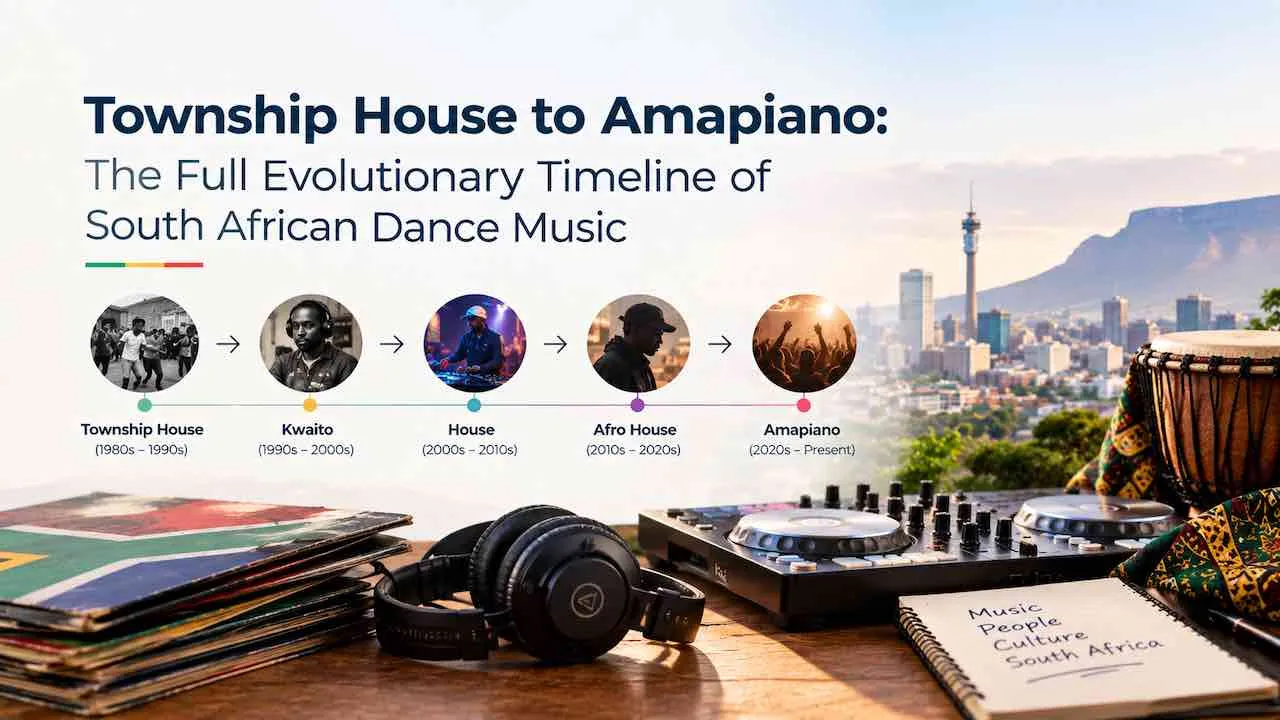
South African dance music evolved from Township House in the late 1980s to global Amapiano dominance across six distinct genre shifts in thirty years. Each shift carried forward the DNA of what came before it. Kwaito slowed Chicago house for township streets. Bacardi House added piano melodies in Pretoria lounges. Shangaan Electro pushed speed to extremes in Limpopo. Gqom stripped everything back in Durban. Afro House took the sophistication global. Amapiano fused all of it into a log drum and jazz piano sound that now plays at Tokyo nightclubs, European festivals, and Grammy stages. This is the full timeline, genre by genre, city by city, producer by producer, from shebeens to stadiums.
Full South African Dance Music Timeline at a Glance
| Era | Genre | Primary City | BPM Range | Defining Sound | Key Milestone |
|---|---|---|---|---|---|
| Late 1980s to mid-1990s | Township House and Bubblegum | Johannesburg, Soweto, Cape Town | 120 to 128 | African pop over house beats; bright synths; Zulu and Sotho lyrics | Brenda Fassie “Weekend Special” (1983); Chicco Twala; Yvonne Chaka Chaka; post-apartheid youth radio culture |
| Early to late 1990s | Kwaito | Soweto, Johannesburg | 95 to 115 | Slowed house; deep bass; Zulu, Sotho, Tswana vocals; township slang | TKZee “Shibobo” (1998 FIFA World Cup anthem); Mandoza “Nkalakatha” (2000) |
| Late 1990s to mid-2000s | Bacardi House | Pretoria, Gauteng | 105 to 118 | Piano-led house; jazz keyboard riffs; informal party circuit | Direct structural ancestor of amapiano; Pretoria’s piano house vocabulary established |
| Mid-2000s to 2010s | Shangaan Electro | Limpopo, Johannesburg | 160 to 200+ | Extremely fast electronic beats over Tsonga traditional rhythms; hyperactive percussion | Nozinja “Shangaan Electro” compilation (2011) on Honest Jon’s Records; global cult following |
| Early 2000s to 2010s | Afro House and Afro Tech | Cape Town, Johannesburg | 120 to 128 | Deep house with African percussion; tribal elements; sophisticated production | Black Coffee Grammy 2022; Afro House downloads on Splice surged 778% in 2025 |
| Early 2010s to 2017 | Gqom | Durban, KwaZulu-Natal | 125 to 130 | Booming bass drum; broken beat; minimal melody; stripped percussion | Naked Boyz pioneers; DJ Lag “Drumming” (2016); Beyonce “My Power” (2018) |
| Mid-2010s to 2019 | Amapiano (underground) | Pretoria, East Rand, Gauteng | 110 to 120 | Deep house plus jazz piano plus log drum; kwaito vocal tradition | MFR Souls name the genre; De Mogul SA “Oe Batla Kae” (2017); Kabza “Umshove” (2018) |
| 2019 to 2022 | Amapiano (national to continental) | All South Africa; Lagos; Nairobi | 110 to 120 | Log drum and piano hooks dominate SA charts; Afropiano crossover begins | Semi Tee “Labantwana Ama Uber” (2019); COVID YouTube boom (2020); Sponono with Wizkid and Burna Boy (2020) |
| 2023 to present | Amapiano (global) | Global: London, Tokyo, New York | 110 to 120 | Amapiano fused with Afrobeats, R&B, pop; international collaborative crossovers | Tyla “Water” first SA solo in Billboard Hot 100 in 55 years; Grammy Best African Music Performance 2024 |
Era 1: Township House and Bubblegum (Late 1980s to Mid-1990s)
South African dance music’s modern lineage begins with a collision between imported American house music and the cultural survival sounds of township life under apartheid. In the late 1980s, as apartheid entered its final collapse, DJs in Soweto and Braamfontein record shops blended Chicago house and New York garage with marabi, mbaqanga, and kwela, the street corner music that had filled township shebeens since the 1950s. These shebeens, informal unlicensed drinking venues in the township, were not simply bars. They were the cultural incubators, community gathering points, and the distribution network through which new music spread before radio ever played it.
The Bubblegum Layer
Bubblegum emerged as the commercially polished surface of township music, with Brenda Fassie as its defining artist. Her 1983 hit “Weekend Special” established the template: South African township feeling delivered through electronic pop production that radio could broadcast nationally. Yvonne Chaka Chaka and Chicco Twala extended the bubblegum format through the late 1980s, each pushing African language lyrics further into mainstream electronic production. Bubblegum gave township music its first national radio identity and proved that African artists could produce internationally competitive pop records from South African studios using locally rooted content.
What Township House Sounded Like
Township House ran at 120 to 128 BPM, matching Chicago house energy while carrying unmistakably African vocal character. Synth hooks ran over four-on-the-floor kick patterns. The shebeen was the original listening room for this music, the same cultural function the Chicago warehouse played for American house. Production ran on Roland TR-808 and TR-909 drum machines, basic synthesisers, and reel-to-reel tape, assembled in home studios built from secondhand equipment in matchbox houses. The same creative resourcefulness that shaped township music’s content also shaped its production: make what you have sound like more than it is.
Radio’s Role in This Era
SABC (South African Broadcasting Corporation) dominated broadcast under apartheid and initially resisted Black South African popular music. Pirate radio stations operating from the townships became the primary broadcast channel for Township House and early bubblegum, years before SABC programming shifted. Radio Bop, Radio Setswana, and eventually Radio Metro brought township sounds to broader audiences from the late 1980s onward. The commercial radio deregulation that followed the 1994 democratic elections opened SABC channels and created space for new stations like YFM (launched 1997) that would become central to Kwaito’s rise.
Era 2: Kwaito (Early to Late 1990s)
Kwaito emerged from Soweto in the early 1990s as the first music born in the post-apartheid moment. South Africa held its first democratic elections in April 1994. Kwaito was already in the streets before the votes were counted. It became the defining soundtrack of what Black South African youth culture meant in the new country. The word itself comes from the Afrikaans slang “kwaai,” meaning cool or fierce, repurposed into Sabela and Camtho township street language as something fashionable, celebratory, and specifically of this moment.
The Kwaito Sound: Why It Slowed Down
Kwaito took Chicago house and deliberately dropped the tempo from 120 BPM to 95 to 115 BPM. The slower tempo matched the gait of township street culture, the laid-back confidence of young Black South Africans moving through spaces that had been legally restricted to them for their entire parents’ lives. Deep basslines anchored the tracks. Vocals were spoken or half-sung in Zulu, Sotho, Tswana, or Camtho, the township code-switching slang. Catchy melodic loops repeated over and over, drawing from African oral music tradition and house music’s hypnotic structure simultaneously. Kwaito also drew from American hip-hop’s spoken word delivery, blending all three influences into something that belonged to no existing category.
Kwaito’s Defining Artists, Albums, and Moments
| Artist or Group | Hometown | Key Track or Album | Significance |
|---|---|---|---|
| Arthur Mafokate | Soweto, Johannesburg | “Kaffir” (1995) | One of kwaito’s founding fathers; reclaimed a racial slur as a post-apartheid assertion of identity |
| Boom Shaka | Soweto, Johannesburg | “It’s About Time” (1994) | Female-fronted group; brought kwaito to mainstream audiences; politically charged social commentary |
| TKZee | Soweto, Johannesburg | “Shibobo” (1998) | FIFA World Cup 1998 official South Africa anthem; kwaito’s biggest single international moment |
| Mandoza | Soweto, Johannesburg | “Nkalakatha” (2000) | One of kwaito’s highest-selling records; bridged kwaito and mainstream South African pop audiences |
| Mzekezeke | Johannesburg | “Nguwe Lo” (2001) | Masked anonymous artist; created massive cultural curiosity; kwaito’s first major mystery figure |
| Malaika | Johannesburg | “Thatha Wena” | Female kwaito; pushed the genre toward R&B crossover territory; expanded kwaito’s gender representation |
| Mapaputsi | Soweto | “Ghetto” (2000s) | Extended kwaito deeper into humour and social observation; influenced later township rap and street culture |
Kwaito’s Dance Culture
Kwaito was inseparable from its dance forms. The genre developed specific movement styles tied to its slow-groove tempo, including the pantsula dance tradition that predated kwaito but merged with it, and new moves that reflected the era’s specific energy: deliberate, confident, never hurried. Kwaito dance was a statement of belonging in post-apartheid South African public space. It appeared at weddings, schools, shebeens, and eventually on SABC television as the genre entered mainstream culture in the mid to late 1990s.
Radio and the Kwaito Breakthrough
YFM launched in Johannesburg in 1997 and became kwaito’s primary broadcast platform, playing the genre to the city’s Black youth audience and building the genre’s first mass radio audience. Metro FM, one of South Africa’s largest radio stations, followed as kwaito grew commercially dominant. SABC television’s “Live Amp” and later dedicated music video channels gave kwaito visual culture a broadcast home. By the late 1990s, kwaito dominated South African popular music commercially, with TKZee’s FIFA World Cup placement confirming international visibility.
Why Kwaito Mattered Beyond Music
Kwaito was not simply a genre. It was the first full cultural language of post-apartheid Black South African youth. It came with its own fashion (bucket hats, oversized sportswear, Loxion Kulca clothing brand), its own dance moves, its own slang, and its own moral universe that rejected both the heaviness of the struggle era and the aspirational mimicry of Western pop. The cultural confidence kwaito established became the direct inheritance of every South African genre that followed, from Afro House’s sonic sophistication to Amapiano’s assertion of South African identity on a global stage.
Era 3: Bacardi House (Late 1990s to Mid-2000s)
Bacardi House is the genre that most directly planted the piano into South African dance music’s DNA and the most structurally significant precursor to amapiano. It emerged from Pretoria’s informal party scene in the late 1990s, drawing from kwaito’s tempo range but adding melodic jazz keyboard progressions and a slightly more uptempo, celebratory energy. The name came from the Bacardi brand’s association with leisure and nightlife in township party culture. Bacardi House played at house parties, outdoor gatherings, and informal private lounges that defined Pretoria’s social life in the post-apartheid period.
Bacardi House’s Sonic DNA and the Piano Connection
Where kwaito was vocal-heavy and groove-driven, Bacardi House was keyboard-led. Piano riffs ran for minutes at a time over deep bass and light percussion. Calvin Fallo’s 2015 recording “Yellow, Yellow,” often cited as an early reference point, features close to six minutes of piano riffing and screeching organs over a broken drum beat. The tempo sat between 105 and 118 BPM, faster than kwaito but without the full energy of house. This precise sonic space, piano-driven, groove-forward, built for an intimate party rather than a club, became the exact territory where amapiano would emerge a decade later.
Distribution ran entirely on physical media. Cassette tapes traded at parties, CD-R copies circulated at taxi ranks and spaza shops, and early USB sticks passed between producers at informal gatherings. There was no streaming, no online distribution, no Spotify editorial playlist. Music moved through physical hands in physical locations. This community-rooted model created a music culture where the neighbourhood was always the first audience, the immediate community always the first judge, and organic approval from real people always the only metric that mattered.
Era 4: Shangaan Electro (Mid-2000s to 2010s)
Shangaan Electro is South African dance music’s most extreme and most misunderstood genre, running at 160 to 200 BPM or faster and fusing Tsonga traditional music from Limpopo province with electronic production in a way that had no parallel anywhere else in the world. Created primarily by producers in and around Johannesburg’s Tsonga community, with Nozinja (Richard Mthetwa) as its most visible figure, Shangaan Electro drew its rhythmic vocabulary from Tsonga traditional music, which uses fast hand-clapping, stomping, and vocal calls at naturally high tempos that exceed most Western electronic music conventions.
Why Shangaan Electro Matters in This Timeline
Shangaan Electro is often excluded from South African house music histories because it sits so far outside the BPM range of any other genre. Its significance is in what it demonstrated: that South African producers would push electronic music in directions that served their own cultural logic rather than conforming to Western electronic music conventions. In 2011, the compilation “Shangaan Electro: New Wave Dance Music from South Africa” released on the London label Honest Jon’s Records introduced the genre to a global audience of electronic music critics and DJs who had never heard anything operating at that speed. The global underground recognition that followed presaged exactly the kind of international attention that Amapiano would receive a decade later through different channels.
Era 5: Afro House and Afro Tech (Early 2000s to 2010s)
While Pretoria’s underground built piano house and Limpopo pushed tempo to its limits, Johannesburg and Cape Town developed Afro House: a deeper, more sophisticated electronic genre that could hold its own against the world’s best electronic music. Afro House stripped kwaito’s vocal abundance and replaced it with atmospheric African percussion, tribal chant samples, and production designed for clubs with internationally calibrated sound systems. “Afro House” emerged as a named subgenre in the early 2010s on Beatport and Traxsource, the digital retailers where global DJs discovered South African music, but its roots go back to late 1990s Johannesburg DJs blending Chicago house with Zulu percussion elements and sub-bass architecture.
Black Coffee and the Architecture of Afro House
Nkosinathi Innocent Maphumulo, known as Black Coffee, is Afro House’s most significant global figure. Born in Durban and raised in Mthatha, Black Coffee was selected for the Red Bull Music Academy in Cape Town in 2003, the break that launched his international career. His production philosophy combined deep house’s subterranean bass with African percussion patterns, Zulu vocal chops, and a hypnotic restraint that refused to give the listener everything at once. By the 2010s he was headlining Ibiza residencies and commanding $300,000 per DJ set. His 2022 Grammy for Best Dance/Electronic Album for “Subconsciously” confirmed Afro House’s arrival at global electronic music’s highest recognition level.
Other key Afro House architects include Culoe de Song from KwaZulu-Natal, whose releases on Innervisions and Systematic built the genre’s European reputation; Kyle Watson, whose Cape Town productions defined a harder Afro Tech variant; and Enoo Napa and Themba, who pushed percussive Afro Tech onto labels in Berlin, Amsterdam, and London. Afro House downloads on Splice surged 778% in 2025, making it the platform’s Sound of 2026. The global appetite for South African electronic music that Black Coffee opened is now producing its largest commercial numbers long after his initial breakthrough. For the full story of how the Scorpion Kings unit bridged Afro House production sensibility with early Amapiano, read the complete profile of Kabza De Small and DJ Maphorisa.
Vocal House and Deep House South Africa
Running parallel to Afro House, South Africa also developed a vocal house and soulful house tradition in the early 2000s, centered on Johannesburg and Cape Town producers who worked with gospel-influenced singers over house beats. Artists like Lira, Mi Casa, and early Thandiswa Mazwai collaborations brought full-voiced vocal performance back into house production after kwaito had moved away from melody-centred singing. This vocal house strand fed directly into the warm, song-oriented Amapiano that Sha Sha and Ami Faku would later represent: piano house that could hold a genuine vocal performance across a full song structure rather than loops and chants.
Era 6: Gqom (Early 2010s to 2017)
Gqom (pronounced with a Zulu click, approximately “nqu-om”) emerged from Durban’s townships in the early 2010s as the most radical sonic departure in South African dance music since kwaito slowed down house in the 1990s. Where Afro House added sophistication and Bacardi House added melody, Gqom subtracted everything. It stripped house music down to booming bass drums, looping vocal chops, distorted bass tones, and a locked 4/4 pattern that hit with the force of a physical impact on a Durban dancefloor. The word gqom is a Zulu onomatopoeia from the sound of a drum hitting. The music is exactly that: a drum, hitting.
The Gqom Pioneers
Naked Boyz are credited as the first producers to create the broken beat tracks that became recognisable Gqom, working in the Clermont and Umlazi townships of Durban around 2010 to 2012. Griffit Vigo, a classically influenced producer who listened to Beethoven and Nina Simone alongside electronic music, heard Naked Boyz’s broken beats and developed his own variant. DJ Lag, born Lwazi Asanda Gwala in Clermont around 1995 or 1996, became the genre’s most internationally visible figure. Rudeboyz introduced the famous tom roll that became Gqom’s most recognisable percussive element and spread virally among competing producers. Distruction Boyz, Citizen Boy, Sbucardo, Spoukado, and Lucy Man all contributed to the genre’s early development.
Gqom’s Distribution Before the Internet
Early Gqom tracks spread entirely through USB drives, WhatsApp file sharing, and Bluetooth transfers between phones. Dance crews across Durban competed at end-of-month gatherings, playing new tracks and judging which producers had developed the strongest sound. This competition culture drove rapid sonic evolution. Producers made music in their bedrooms and immediately tested it in social contexts where the community response was immediate and unfiltered. No label filter, no radio gatekeeping, no A&R approval. The music worked or it did not, and that community judgment operated at speed. As DJ Lag described it directly: the scene got stronger in 2012, when Gqom was getting recognised all over South Africa.
Gqom’s Dance Culture: Gwara Gwara and Ivoosho
Gqom developed its own choreographic vocabulary, with the gwara gwara and ivoosho as the most widely known dance forms. The gwara gwara involves a specific arm swing and leg movement that matches Gqom’s percussive hit pattern, spreading from Durban to schools, social gatherings, and eventually to Instagram challenges that carried Gqom’s movement culture internationally before many audiences knew what the music was called. Babes Wodumo’s “Wololo” brought the gwara gwara to mainstream South African television and radio in 2016. The “Water” dance that Tyla performed in 2023 draws a direct lineage from this same Durban movement tradition passed through the bacardi dance style of Amapiano.
Gqom vs. Amapiano: The Durban vs. Pretoria Divergence
The contrast between Gqom and Amapiano is the contrast between Durban and Pretoria. Gqom is dark, stripped, percussion-first, and deliberately harsh. Amapiano is warm, piano-led, melodic, and community-oriented. Both emerged simultaneously from South African townships in the early 2010s. Both circulated on USB drives and WhatsApp. Gqom And Amapianobuilt their first audiences through dance culture and community listening. But they moved in completely opposite sonic directions, and that divergence reflects the different cultural characters of their home cities.
| Element | Kwaito | Gqom | Afro House | Amapiano |
|---|---|---|---|---|
| BPM | 95 to 115 | 125 to 130 | 120 to 128 | 110 to 120 |
| Melody | Melodic vocal loops; rhythmic hooks | Minimal; almost none | Atmospheric; African percussion textures | Prominent jazz piano; full keyboard progressions |
| Bass character | Deep, warm basslines | Booming, distorted bass drum | Sub-bass; tribal weight | Log drum; woody, percussive bass pulse |
| Vocals | Spoken; half-sung; township slang | Chopped vocal loops; minimal full vocals | Atmospheric chops; minimal lyrics | Full sung vocals; Zulu and Sotho; call and response |
| Primary city | Soweto, Johannesburg | Durban | Cape Town, Johannesburg | Pretoria, East Rand |
| Dance culture | Pantsula; kwaito shuffle | Gwara gwara; ivoosho | Club movement; sophisticated floor culture | Sbujwa; bacardi; log drum shoulder roll |
Era 7: The Birth of Amapiano (Mid-2010s to 2018)
Amapiano did not announce itself. It grew quietly in Gauteng’s townships and house parties while the rest of South Africa focused on Gqom. The genre’s exact birthplace is debated between Pretoria and the East Rand townships of Katlehong and Alexandra. What is clear is that by 2014 to 2016, a network of producers across Gauteng were independently arriving at the same sonic conclusion: take the deep house and kwaito foundation everyone knew, add prominent jazz piano melodies, introduce the log drum’s distinctive woody bass pulse, slow the tempo slightly from standard house, and let the groove breathe at length. The result was a genre with no exact precedent, even though every element it used came from South Africa’s existing musical vocabulary.
Who Named Amapiano and Why the Name Stuck
MFR Souls, Tumelo Nedondwe and Tshiamo Rantao from Katlehong, are credited with coining the name “Amapiano.” The genre circulated as “iNumba” before MFR Souls renamed it to reflect the piano’s central role. “Amapiano” translates loosely from isiZulu as “the pianos,” and the name was immediately accurate: the piano was the identifying element that separated this sound from every prior South African house variant. JazziDisciples from Alexandra, Junior Taurus, and Kabza De Small working independently in Pretoria all built the genre’s early identity in parallel without coordination, each arriving at a similar sonic space from slightly different directions.
The Bacardi House Connection
The link between Bacardi House and Amapiano is musical genealogy, not coincidence. Both are Pretoria-rooted, both are piano-led, both use similar deep house tempo ranges, and both circulated through the same informal Pretoria party circuit across decades. Veteran deep house DJs Clock and Bekzin Terris, whose productions MFR Souls mixed into their early amapiano sets, provided the sonic bridge between the two eras. Amapiano did not invent piano-driven South African house. It refined and perfected a structure that Bacardi House had been building for fifteen years, added the log drum, extended the piano improvisation, and built a vocal tradition on top of it.
The Log Drum: Amapiano’s Defining Sound
The log drum, a woody percussive bass instrument associated with Central and West African traditional music, became in Amapiano production a synthesised or sampled element that functions as both bassline and central rhythmic pulse simultaneously. No prior South African genre used the log drum in this structural role. Its sound is immediately identifiable: a wooden, booming, slightly hollow bass hit that punches differently from any electronic bass drum. When Kabza De Small’s “Umshove” featuring Leehleza arrived in 2018 with the log drum in its fully refined form, listeners across South Africa recognised that something specific and new had arrived. For a technical breakdown of how the log drum is constructed in production, the complete guide to Amapiano log drum patterns covers every element of the instrument’s role in the genre’s sound architecture.
How Amapiano Spread Before Streaming
Amapiano’s distribution before Spotify and Boomplay had African editorial teams built entirely on informal digital culture. South African minibus taxis, the primary public transport for township residents, played music through powerful speaker systems that passengers heard whether they chose to or not. A new amapiano track that a taxi DJ chose to play could reach thousands of commuters across Johannesburg, Pretoria, and Soweto in a single day without any radio involvement. WhatsApp groups sharing DJ mixes circulated tracks horizontally across social networks at speed. Hour-long DJ mixes uploaded to YouTube channels without any marketing budget accumulated hundreds of thousands of views from listeners who passed the link in communities and family groups. This grassroots distribution model built amapiano’s first national audience entirely outside the music industry’s gatekeeping structures.
Era 8: Amapiano Goes National (2017 to 2019)
Three specific songs between 2017 and 2019 pushed Amapiano from a Gauteng underground genre to South Africa’s dominant popular music form.
De Mogul SA “Oe Batla Kae” (2017)
Documented by the GRAMMY organisation as one of the first amapiano tracks to achieve commercial success, “Oe Batla Kae” generated De Mogul SA’s first booking requests and demonstrated that amapiano could produce the same kind of live performance income that kwaito and Afro House had built. It proved the genre had commercial infrastructure beyond streaming and community listening.
Kabza De Small “Umshove” (2018)
“Umshove” featuring Leehleza showcased the log drum in its clearest early form. Kabza’s debut studio album “Avenue Sounds” in 2018 brought amapiano to a significantly wider audience and established him as the genre’s most important production architect. By 2019, Kabza De Small was the most-streamed local musician on Spotify South Africa, holding that position for multiple consecutive years. His 2020 album “I Am the King of Amapiano: Sweet and Dust” became the most popular South African project in Apple Music history. The title “King of Amapiano” was not a marketing phrase. It reflected the actual centrality of his production to the genre’s sound definition across its entire national breakthrough period.
Semi Tee “Labantwana Ama Uber” (2019)
“Labantwana Ama Uber” featuring Kammu Dee and Miano is the song most South African music observers point to as amapiano’s moment of national mainstream capture. Its hook, built around using Uber as a verb in township youth language, connected the genre’s sound to a specific and widely shared urban South African experience. Radio stations that had resisted amapiano began playing it. Club promoters started booking amapiano nights. The same year, DJ Maphorisa and Kabza De Small released “Vula Vala,” cementing the Scorpion Kings pairing as amapiano’s most commercially powerful unit. The full sound architecture of this moment is covered in the complete guide to the amapiano South Africa sound.
Era 9: Amapiano Subgenres (2019 to Present)
As amapiano scaled from underground to national to global, internal subgenres differentiated the sound into distinct strands that serve different audiences and contexts.
Dust Amapiano
Dust amapiano, also called street amapiano, is the rawer variant. Heavy basslines dominate, percussion is more aggressive, and the production quality is intentionally rough-edged. It maintains the closest connection to the genre’s underground origins in township house parties and informal settings. Dust amapiano circulates most actively through WhatsApp groups and local DJ sets rather than editorial streaming playlists, preserving the community listening model that built the original genre.
Private School Amapiano
Private school amapiano is the more soulful, heavily vocalised variant. Piano runs are more prominent, vocals are more central, production quality is polished to streaming-ready commercial standard, and the emotional register is warmer and more melodic. This is the strand that connects most directly to Afro House’s sonic sophistication and to the vocal house tradition running through South African music since the early 2000s. Ami Faku, Sha Sha, and Khanyisa’s contributions sit clearly in this variant. It is also the strand that international crossover artists like Tyla draw from when blending amapiano with Afropop or R&B.
Afropiano
Afropiano describes the fusion between amapiano’s rhythmic structure and Afrobeats’ song and lyric orientation. Nigerian artists like Davido, Wizkid, and Burna Boy began incorporating amapiano production elements from 2020 onward, creating a blended genre that carries both traditions. Chris Brown’s 2024 collaboration “Hmmm” featuring Davido is the clearest mainstream international example of Afropiano, now with over 14 million YouTube views. The convergence of South African and Nigerian music in this hybrid form is covered in depth in the comparison of Afrobeats and Afrobeat and in the broader guide to African music genres.
Era 10: COVID Lockdown and the Amapiano Explosion (2020 to 2022)
South Africa’s strict COVID-19 lockdowns in 2020 produced a paradox: live performance stopped completely while amapiano production and streaming surged beyond any prior trajectory. With clubs and venues shuttered, DJs moved to YouTube and Facebook livestreams. Hour-long amapiano mixes accumulated millions of views. Producers locked indoors with FL Studio and Ableton setups released at a pace the pre-lockdown years could not have supported. Kabza De Small released “Sponono” featuring Wizkid and Burna Boy alongside Njelic and Daliwonga in 2020, a collaboration that signalled to the rest of Africa that amapiano was not South Africa’s internal genre but Africa’s next shared continental sound.
Female Artists Redefining Amapiano
The 2020 to 2022 period established female artists as central to amapiano’s identity. Kamo Mphela, Uncle Waffles, DBN Gogo, Nkosazana Daughter, and Ami Faku each brought distinct creative energy to the genre. Kamo Mphela’s bacardi dance style created viral content that drove amapiano discovery across TikTok and Instagram Reels internationally. Uncle Waffles built an international DJ career from a single viral Johannesburg set clip and performed at Coachella. DBN Gogo’s productions bridged amapiano and techno, resulting in a 2023 collaboration with Benny Benassi. The full picture of this generation is in the profile of South Africa’s top female amapiano artists.
Era 11: Global Domination (2023 to Present)
Amapiano’s definitive global breakthrough arrived not with a DJ set or a label campaign but with a dance challenge on TikTok and a 22-year-old from Johannesburg named Tyla Seethal.
Tyla “Water” (2023): The Billboard Moment
“Water,” produced with Kooldrink and released in 2023, entered the US Billboard Hot 100 as the first South African solo entry in 55 years, since Hugh Masekela in 1968. It topped the Billboard US Afrobeats Songs and Hip-Hop/R&B charts simultaneously. The “Water” TikTok dance challenge drew Khaby Lame, Jason Derulo, and Laurent and Larry Bourgeois. At the 2024 GRAMMYs, Tyla won the inaugural Best African Music Performance award, beating Burna Boy, Davido, Asake and Olamide, and Ayra Starr. The category was created specifically to recognise African music’s global scale. Tyla’s win confirmed that amapiano, a genre born on USB sticks in Pretoria house parties, had fully crossed into global mainstream recognition. The complete story of Tyla’s musical journey traces that path from her 2019 debut to Grammy history.
Why Amapiano Became Global: The Actual Reasons
Amapiano’s global reach is not accidental. Five specific structural factors drove the genre from South African townships to international stages.
- Tempo accessibility: At 110 to 120 BPM, amapiano runs at a tempo close enough to global pop and R&B that international producers and listeners can engage with it without cultural or rhythmic dislocation
- Dance culture virality: The sbujwa, bacardi, and log drum shoulder roll movements translate visually across cultures on TikTok and Instagram in a way that does not require language comprehension
- Piano as universal instrument: The piano melody is a globally legible musical element that reduces genre unfamiliarity for listeners encountering amapiano for the first time
- African diaspora infrastructure: South African and Nigerian diaspora communities in London, Toronto, Houston, and Atlanta had already built concert and streaming audiences for African music that amapiano plugged into directly
- TikTok challenge culture alignment: Amapiano’s repetitive groove structure and its associated dance moves fit TikTok’s challenge format better than most genres, generating organic virality at a scale no marketing budget could replicate
Amapiano in 2025 and 2026
“Tshwala Bam” by TitoM and Yuppe spawned a massive TikTok challenge in 2024, with Tyla dancing alongside popular streamer Kai Cenat in a video that reached global audiences far outside the African music listener base. Burna Boy jumped on the “Tshwala Bam” remix, further cementing the Afropiano crossover. International nightclubs in Tokyo, New York, London, and Ibiza added dedicated amapiano nights to their programming. The Amapiano Grooves playlist on Spotify crossed 500,000 followers. Among the continent’s famous artists who built their careers from South African dance music foundations, those now carrying amapiano globally represent the genre’s third generation, inheriting a tradition that runs from Brenda Fassie’s shebeen-circuit bubblegum to Grammy stages in forty years. Tracking their ongoing movement is part of what South African music history on Tubidy Africa documents across all 50 of the continent’s most influential artists.
The Technology That Enabled Each Genre Transition
| Era | Production Tools | Distribution Method | Impact on the Sound |
|---|---|---|---|
| Late 1980s to 1990s (Kwaito) | Roland TR-808 and TR-909; basic synths; reel-to-reel tape | Vinyl; cassette tapes; pirate radio; shebeens | Lo-fi warmth; drum machine character dominant; community-rooted production quality |
| Late 1990s to 2000s (Bacardi and Afro House) | CD-R production; early home studio computers; hardware keyboards; Cubase DAW | CD-Rs; early music blogs; township record stores; YFM and Metro FM radio | Cleaner production; keyboard composition possible at home; first music computer generation in townships |
| Early 2010s (Gqom) | FL Studio on low-spec laptops; free VST plugins; cheap sample packs | USB sticks; WhatsApp file sharing; Bluetooth transfers; SoundCloud; local blogs | Bedroom production the dominant model; lo-fi is authenticity not failure; bypasses all gatekeepers |
| Mid-2010s (Early Amapiano) | FL Studio; Ableton; accessible log drum samples; piano VSTs; smartphone recording | WhatsApp DJ mixes; YouTube sets; Facebook groups; minibus taxi audio systems | Hour-long DJ mix replaces single as primary format; taxi plays drive discovery; YouTube builds national audience without radio |
| 2019 to 2020 (Amapiano mainstream) | Professional studio access expands; streaming master quality standards adopted | Spotify; Boomplay; Apple Music; TikTok challenges; Audiomack DJ reposts | Production quality improves to streaming standard; TikTok hook structure becomes compositional consideration |
| 2023 to present (Global Amapiano) | International studio collaborations; global production chains; AI-assisted tools | Spotify Amapiano Grooves; TikTok global challenges; Apple Music Africa editorial; YouTube global | Genre fusion with pop, R&B, and EDM; international co-writing sessions; production at global commercial standard |
The Cultural Thread Running Through Every Era
The township was not simply a geographic location in this story. It was the recurring cultural engine. Every genre in this timeline, from kwaito’s Soweto shebeens to Gqom’s Durban dance crew competitions to Amapiano’s Pretoria house parties, originated in the creative compression of community life in spaces that apartheid designed to limit Black South African mobility and expression. The music carried that compression as energy. The rawness, the communal structure, the dance-first orientation, and the rejection of outside gatekeepers all flow directly from the township’s cultural logic. South African dance music is not a genre history. It is a survival and celebration history told through sound.
Amapiano’s global success is not a departure from its township origin. It is the fullest expression of it. A sound that began on USB sticks passed between friends in Pretoria now plays on Grammy stages, in Ibiza clubs, and at Lagos festivals where the continent’s leading artists perform for audiences who learned the dances on TikTok before they knew the genre’s name. For South African music news, artist updates, and coverage of how this evolution continues in real time, Tubidy Africa covers African music history and current developments across every major genre and market.
FAQs: Township House to Amapiano Timeline
Township House is the late 1980s fusion of Chicago house with marabi, mbaqanga, and Zulu vocal styles, running at 120 to 128 BPM. It played in shebeens, the informal township venues that served as South African dance music’s original circuit before commercial clubs were accessible to Black South Africans.
Kwaito slowed house to 95 to 115 BPM with deep bass and spoken township slang. Amapiano runs at 110 to 120 BPM and adds jazz piano melodies, the log drum bassline, and full sung vocals in Zulu and Sotho. Both share township DNA but developed in opposite sonic directions across two decades.
Gqom originated in Durban’s Clermont and Umlazi townships around 2010 to 2012, pioneered by Naked Boyz, DJ Lag, Griffit Vigo, and Rudeboyz. It spread through USB drives and WhatsApp before national recognition in 2012 to 2013. DJ Lag’s production later featured on Beyonce’s 2018 Lion King album.
MFR Souls from Katlehong named the genre Amapiano, which translates from isiZulu as “the pianos.” It previously circulated as iNumba. Kabza De Small, JazziDisciples, and Junior Taurus built the sound simultaneously across Gauteng townships in the mid-2010s without coordination.
Amapiano broke globally in 2023 when Tyla’s “Water” became the first South African solo Billboard Hot 100 entry in 55 years. Tyla won the inaugural Grammy for Best African Music Performance in 2024. Chris Brown’s “Hmmm” featuring Davido and Burna Boy’s “Tshwala Bam” remix followed in 2024, confirming sustained international reach.