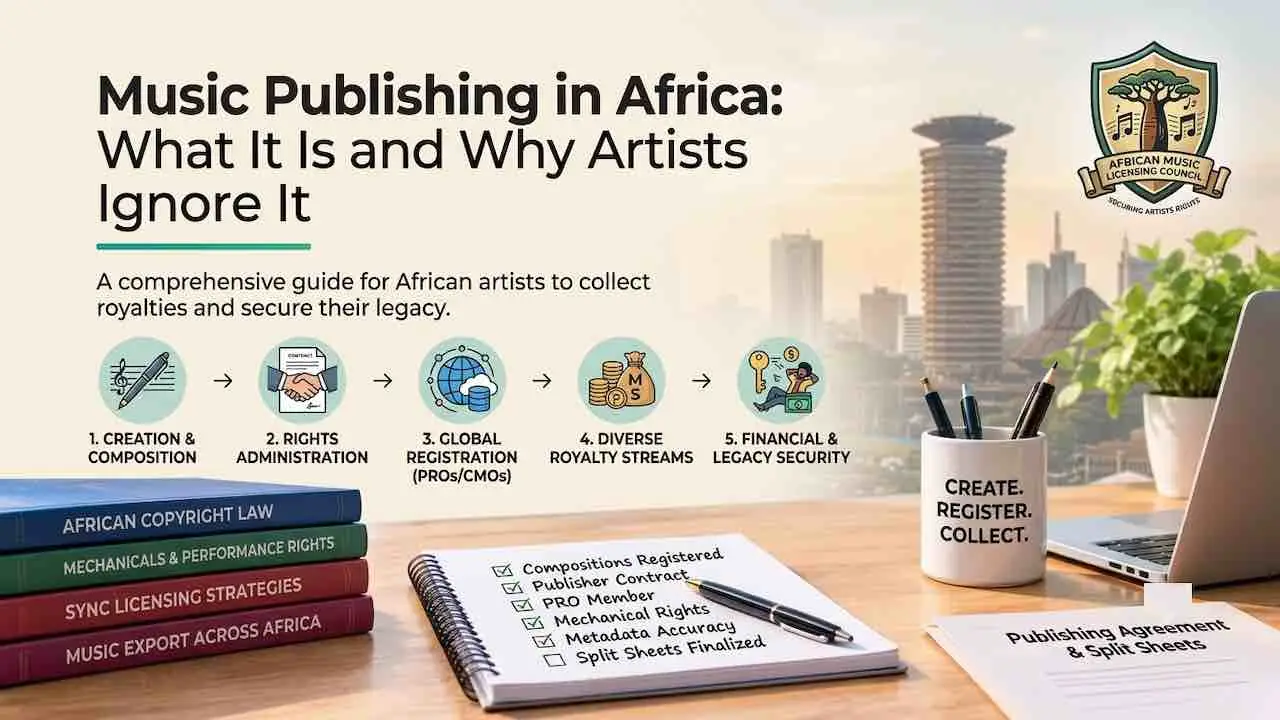
Music publishing in Africa manages the rights in a song’s composition, its melody and lyrics. It collects songwriter royalties every time that composition is used commercially. It generates passive income from radio, TV, streaming, live performance, sync licensing, and film. African artists who ignore publishing leave a permanent income stream uncollected for their entire careers. That income compounds silently while the artist earns nothing from it.
CISAC’s 2025 report confirms African CMO collections reached just 90 million euros. That is only 0.7% of global royalty collections.
African music is the fastest-growing genre worldwide. The gap between creative impact and financial return sits almost entirely in publishing. The royalties and copyright guide for African artists explains the rights system publishing operates within. For publishing news and royalty updates, visit Tubidy Africa, the continent’s African music news platform.
Music Publishing in Africa, Defined
Every song contains two separate assets: the composition and the recording. The composition is the melody and lyrics. The recording is the version an artist performed and a label released. Music publishing in Africa covers the composition only. Master rights cover the recording only. They generate different royalties through different channels and pay different people.
Music copyright in Africa gives the songwriter a property right in every composition they create. That music copyright generates income every time the composition is used commercially. Radio stations pay to broadcast it. Streaming platforms pay to stream it. TV shows pay to feature it. Advertisers pay to license it. Without a publishing setup, most of that income sits permanently uncollected.
Publishing Rights vs Master Rights: The Core Difference
| Feature | Publishing Rights (Composition) | Master Rights (Recording) |
|---|---|---|
| Covers | Melody and lyrics written by the songwriter | The specific recorded version of the song |
| Initial owner | The songwriter or co-writers | The artist or label that funded the recording |
| Income sources | Performance, mechanical, sync, print royalties | Streaming income, sales income, neighboring rights |
| Who collects | Publisher or CMO (SAMRO, CAPASSO, MCSN, GHAMRO) | Distributor, label, or SAMPRA in South Africa |
| Duration | Life of songwriter plus 70 years in most territories | 50 to 95 years depending on territory |
| Transfer | Yes, fully or partially to a publisher | Yes, typically to a record label via contract |
Many African artists sign label contracts that bundle both rights together. They lose their music publishing rights without knowing it. Understanding this difference before signing any deal protects income that lasts for generations.
The 50/50 Split: Writer’s Share vs Publisher’s Share
Every publishing royalty splits into two equal halves: the writer’s share and the publisher’s share. This 50/50 split is the foundation of the entire publishing business. Both halves start with the songwriter. What happens next depends on whether the artist self-publishes or signs a deal.
| Royalty Share | Percentage | Self-Published Artist | Full Publishing Deal |
|---|---|---|---|
| Writer’s share | 50% of every royalty | Keeps all 50% | Keeps all 50% always |
| Publisher’s share | 50% of every royalty | Keeps all 50% | Publisher takes all 50% |
| Total | 100% | Artist keeps 100% | Artist keeps 50% |
| Co-publishing deal | Split shared | N/A | Artist keeps 75%, publisher keeps 25% |
| Administration deal | Commission only | N/A | Artist keeps 75-90%, no ownership transfer |
A Nigerian artist registered with MCSN as a self-publisher collects 100% of every royalty. No publishing deal is needed to achieve this. That same artist who signs a full deal without understanding the split loses half of every future royalty.
Five Income Streams Music Publishing Generates for African Artists
Publishing income does not come from one source. It comes from five distinct channels. Missing one channel closes that income stream permanently for existing releases.
1. Performance Royalties
Performance royalties pay every time a composition is performed or broadcast publicly. This covers radio, TV, streaming, live concerts, clubs, shopping centres, restaurants, and sports venues. In South Africa, SAMRO collects these. In Nigeria, MCSN collects them. In Ghana, GHAMRO handles collection. The IFPI’s 2025 Global Music Report confirmed Sub-Saharan Africa’s recorded music revenues reached $110 million. Performance royalties from radio and TV are a separate pool on top of that streaming income.
The CMO registration guide for Africa covers which collecting society handles performance royalties in each African country. Artists who only track streaming miss this income entirely.
2. Mechanical Royalties
Mechanical royalties pay every time a composition is reproduced. This covers downloads, CDs, vinyl, and every interactive stream on Spotify, Apple Music, Boomplay, and Audiomack. Every Boomplay stream generates two separate royalties. The master royalty goes to the label or distributor. The mechanical royalty goes to the songwriter through the publisher or CMO. In South Africa, CAPASSO collects mechanical royalties. In Nigeria, MCSN covers both performance and mechanical under one body.
Most African artists only see the master side. The mechanical royalty from the same stream sits uncollected. The streaming platform payout comparison shows master royalty rates. Mechanical royalties are a second, separate payment from the same stream.
3. Synchronization Licensing
Sync licensing pays when a composition accompanies visual media: film, TV, advertising, and video games. The sync fee is negotiated upfront. Fees range from a few hundred dollars for a small online ad to hundreds of thousands for a major sync.
After the sync, every broadcast of the film or ad triggers performance royalties through the relevant CMO. A well-structured publishing deal catches both the front-end sync fee and the back-end broadcast royalties. OkayAfrica’s 2026 analysis confirms African music sync placement in global media is growing rapidly. SyncAll, launched in 2025 and an AfCFTA Hackathon award winner, connects rights-cleared African catalogues to international sync buyers. Afro Soundtrack confirms more than 30 sync placements across film, TV, advertising, and games.
4. Micro-Sync and Social Media Licensing
Micro-sync covers short-form use of compositions in social media videos, brand content, podcasts, and digital ads. Fees range from $50 to $5,000 per use. Meta, TikTok, and YouTube operate blanket licensing agreements with music publishers.
When creators use licensed songs in videos, a micro-sync royalty generates for the composition. African artists popular on TikTok and Instagram Reels generate micro-sync income through these agreements. This income only flows if the composition is registered with a publisher connected to those platform deals.
5. Print Rights and Grand Rights
Print rights pay when lyrics or sheet music are reproduced in physical or digital format. This covers album booklets, music shop sheet music, and licensed lyrics platforms like Genius and Musixmatch. Grand rights cover the use of compositions in theatrical productions, musicals, and operas. Both require the same rights registration to activate. Print rights and grand rights are the smallest publishing income streams for most African artists. They still represent real income for music in educational or theatrical contexts.
Producer and Beatmaker Publishing Rights in Africa
African music producers and beatmakers hold publishing rights in the compositions they create, not just the recordings. Any producer who wrote the melodic hook or chord progression in a track is a co-writer of that composition. This applies across Afrobeats, Amapiano, and Bongo Flava. They are entitled to a share of publishing royalties.
This is one of the most overlooked facts in African music publishing. A Nairobi producer who creates an instrumental beat becomes a co-songwriter the moment an artist uses it. The melody and chord patterns in the beat are composition-level contributions. Without a split sheet, those publishing royalties default to whoever registered the song with the CMO.
Producer publishing rights in Africa are rarely formalised. Most African producers work without written agreements. They deliver the beat, the artist records, and the producer never registers their publishing contribution. A producer who created the melodic foundation of a song with 50 million streams loses their mechanical and performance royalty share.
Producers and beatmakers should:
- Create a split sheet for every beat licensed to an artist. The split sheet records the producer’s melody and composition contribution as a percentage of the full song
- Register with their national CMO independently. SAMRO, MCSN, GHAMRO, and CAPASSO all accept producer registrations as co-writers of the composition
- Get an IPI number and ISRC codes. The IPI links you to global rights databases. The ISRC (International Standard Recording Code) links each recording to its registered composition. Both are required before any CMO can match international plays to your name.
- Include publishing terms in every beat licensing agreement. A beat lease that does not address publishing rights leaves the producer’s composition share unprotected
The log drum patterns that define Amapiano are composition-level contributions. Producers like Mdu aka TRP and Kabza De Small created them. Those melodic and rhythmic patterns generate publishing royalties every time an Amapiano track broadcasts. Producers who understand this earn from every broadcast of every track they shaped.
Self-Publishing vs Traditional Publishing Deals in Africa
Self-publishing means the songwriter keeps 100% of publishing rights and registers directly with CMOs and publishing administrators. There is no advance, no publisher’s share leaving the account, and no publisher’s team. The songwriter does all administrative work themselves or through an administrator.
A traditional publishing deal gives the publisher a rights share in return for services and an advance. The advance is repaid from future royalties. It is not a bonus. It is a loan repaid from the songwriter’s future income before any further payment arrives.
| Factor | Self-Publishing | Traditional Publishing Deal |
|---|---|---|
| Upfront income | None | Advance of $10,000 to $250,000 depending on profile |
| Royalty share | 100% of all publishing income | 50% (writer’s share only in full deal) |
| Rights ownership | Artist keeps 100% of copyright | Publisher owns 50% of composition copyright |
| Administration | Artist or administrator handles it | Publisher handles all collection and registration |
| Sync opportunities | Limited to artist’s own network | Publisher pitches to film, TV, and ad buyers globally |
| Long-term value | Higher: artist keeps full catalogue ownership | Lower: publisher owns share indefinitely |
| Best for | Independent artists with active income streams | Artists needing advance funding or international deal access |
Three Types of Publishing Deals African Artists Sign
Full Publishing Deal
In a full publishing deal, the publisher takes 100% of the publisher’s share. The artist receives only the writer’s share: 50% of all royalties. The publisher owns 50% of the composition copyright for the contract term.
Full publishing deals are common in Nigerian Afrobeats. Major labels bundle publishing rights into recording contracts. Universal Music Group took a majority stake in Mavin Global in 2024. The deal included publishing terms. Artists who skip publishing negotiations hand over 50% of their catalogue’s long-term income permanently.
Co-Publishing Deal
A co-publishing deal splits the publisher’s share between the artist and the publisher. Typically, the artist keeps 50% of the publisher’s share. Combined with the writer’s share they always keep, the artist retains 75% of all royalties. The publisher keeps 25%. Co-publishing deals suit established African artists with active release schedules. An artist with consistent streaming and radio play can negotiate a co-publishing deal, not a full deal.
Administration Deal
An administration deal transfers no ownership of the composition. The publisher registers songs with CMOs worldwide and collects royalties across all territories. It then passes income to the artist after deducting a 10% to 25% commission. The artist keeps 100% of copyright ownership and 75% to 90% of income. There is no advance in most administration deals.
Administration deals suit independent African artists who want professional publishing infrastructure without giving up rights. Songtrust, CD Baby Pro, and Afro Soundtrack offer administration services for African artists at low annual fees. Downtown Music Publishing Africa offers administration-oriented representation for African catalogue owners. Clients include Cassper Nyovest, Zahara, and KO.
What Happens if You Already Signed Away Your Publishing Rights
Many African artists find out years later that their first record deal transferred publishing rights. They did not realise it when signing. Label contracts frequently include clauses assigning “all rights” or “ancillary rights” to the label. If you signed such a clause, the publisher’s share of every royalty belongs to the label.
Three options exist for artists in this situation:
- Wait for the reversion period. Copyright law in most African countries includes reversion provisions allowing the original rights holder to reclaim composition rights after a set period, typically 25 to 35 years. The specific timeline depends on the country and the original contract terms.
- Renegotiate the publishing terms. Some labels accept renegotiation when an artist’s streaming and broadcast numbers give them negotiating power. Getting independent legal advice before approaching a label on this is essential.
- Protect future works. Songs written after the original contract period may not be captured by the old publishing clause, depending on how the contract was drafted. A music lawyer can confirm which songs are captured and which are not.
Songs written going forward should never include publishing rights in a recording deal without explicit carve-out language. This is the most important step for African artists entering any new label or management contract. The African artist IP losses guide covers this alongside other common contract pitfalls.
Sub-Publishers and How African Music Earns International Royalties
A sub-publisher is a local publishing company in a foreign country. It collects royalties on behalf of an African artist’s home publisher. When a South African artist’s music plays on UK radio, SAMRO collects those royalties via PRS for Music. But some publishers use sub-publishing agreements to place their artists’ catalogues with local publishers in key territories.
Sub-publishers provide local expertise. They pitch local radio, TV, and sync buyers. They collect from local CMOs more efficiently than a home publisher operating at long range. A Nigerian publisher with a UK sub-publishing deal collects UK royalties faster than one without a local partner.
ARIPO (African Regional Intellectual Property Organisation) provides an IP cooperation framework across 22 member African states. ARIPO membership affects how publishing rights are recognised and enforced across borders within Africa. Artists distributing across multiple African countries should confirm rights registration in each target territory. The CMO guide for Africa shows which collecting societies hold active CISAC affiliations in each country.
Nollywood and African Film: The Sync Opportunity African Artists Miss
Nollywood produces more than 2,500 films annually. It is one of the most prolific film industries worldwide. Every licensed Nollywood music placement triggers an upfront sync fee. Every broadcast of that film on TV, streaming platforms, and in cinemas then generates performance royalties. Nollywood’s Netflix Africa and Prime Video Africa distribution triggers sync and broadcast royalties in international territories.
Most African artists with suitable music have no administrator pitching their catalogue to Nollywood producers. Rights-unclear music with missing metadata cannot be licensed by any production company operating with legal compliance requirements. A rights-cleared, metadata-rich catalogue is the entry requirement for Nollywood sync income.
South Africa’s TV drama industry and Kenya’s growing film sector also represent sync licensing opportunities beyond Nollywood. Africa’s music industry growth data confirms that African content consumption is rising across every platform. Each play of licensed music generates publishing income. Without publishing registration, those plays are silent to the rights holder.
Traditional African Music and Publishing Copyright
Traditional African music presents a unique music copyright challenge. Indigenous musical traditions passed down across generations belong to the public domain in most legal frameworks. However, original arrangements, adaptations, and new compositions built on traditional foundations do carry copyright protection.
An African artist who arranges a traditional Yoruba rhythm or builds on Congolese folk structure creates original copyrightable work. That new composition carries full publishing rights that generate performance, mechanical, and sync royalties.
Several high-profile disputes arose when international artists sampled African traditional music without crediting or compensating the community of origin. ARIPO and national copyright boards are building frameworks to protect community IP in traditional African music. The full range of African music genres includes many whose roots in traditional music create this copyright complexity. Artists drawing from traditional music should get legal clarity on protectable elements before registering publishing rights.
Gospel Music Publishing in Africa
African gospel music is one of the continent’s most commercially active genres. It is also one of the least-served by formal publishing infrastructure. Artists like Rebecca Malope built decades-long careers on gospel music that reached millions of South African households. The top African gospel artists generate significant radio play, TV placement, and live performance royalties.
Gospel music publishing in Africa has three complications. First, many gospel songs adapt public domain hymns. Original new elements in those adaptations are protectable, but the underlying public domain melody is not. Second, many gospel artists record for church-affiliated labels that historically did not formalise publishing rights. Third, some gospel artists morally object to commercialising music and leave publishing income uncollected voluntarily.
Every original element of a gospel composition carries full publishing rights regardless of the music’s spiritual context. Collecting those royalties does not conflict with the music’s religious purpose. It is the songwriter’s legal right and a sustainable income that supports continued gospel music creation.
Music Publishing as Passive Income and Generational Wealth
Music publishing is the closest thing to passive income that exists in the music industry. A song registered correctly with a CMO and publishing administrator generates royalties every time it plays. No additional work is needed from the artist. One well-placed sync or viral moment can generate publishing income for decades. In most African territories, copyright lasts the life of the songwriter plus 70 years.
That timeframe makes publishing a generational wealth asset. An African artist who registers 20 original compositions creates an asset their children and grandchildren can inherit. Streaming income stops immediately if the artist removes music from a platform. Publishing rights do not stop. Publishing rights outlast every other music income stream.
Global catalog valuations demonstrate the scale. Bruce Springsteen sold his publishing catalog for $500 million. Neil Young sold for $150 million.
African publishing catalogs are valued far below those numbers due to poor documentation and limited formal publishing. AfroFlow’s November 2025 analysis confirms African publishing rights are an increasingly attractive investment class. Properly registered African catalogues will carry higher valuations as the continent’s streaming audience expands.
The African music streaming growth data confirms the trajectory. Amapiano, Afrobeats, and Bongo Flava each represent publishing royalty pools that compound with every new listener. Artists who build documented publishing catalogs now position themselves to benefit as African music keeps rising globally.
Music Publishers and Publishing Administrators for African Artists
| Company | Type | Territory | Key Services | Notable Detail |
|---|---|---|---|---|
| Downtown Music Publishing Africa | Publisher and administrator | Africa and global | Sync, royalty collection, neighboring rights, legal | Clients: Cassper Nyovest, Zahara, KO |
| Native Tongue Music Publishing | Publisher | South Africa | Publishing representation, CMO registration, sync | South African songwriters across genres |
| Universal Music Publishing Africa | Major publisher | Africa and global | Full and co-publishing deals, sync | Majority stake in Mavin Global (2024) |
| Sony Music Publishing Africa | Major publisher | Africa and global | Full publishing deals, sync, licensing | Cross-continent African artist roster |
| Warner Chappell Music | Major publisher | Global with Africa presence | Full and co-publishing deals | International African artist deals |
| Afro Soundtrack | Publishing administrator and sync | Nigeria and Africa | Publishing admin, sync licensing, CMO collection | 30+ confirmed sync placements |
| SyncAll | Sync licensing marketplace | Africa and global | Rights-cleared catalogue, metadata, sync deals | Launched 2025, AfCFTA Hackathon award |
| Songtrust | Publishing administrator (global) | Global including Africa | CMO registration in 245 territories | One-time setup fee, no ownership transfer |
| CD Baby Pro Publishing | Publishing administrator (global) | Global including Africa | Publishing registration, royalty collection | Integrated with CD Baby distribution |
Burna Boy, Tyla, and Davido and Wizkid attract major publishers competing for their catalogues. Yemi Alade and Ayra Starr represent the mid-tier where co-publishing and administration deals are most relevant. Every independent artist in the African music ecosystem can access publishing income through an administration deal or CMO registration.
How to Start Collecting Publishing Royalties in Africa
Collecting publishing royalties requires six registration steps. Each step opens a different income channel. Skipping one step closes that channel permanently for existing releases.
- Step 1: Get an IPI number. Your home CMO issues one during registration. Without it, international CMOs cannot match foreign royalties to your name.
- Step 2: Register with your national CMO. South African songwriters register with SAMRO for performance and CAPASSO for mechanical. Nigerian songwriters register with MCSN. Ghanaian songwriters register with GHAMRO.
- Step 3: Submit a Notification of Works for every song. List every title, co-writer, and the split percentage for each contributor. This is the step that determines whether any royalty ever matches your name.
- Step 4: Create a split sheet for every co-written song. A split sheet is a signed document recording who wrote what percentage. It costs nothing to create. A dispute over the same information costs thousands in legal fees.
- Step 5: Register with a publishing administrator for global coverage. Songtrust and Afro Soundtrack extend registration into 245 or more territories with dedicated licensing and sync services. This step significantly increases total publishing income for artists with international play.
- Step 6: Register songs before releasing, not after. Publishing income does not backdate. Royalties from plays before your registration date are lost permanently. Songs released before you set up publishing are generating income for other registered rights holders right now.
How Publishing Income Is Calculated: A Practical Example
The following example uses a South African artist registered with SAMRO and CAPASSO as a self-publisher.
| Income Source | Activity | Approximate Rate | Self-Publisher Keeps | Full Deal Artist Keeps |
|---|---|---|---|---|
| SAMRO radio royalties | 100 spins on a major SA station | R60 to R200 per spin | R6,000 to R20,000 | R3,000 to R10,000 |
| CAPASSO mechanical | 1 million Spotify streams (SA Premium) | Approx $0.0003 to $0.001 per stream | $300 to $1,000 | $150 to $500 |
| Sync placement | SA TV advertisement, 30 seconds | R15,000 to R150,000 upfront | R15,000 to R150,000 | R7,500 to R75,000 |
| TV broadcast royalties | Song in 10 TV episodes | R500 to R3,000 per episode | R5,000 to R30,000 | R2,500 to R15,000 |
These are South African domestic figures only. A CISAC-connected publishing setup generates the same income types across every territory where the music plays. One South African song licensed to a film and streamed globally generates publishing income in multiple currencies. All of it routes back to the registered publisher or CMO. The guide on how African musicians make money covers publishing alongside streaming, live income, and brand deals.
Common Mistakes African Artists Make With Music Publishing
- Signing label contracts without separating publishing rights. Labels frequently bundle publishing rights into recording contracts. An artist who signs without a publishing carve-out transfers half their catalogue’s long-term income permanently.
- Not registering with the national CMO before releasing music. Publishing royalties do not backdate. Every play before registration is permanently lost.
- Releasing co-written songs without a split sheet. No signed document means every future dispute becomes a legal problem. One page signed before release costs nothing.
- Treating streaming income and publishing income as the same thing. The distributor payout is the master royalty. The mechanical and performance royalties from the same stream are separate payments. Most African artists only see one.
- Using a publishing advance without understanding recoupment. A $50,000 advance is repaid from future royalties. The publisher keeps their percentage throughout the entire recoupment period and beyond.
- Ignoring sync licensing opportunities. A single placement in a major global advertising campaign pays more than a full year of streaming royalties. Artists without a publisher or sync administrator have no channel to access these deals.
- Leaving existing catalogue unregistered. Songs already released are generating songwriter royalties and backend royalties right now. Those royalties are going to registered rights holders and CMO welfare funds. Registering existing catalogue today captures all future income from those songs immediately.
- Producers not claiming their publishing share. A beatmaker who creates the melodic foundation of a song holds a co-writer share of the publishing. Without registration and a split sheet, that share redistributes to whoever registered the song first.
For publishing news and royalty developments, Tubidy Africa tracks African music publishing and royalty updates across the continent.
Frequently Asked Questions
No. African artists collect publishing royalties without a publisher by registering with their national CMO as a self-publisher. SAMRO, CAPASSO, MCSN, and GHAMRO all allow songwriter self-registration. Songtrust and Afro Soundtrack collect royalties across multiple territories without any rights transfer.
A full publishing deal gives the publisher 50% of all publishing royalties permanently. A co-publishing deal gives the publisher 25%. An administration deal takes 10% to 25% as commission with no rights transfer. Publishing advances are not bonuses. They are loans repaid from future royalties before the artist receives further income.
Streaming income from a distributor is the master recording royalty. It pays the label or artist who owns the recording. Publishing royalties from the same stream are the mechanical royalty. They pay the songwriter separately through a CMO or publisher. One Spotify stream generates two separate royalties. Most African artists only receive the master side.
Yes, but only for royalties generated after your registration date. Pre-registration royalties redistribute permanently to other rights holders. Registering existing songs captures all future publishing income from those songs immediately.
Yes. A producer who created the melodic hook or musical phrase in a track is a co-writer. That co-writer holds a share of the composition’s publishing rights. Without a split sheet and CMO registration, that share defaults to whoever registered the song first. Producers should create split sheets and register independently with their national CMO before any track is released.