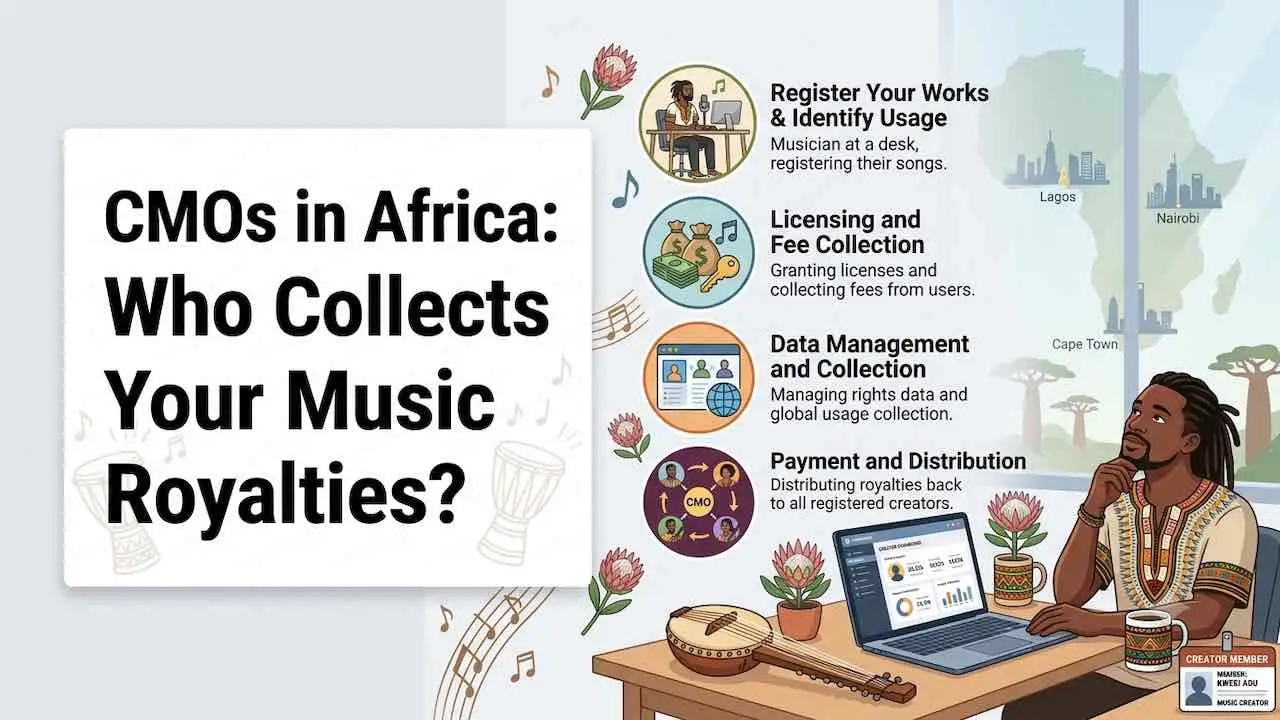
Collective Management Organizations (CMOs), also called collecting societies, collect royalties when your music plays publicly in Africa. The main bodies are SAMRO in South Africa and MCSN in Nigeria. PAVRISK and KAMP cover Kenya. GHAMRO covers Ghana. Register with your country’s CMO. Without registration, every qualifying play generates permanently unclaimed income.
This guide covers every major African CMO, registration steps, payment schedules, and how to claim foreign royalties. It also explains what happens to unclaimed royalties and the most common problems African artists face. The African artist royalties guide covers the rights chain that feeds into the CMO system. For African music industry news and royalty updates, visit Tubidy Africa, the continent’s African music news platform.
CMO vs Music Publisher: Two Different Things
A CMO and a music publisher are not the same thing. Many African artists confuse the two. Understanding the difference protects your income from both sides.
| Feature | CMO (Collecting Society) | Music Publisher |
|---|---|---|
| Role | Collects and distributes royalties from licensees | Pitches, licenses, and administers your catalogue |
| Membership | Open to any eligible songwriter or performer | Contract-based, selective |
| Cost | Free in most African countries | Takes 10% to 50% of publishing income |
| Sub-publishing | Not applicable | Publisher can sub-publish your work in other territories |
| Who registers with CMO | Artists do it themselves or via publisher | Publisher registers on artist’s behalf if applicable |
| Royalty flow | CMO collects from venues, broadcasters, DSPs then pays artist | Publisher receives CMO payout and splits with artist per contract |
If you have a publisher, they may handle CMO registration on your behalf. If you do not have a publisher, you must register yourself. Not having a publisher does not stop you collecting CMO royalties. It only changes who files the paperwork.
Three Royalty Types African CMOs Collect
African CMOs collect three distinct royalty types. Each type requires separate registration in most countries. Missing one type means losing an entire income stream permanently.
| Royalty Type | Triggered By | Who Receives It | Example CMO |
|---|---|---|---|
| Performance royalties | Public play: radio, TV, live venues, streaming | Songwriters and composers | SAMRO, MCSN, GHAMRO, ZIMURA |
| Mechanical royalties | Reproduction: downloads, streaming copies, CDs | Songwriters, composers, publishers | CAPASSO (South Africa), MCSN (Nigeria) |
| Neighboring rights | Broadcast use of a recorded performance | Performing artists and record labels | SAMPRA (South Africa), KAMP (Kenya) |
Performance royalties pay the songwriter. Neighboring rights pay the performer. A session vocalist who did not write the song still earns neighboring rights from every radio broadcast. Most African artists qualify for both types but only register for one. That single oversight cuts their CMO income in half.
How CMOs Know When Your Music Plays: Broadcast Monitoring
CMOs use automated broadcast monitoring to track every play on radio, TV, and streaming platforms. Without this technology, collecting royalties from millions of daily broadcasts would be impossible.
Three main monitoring methods are used across African CMOs:
- Audio fingerprinting: A unique digital identifier is created from the song’s audio waveform. Monitoring software like ACRCloud scans live radio and TV streams continuously. When a match is detected, it logs a play event with timestamp, channel, and duration. GHAMRO uses ACRCloud for this purpose.
- Cue sheets: TV and film producers are legally required to submit cue sheets after every broadcast. A cue sheet lists every piece of music used, the composer, publisher, duration, and timing. TV royalties from SAMRO, GHAMRO, and COSOTA depend heavily on cue sheet submissions. If no cue sheet is filed, no TV royalty is generated even if your music aired.
- DSP reporting: Streaming platforms like Spotify, Boomplay, and Apple Music send monthly usage reports to CMOs. These reports list every song streamed, the number of streams, and the territory. CMOs use this data to calculate and distribute mechanical and performance streaming royalties. How Spotify reports to African CMOs differs from how it reports in Europe, because African subscription prices affect the royalty pool size before it even reaches the CMO.
Songs without accurate ISRC codes cannot be matched by any of these three systems. The fingerprint matches, but the song is unidentified. The cue sheet has the title but no registered writer. The DSP report lists the track but the CMO system has no corresponding registration. In every case, the royalty stays in the undistributed pool.
ISRC and IPI Numbers: What They Are and Why You Need Both
An ISRC (International Standard Recording Code) is a unique 12-character code assigned to every individual sound recording. It identifies the recording, not the song. A song recorded twice has two ISRCs. Your music distributor usually issues ISRCs automatically when you upload a release. Confirm they are present on every track before CMO submission.
An IPI (Interested Parties Information) number identifies you as a rights holder in global CMO databases. Your name alone is not unique enough. Without an IPI number, two artists with the same name are indistinguishable in any CMO database worldwide. Most CMOs issue an IPI number during registration. If yours does not, request one directly from the CISAC IPI database online.
Both codes must match exactly across your distributor, your home CMO, and every foreign CMO in the chain. One wrong digit in your ISRC or IPI breaks the royalty chain at every check point.
SAMRO: South Africa’s Largest Collecting Society
SAMRO (Southern African Music Rights Organisation) is the largest collecting society in Sub-Saharan Africa. It collects performance royalties for songwriters, composers, and publishers. SAMRO joined CISAC in June 1962. That gives it reciprocal collection access through 238 national CMOs worldwide.
What SAMRO Collects and Pays
SAMRO distributes across six categories: Radio and General, Live, Television, Film, Foreign Royalties, and MIT (Mobile and Internet Transmission). One spin on a major South African station pays between R60 and R200. SAMRO completed 29 distribution cycles in 2024, up from 15 in 2022. Streaming and MIT royalties pay quarterly. Radio and TV royalties pay approximately 12 months after broadcast.
As of FY2026, clean rights data is a prerequisite before any work enters a payable royalty line. Works with inaccurate title, writer, or ISRC data sit in undocumented status and do not pay out. SAMRO sends a royalty distribution statement after every cycle. It shows exactly which works generated income and which remain undocumented. Checking this statement after every distribution is how artists identify missed registrations.
SAMRO Administration Fees
SAMRO deducts an administration fee from gross royalties collected before distribution. The administration deduction typically ranges from 15% to 25% by royalty category and distribution period. Live performance royalties carry different deduction rates than radio royalties. The net amount after deduction is what appears on the royalty distribution statement. Zero fee is charged upfront at registration. The deduction comes from collected income, not from members’ pockets.
How to Register with SAMRO
SAMRO registration is free with no upfront membership fee. Associate membership requires earning at least R100 in royalties within the three preceding years. Full membership requires R1,000 across three years, plus two years as an Associate Member.
Required registration documents:
- Completed SAMRO Member Application Form
- Notification of Works (NOW) Form listing every song and all co-writers
- Signed Deed of Assignment
- Certified copy of ID or passport
- South African tax number
- Certified bank confirmation letter
The Notification of Works form is the step most African artists skip. Without it, SAMRO cannot match any broadcast to your name. No royalties process, regardless of how many times your music plays.
Can I Register with SAMRO After Releasing My Music?
Yes. You can register with SAMRO after your music is already on streaming platforms or radio. Royalties generated before your registration date are not retroactively paid. Royalties generated from your registration date forward begin accumulating in your account. The sooner you register, the less unclaimed income you leave behind. The only income you cannot recover is royalties from plays that happened before you registered. Those redistribute permanently to other rights holders.
| Tier | Earnings Required | Waiting Period | Voting Rights |
|---|---|---|---|
| Associate Member | R100 or more in past 3 years | None | Limited |
| Full Member | R1,000 or more in past 3 years | 2 years as Associate | Full including board eligibility |
CAPASSO and SAMPRA: South Africa’s Other Collecting Societies
South African artists need three CMO registrations, not one. SAMRO, CAPASSO, and SAMPRA each cover a different royalty type. Missing any one leaves a full income stream uncollected.
CAPASSO: Mechanical Royalties from Streaming and Downloads
CAPASSO (Composers, Authors and Publishers Association) collects mechanical royalties. It covers every stream, download, and physical reproduction. Every Spotify stream, Apple Music play, and Boomplay download generates a CAPASSO mechanical royalty. CAPASSO runs the Pan-African Licensing Hub portal for works registration. Submit works using ISRC codes, split sheets, and aggregator details. Registration is free. Writers without a publisher register as self-publishers.
SAMPRA: Neighboring Rights for Performing Artists
SAMPRA (South African Music Performance Rights Association) pays needletime royalties to performing artists and record labels. These pay when recordings broadcast on radio or TV. SAMPRA is separate from SAMRO. Songwriters register with SAMRO. Performers register with SAMPRA. A singer-songwriter who also wrote the songs they perform must register with both independently.
Registration is free. Artists without a record label submit a Notification of Recorded Performances Form directly. SAMPRA catalogue royalties are indefinite. A recording first released in 2015 still generates SAMPRA income every time it broadcasts in 2026.
| CMO | Royalty Type | Who Registers | Fee | Admin Deduction |
|---|---|---|---|---|
| SAMRO | Performance royalties | Songwriters, composers, publishers | Free | 15% to 25% |
| CAPASSO | Mechanical royalties | Songwriters, composers, publishers | Free | Varies by distribution |
| SAMPRA | Neighboring rights | Performing artists, record labels | Free | Deducted from gross receipts |
South African Amapiano, Afro house, and gospel artists across every genre benefit from all three CMOs simultaneously. Songwriter credits generate SAMRO and CAPASSO income. Recorded performances generate SAMPRA income. Artists who understand Amapiano’s global broadcast reach can calculate what their international plays should generate. Kabza De Small and DJ Maphorisa earn all three royalty streams on every broadcast of their catalogue.
MCSN: Nigeria’s Only Approved Collecting Society
MCSN (Musical Copyright Society Nigeria) is Nigeria’s only CMO approved by the Nigerian Copyright Commission (NCC). It collects both performance royalties and neighboring rights under one registration. Nigeria’s Collective Management Regulations 2025 (CMR 2025) confirmed this. Those regulations came into force on January 28, 2025 under the Copyright Act 2022.
Nigeria’s CMO History and the COSON Collapse
| Year | Organisation | Status |
|---|---|---|
| 1970 | PMRSN | Nigeria’s first collecting society |
| 1984 | MCSN | Replaced PMRSN as national CMO |
| 2010 | COSON | Registered as new sole CMO by NCC |
| 2017 | COSON | Suspended by NCC for governance failures |
| 2020 | COSON | Struck down as corporate entity by Federal High Court, March 25, 2020 |
| 2025 | MCSN | Confirmed as Nigeria’s only approved CMO under CMR 2025 |
The collapse of COSON left a significant gap in Nigerian royalty collection between 2017 and 2025. Nigerian artists lost royalties permanently from every radio, TV, and live venue play during that gap. CMR 2025 created stricter governance rules specifically to prevent this from happening again.
Artists like Davido and Wizkid, Ayra Starr, and Burna Boy generate royalties from Nigerian and international broadcasts. Only MCSN-registered artists can access the domestic Nigerian royalty pool. Foreign royalties from UK, US, and European broadcasts route back through MCSN’s reciprocal agreements with international CMOs.
Kenya’s CMO Landscape After the 2025-2026 Shake-Up
Kenya’s collecting society landscape changed significantly in 2025. Artists registering in Kenya must confirm which bodies currently hold valid licences before submitting any application.
MCSK’s Current Status
MCSK (Music Copyright Society of Kenya) was Kenya’s most recognised CMO for years. By mid-2025, MCSK had no authority to collect or distribute royalties. Court rulings and tribunal decisions removed its operational standing. Kenya Copyright Board (KECOBO) regulatory actions confirmed that removal for the 2025-2026 period. MCSK failed to meet conditions including member verification, ICT-based collection systems, and 70/30 distribution compliance.
PAVRISK and KAMP: Kenya’s Licensed CMOs
PAVRISK and KAMP are the two bodies licensed to collect royalties in Kenya as of 2025. Kenyan artists should register with both since each covers different rights categories.
| CMO | Full Name | Licence Status | Rights Covered | Who Registers |
|---|---|---|---|---|
| PAVRISK | Performing and Audio-Visual Rights Society of Kenya | Licensed and operating | Performance and audio-visual rights | Songwriters, composers |
| KAMP | Kenya Association of Music Producers | Licensed and operating | Producer and related rights | Music producers, record labels |
| MCSK | Music Copyright Society of Kenya | Without authority as of mid-2025 | N/A pending regulatory outcome | Do not register until status is confirmed |
Kenya’s 70/30 rule caps CMO administration costs at 30%. At least 70% of all collected royalties must reach rights holders directly. The African artist IP losses guide covers Kenya and other unstable CMO markets.
CMOs Across the Rest of Africa
Every African country with a copyright law has at least one collecting society. African music streaming is growing rapidly, expanding the royalty pools CMOs collect. Timely registration grows more valuable each year. The table below maps active CMOs across the continent’s major markets.
| Country | CMO | Full Name | CISAC Status | Rights Covered |
|---|---|---|---|---|
| South Africa | SAMRO | Southern African Music Rights Organisation | Full member since 1962 | Performance |
| South Africa | CAPASSO | Composers, Authors and Publishers Association | Full member | Mechanical |
| South Africa | SAMPRA | South African Music Performance Rights Association | Full member | Neighboring rights |
| Nigeria | MCSN | Musical Copyright Society Nigeria | Partial affiliation | Performance and mechanical |
| Kenya | PAVRISK | Performing and Audio-Visual Rights Society of Kenya | Provisional | Performance and audio-visual |
| Kenya | KAMP | Kenya Association of Music Producers | Provisional | Producer and neighboring rights |
| Ghana | GHAMRO | Ghana Music Rights Organisation | Provisional (CISAC code 285) | Performance, mechanical, neighboring rights |
| Zimbabwe | ZIMURA | Zimbabwe Music Rights Association | Full member | Performance |
| Ivory Coast | BURIDA | Bureau Ivoirien du Droit d’Auteur | Full member | Performance and mechanical |
| Malawi | COSOMA | Copyright Society of Malawi | Full member | Performance and mechanical |
| Uganda | UPRS | Uganda Performing Right Society | Provisional | Performance |
| Tanzania | COSOTA | Copyright Society of Tanzania | Full member | Performance and mechanical |
| Cameroon | SOCILADRA | Societe Camerounaise de Gestion des Droits d’Auteur | Provisional | Performance and mechanical |
Tanzanian Bongo Flava artists register with COSOTA for both performance and mechanical royalties. Central African artists face CMOs with limited international connectivity. Checking current CISAC affiliation before registering is critical in those markets.
GHAMRO: Ghana’s Collecting Society in Detail
GHAMRO (Ghana Music Rights Organisation) collects performance, mechanical, and neighboring rights under one body. It distributed the equivalent of $123,000 in royalties in July 2026. The highest single recipient received GHS 121,000. This confirms meaningful payouts are possible when music usage is properly tracked. GHAMRO distributes twice a year. It issues annual blanket licences to radio stations, TV channels, streaming services, and live venues.
GHAMRO is a provisional CISAC member with code 285. Its technology stack covers WIPO Connect for repertoire, ACRCloud for broadcast monitoring, and CIS-Net for international data exchange. Despite this infrastructure, an unresolved licensing impasse continues to limit some collection operations. Ghanaian artists should confirm current GHAMRO operational status before registering and submitting works.
CISAC and Reciprocal Agreements: How to Claim Foreign Royalties
Foreign royalties are the biggest unclaimed income stream for African artists. When a Nigerian artist’s song plays on UK radio, royalties generate in the UK. When it appears on a French streaming playlist, royalties generate in France. Without the correct registration chain, that money stays abroad permanently.
How the Reciprocal Agreement System Works
CISAC (International Confederation of Societies of Authors and Composers) connects 239 member CMOs worldwide. Two CMOs with a reciprocal agreement each collect royalties for the other’s members in their own territory. SAMRO collects UK royalties for South African artists through its agreement with PRS for Music. PRS sends those funds to SAMRO, which distributes them to registered South African members.
Four conditions must all be met for this chain to work:
- The artist must be registered with their home CMO
- The home CMO must hold a reciprocal agreement with the foreign CMO
- The song must be registered in the home CMO’s repertoire database
- ISRC and IPI metadata must be accurate and consistent across all systems
African artists who skip CMO registration lose all foreign royalties permanently. Those royalties do not accumulate and wait. They redistribute to other registered rights holders in the same distribution period. There is no back-dating or recovery process.
| CMO | CISAC Status | Foreign Collection | Key International Partners |
|---|---|---|---|
| SAMRO | Full member since 1962 | Strong, well-established | PRS (UK), SOCAN (Canada), ASCAP and BMI (US), SACEM (France) |
| CAPASSO | Full member | Strong for mechanical rights | MCPS (UK), HFA (US), GHAMRO (Ghana) |
| GHAMRO | Provisional | Growing, technology-enabled | SAMRO, CAPASSO, CIS-Net network |
| ZIMURA | Full member | Active reciprocal network | ARIPO-linked societies |
| MCSN | Partial affiliation | Developing under CMR 2025 | Limited bilateral agreements currently |
| COSOTA | Full member | Active | CISAC global network |
| BURIDA | Full member | Active for Francophone markets | SACEM (France) and CISAC network |
Which Is the Best CMO for African Artists?
There is no single best CMO for all African artists. The right CMO depends on your country, your role, and the royalty types your music generates.
- Best for South African songwriters: Register with SAMRO for performance royalties and CAPASSO for mechanical royalties. Both are free. Missing either one cuts your income from the same songs.
- Best for South African performing artists: Register with SAMPRA for neighboring rights in addition to SAMRO or CAPASSO depending on whether you also write.
- Best for Nigerian artists: MCSN is the only option as of 2025. It covers both performance and neighboring rights under one registration.
- Best for Kenyan artists: Register with PAVRISK and KAMP. Both are currently licensed. Do not register with MCSK until its status is officially confirmed by KECOBO.
- Best for Ghanaian artists: GHAMRO covers all three royalty types under one registration. Confirm current operational status before submitting.
- Best for international reach: SAMRO has the strongest reciprocal agreement network of any African CMO. South African artists with international radio or TV play benefit most from SAMRO’s 62-year CISAC membership history.
How to Register with an African CMO: Step by Step
The core registration process is the same across almost every African collecting society. Specific forms and thresholds differ by country. These steps apply to most markets.
- Step 1: Confirm which CMO covers your rights type. Songwriters register with the performance CMO. Performers register with the neighboring rights CMO. South Africa splits these across three bodies. Nigeria combines them under MCSN.
- Step 2: Get your IPI number. Register at the CISAC IPI database if your home CMO does not issue one automatically. This number links you to all global rights databases.
- Step 3: Register all ISRC codes. Confirm every track has a correct ISRC from your distributor before CMO submission. One wrong digit breaks the matching system.
- Step 4: Complete the membership application. Download forms from your CMO’s website. Submit your ID, banking details, and tax reference where required.
- Step 5: Submit a Notification of Works for every song. List every title, co-writer, publisher, and split percentage. This step determines whether any royalty ever matches your name.
- Step 6: Register with all applicable CMOs for your rights type. South African artists need SAMRO, CAPASSO, and SAMPRA. Kenyan artists need PAVRISK and KAMP.
- Step 7: Check your royalty distribution statement after every payout cycle. Works showing as undocumented need metadata correction before the next distribution. Every uncorrected cycle is income you will not recover.
What Happens to Unclaimed Royalties in Africa?
Unclaimed royalties in the African CMO system do not sit waiting indefinitely. Most CMOs hold undistributed funds for a limited period, typically three to five years. After that, funds redistribute proportionally to active registered members. Some CMOs transfer them to a general welfare fund for music creators.
This means two things for African artists. First, royalties generated before your CMO registration date are not recoverable. Second, royalties from works failing to match due to metadata errors also redistribute after the holding period. SAMRO’s royalty distribution statement identifies all undocumented works in your account. Correcting metadata errors before the holding period ends is the only way to recover those funds. After it expires, the money is gone.
Metadata: Why It Controls Whether You Get Paid
Metadata is the digital identity of your song inside every CMO database. It includes song title, songwriter names, split percentages, ISRC code, IPI number, and publisher details. CMOs use metadata to match a broadcast or stream to a rights holder. If your metadata is wrong, the match fails and the royalty enters the undistributed pool.
SAMRO’s FY2026 framework made clean rights data a prerequisite for royalty processing. GHAMRO adopted WIPO Connect and ACRCloud specifically to improve matching accuracy. Ten million streams produce zero CMO royalties if the song’s metadata does not match the CMO’s registered data. Getting metadata right before releasing music avoids the correction process entirely. The music publishing guide for Africa covers split sheets, works registration, and metadata standards in full detail.
Streaming Platforms and African CMOs: How the Connection Works
Spotify, Apple Music, Boomplay, and Audiomack all send monthly usage reports to CMOs in their operating territories. These reports contain every stream, the track ISRC, the territory, and the stream count. The CMO uses this data to calculate mechanical and performance streaming royalties.
Your song’s ISRC must be in the CMO’s system before the DSP report arrives. If the ISRC is in Spotify’s report but not in SAMRO’s database, no royalty processes. Spotify works differently in Africa than in European markets. This directly affects the royalty pool size your CMO receives from DSP reports. Lower African subscription prices mean smaller pool sizes even when stream counts are high. The platform payout comparison shows per-stream differences across platforms before CMO deductions apply.
Common Complaints African Artists Have About Collecting Societies
| Complaint | Root Cause | Resolution |
|---|---|---|
| Payment takes too long | CMOs pay 9 to 18 months after broadcast date | Register early; the lag on first payout is normal |
| Songs missing from statements | Notification of Works not submitted or metadata mismatch | Submit NOW form and verify ISRC and IPI codes are correct |
| Lower payout than expected | Free-tier streaming rates are lower than broadcast rates | Track broadcast vs streaming splits in your portal separately |
| Foreign royalties never arrive | No home CMO registration or no reciprocal agreement | Confirm your CMO holds CISAC affiliation or bilateral deals with the target country |
| CMO suspension or collapse | COSON Nigeria and MCSK Kenya both lost operating authority | Check licensing status on the national copyright board website before registering |
| No digital royalty collection | Some African CMOs lack streaming platform monitoring infrastructure | Supplement with distributor deals that include full royalty accounting |
| Unclaimed royalties redistributed | Funds held for 3 to 5 years then redistributed to active members | Register before releasing music, not after. Correct metadata errors immediately after every distribution statement. |
Artists like Yemi Alade and Master KG generate CMO royalties in dozens of territories simultaneously. Africa’s top artists manage CMO royalties across multiple markets through dedicated publishers or management companies. Independent artists without that support must manage this themselves. Every missed step is permanent lost income. The guide on how African musicians make money covers CMO royalties, streaming, live income, and brand deals. Tubidy Africa covers CMO regulatory changes and royalty news across the continent as they happen.
Frequently Asked Questions
MCSN (Musical Copyright Society Nigeria) is Nigeria’s only NCC-approved collecting society as of 2025. COSON was suspended in 2017 and struck down by a Federal High Court in March 2020. Nigeria’s CMR 2025 came into force on January 28, 2025. It confirms MCSN as the sole licensed body for musical works and sound recordings.
Register with your home CMO. Your CMO holds bilateral reciprocal agreements with foreign CMOs through CISAC. Foreign bodies collect in their territory and send funds back to your home CMO for distribution. Accurate ISRC and IPI metadata is required at every stage. Without a home CMO registration, all foreign royalties are permanently redistributed to other registered artists.
Yes, but royalties generated before your registration date are not recoverable. Income from plays after you register accumulates immediately. Pre-registration royalties redistribute to other rights holders permanently. The sooner you register, the less income stays unclaimed.
SAMRO pays radio and TV royalties approximately 12 months after the broadcast date. Streaming royalties pay quarterly. SAMRO completed 29 distribution cycles in 2024. Artists must submit a Notification of Works form and earn at least R100 before any payment processes.
Yes. Performing artists register for neighboring rights separately from performance royalties. Neighboring rights pay when a recording broadcasts on radio or TV, regardless of songwriting credit. SAMPRA handles this in South Africa. MCSN covers both under one registration in Nigeria. Performers who skip neighboring rights registration lose broadcast income on every qualifying play of their recordings.