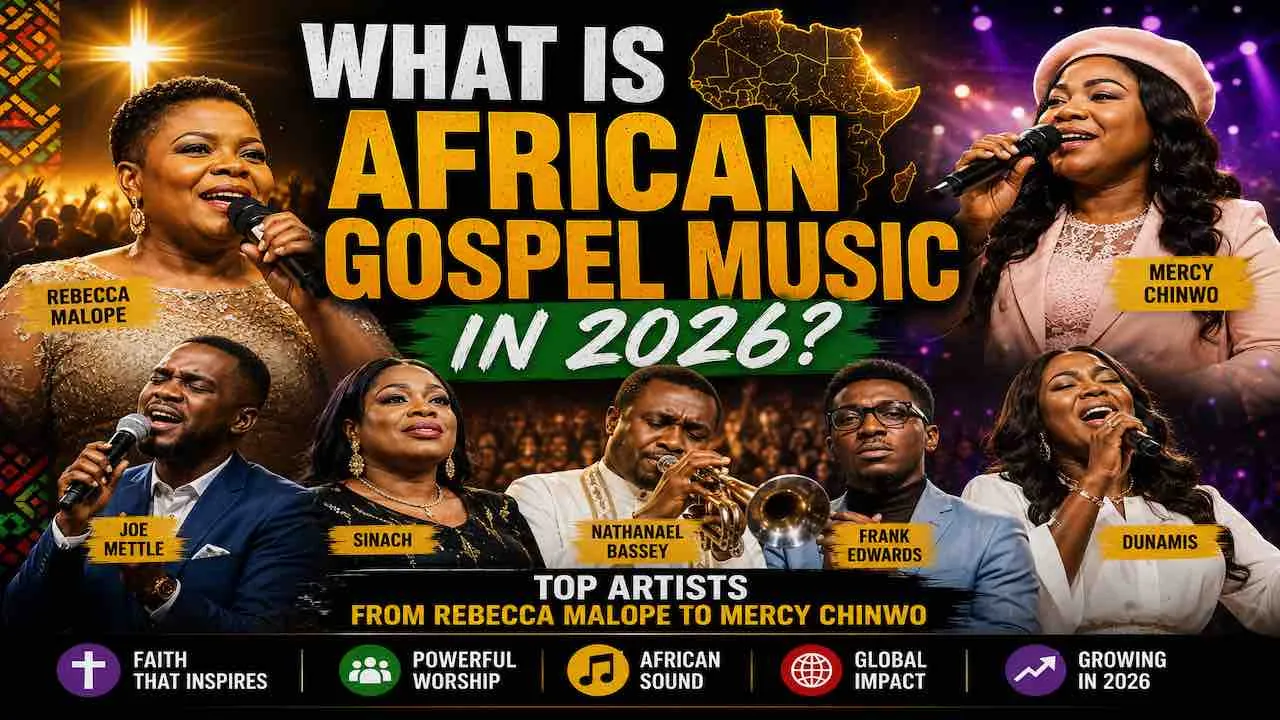
African gospel music pairs worship lyrics with African vocal harmony, talking drums, choir arrangement and, in its newer form, Afrobeats percussion. Rebecca Malope carries the choral tradition from South Africa. Mercy Chinwo, Nathaniel Bassey and Sinach lead Nigeria’s contemporary wave, built on trumpet lines, praise chants and dance rhythm. This guide breaks down the sound behind each name, not just their chart positions.
Gospel in Africa never sat still as one style. A choir arrangement in Soweto sounds nothing like a trumpet-led worship set in Lagos or a praise chant from Yaoundé. What ties these artists together is call and response singing, a technique carried over from church congregations into full studio production.
This breakdown covers the instrumentation, vocal technique and song structure behind Africa’s leading gospel artists, from the choral originators to the Afro gospel wave reshaping the genre now.
What Is African Gospel Music: The Sound Behind the Lyrics
African gospel music is worship lyrics carried by African vocal harmony and call and response singing, built on 2 distinct production styles. Traditional choral gospel uses layered a cappella harmony and hymn structure, led by artists such as Rebecca Malope and the choir collective Joyous Celebration. Contemporary Afro gospel adds drums, electric guitar and dance rhythm borrowed from Afrobeats production, led by artists such as Mercy Chinwo and Moses Bliss. A trumpet often carries the lead melody in Nigerian worship music, a technique Nathaniel Bassey built his entire sound around.
Top African Gospel Artists Ranked by Sound and Influence
Nigerian and South African artists lead current gospel streaming charts through 2 distinct vocal traditions. Nigeria favors trumpet-led praise and Afrobeats-infused worship. South Africa favors layered choir harmony.
| Artist | Country | Signature Sound | Defining Song |
|---|---|---|---|
| Rebecca Malope | South Africa | Layered choir harmony over gospel piano chords | “Ngenxa Yam” |
| Mercy Chinwo | Nigeria | Powerful alto belt over Afrobeats percussion and praise chant | “Excess Love” |
| Nathaniel Bassey | Nigeria | Trumpet-led worship with extended, repeated vocal declarations | “Olowogbogboro” |
| Sinach | Nigeria | Simple, repeatable worship melody built for congregational singing | “Way Maker” |
| Moses Bliss | Nigeria | Melodic Afro gospel duets built around call and response hooks | “Too Faithful” |
| Joe Mettle | Ghana | Highlife guitar tone under a gentle tenor worship voice | “Bo Noo Ne” |
| Prosper Germoh | Cameroon | Central African praise melody over acoustic guitar and hand percussion | “Ndolo Na Yesu” |
Rebecca Malope Built South African Gospel’s Choral Sound
Rebecca Malope carries South African gospel through layered choir harmony stacked over simple piano chord progressions. She started as a pop singer, then shifted her voice toward gospel phrasing on “Rebecca Sings Gospel” in 1992, a record that reshaped South African gospel radio. Her vocal technique leans on sustained, building crescendos rather than the rhythmic percussion common in West African gospel. Across more than 30 albums, that choral build defines her catalog. Read the full breakdown in our feature on Rebecca Malope’s gospel queen legacy.
Mercy Chinwo Carries the Afro Gospel Sound Into the Mainstream
Mercy Chinwo built her sound around a powerful alto belt set over Afrobeats percussion and praise chant hooks. Her breakout song “Excess Love” pairs a simple repeated declaration with dance-ready drum programming, a template she expanded across her album Satisfied. Her fourth studio album, In His Will, leans further into that fusion, with the lead single “Onyeoma (Good God)” layering testimony-driven lyrics over an upbeat, danceable groove. That blend of praise chant and Afrobeats rhythm mirrors the production style fans of Tiwa Savage’s Afrobeats vocal work also recognize.
Nathaniel Bassey Built Nigerian Worship Around Trumpet and Repetition
Nathaniel Bassey leads Nigerian worship music with a trumpet-led sound built around slow, repeated vocal declarations. “Olowogbogboro” set his trumpet melody against a sparse worship arrangement, a formula built for extended congregational singing rather than radio length. His recent duet with Sinach, “Fountain of Mercy,” blends his trumpet phrasing with her simpler, hook-driven melody line. He ranks second among all gospel artists streamed in Sub Saharan Africa on Spotify, trailing only Maverick City Music.
Sinach Built a Melody Simple Enough for Global Congregations
Sinach writes worship melodies built around a short, repeatable phrase that any congregation can sing without rehearsal. “Way Maker” carries that technique globally, built on a single rising melodic line repeated across a full arrangement. That simplicity, rather than vocal complexity, carried her song into churches across North America and Europe. Her catalog favors declarative, one-line hooks over the layered harmony found in South African choral gospel.
How the Afro Gospel Sound Changed African Worship Music
African gospel music shifted from choral, hymn based arrangements toward Afrobeats infused production over the past decade. Producers began layering drums, guitar riffs and dance rhythm under praise lyrics, a movement industry writers now call Afro gospel. Zimbabwe’s Annatoria leads that fusion among female artists, building her sound around a soulful alto voice set over mid-tempo Afropop drums. Tim Godfrey’s co-written track “Omemma,” performed by Chandler Moore, pairs a call and response chorus with a full gospel choir backing. To compare that shift against secular genre lines, see our breakdown of Afrobeats versus Afrobeat.
Why African Gospel Music Keeps Growing Its Audience
African gospel music grows through short viral clips that carry a single melodic hook out of church services and onto TikTok and Instagram Reels. A repeated chorus line, built for congregational singing, transfers easily into a 15 second clip. That same repetition technique built into Sinach’s and Nathaniel Bassey’s songwriting is what makes them spread fast online. Sixteen of the top 20 most streamed gospel artists in Sub Saharan Africa on Spotify come from the continent itself, proof that the sound competes directly with secular Afrobeats rather than sitting apart from it. Compare that growth against other sounds in our guide to types of African music genres.
Where to Hear African Gospel Music
Spotify, YouTube Music and Audiomack carry the largest African gospel catalogs, each favoring a different listening habit. YouTube works best for trumpet-led worship sets and live choir recordings, since video captures the call and response between artist and congregation. Audiomack favors shorter, radio-length Afro gospel singles built around a single hook. Many artists release music free on these platforms and earn through concerts, merchandise and direct fan support instead of paid downloads.
Frequently Asked Questions About African Gospel Music
Rebecca Malope holds the title Queen of African Gospel. She built her sound around layered choir harmony over simple piano chords, releasing more than 30 albums and selling over 10 million copies across South Africa.
Afro gospel adds Afrobeats drums, guitar riffs and dance rhythm to worship lyrics. Traditional gospel relies on choral harmony and hymn based arrangement, built for a choir rather than a dance floor.
Nathaniel Bassey ranks as the most streamed African gospel artist in Sub Saharan Africa on Spotify, trailing only Maverick City Music. His trumpet-led sound and repeated worship declarations built a catalog that places him among Nigeria’s top streamed acts overall.
Yes. Sinach’s simple, repeatable melody on “Way Maker” reached churches and streaming charts across North America and Europe, built on a hook short enough for any congregation to learn instantly.
Trumpet, talking drum, acoustic guitar and layered vocal harmony define the African gospel sound. Nigerian worship leans on trumpet and Afrobeats percussion, while South African gospel leans on choir harmony over piano.