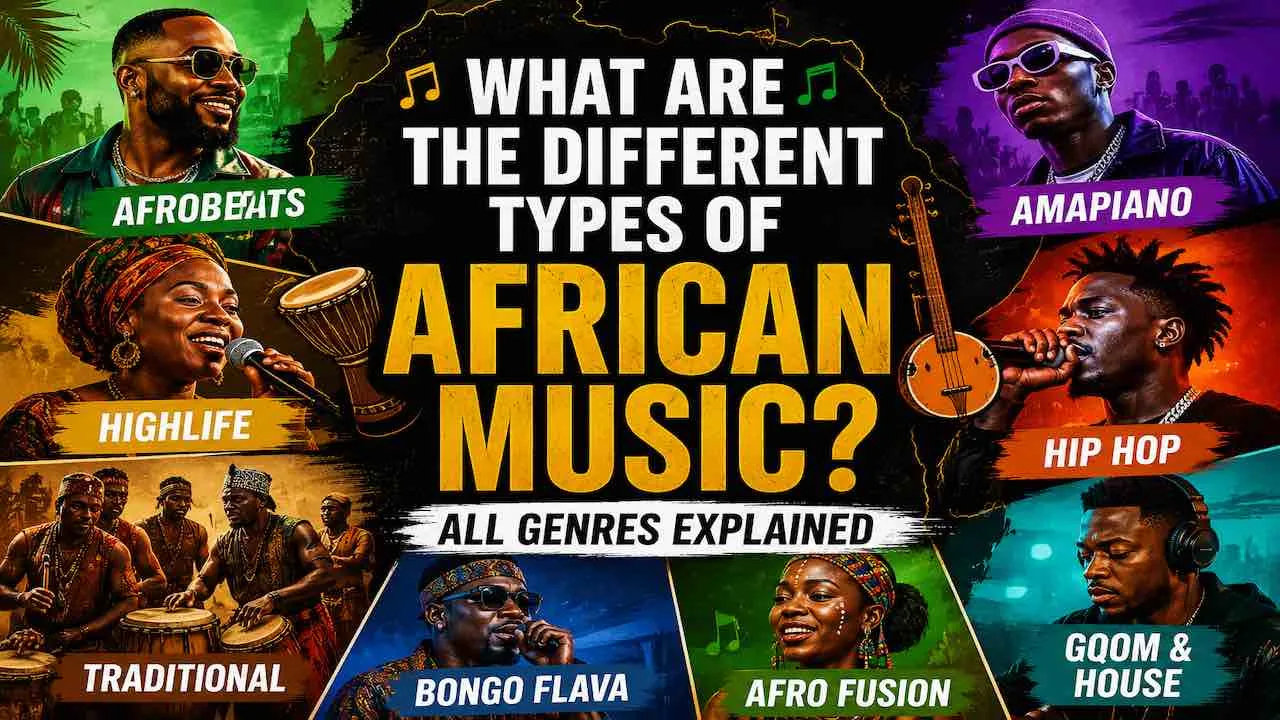
African music splits into more than 50 distinct genres, each carrying its own drum pattern, tempo, and story. Afrobeats swings at 100 beats a minute with a melody that sticks in your head for days. Amapiano leans back on a log drum that thuds like a heartbeat under jazz piano. Gqom hits harder and colder, built for a taxi speaker rattling through Durban at midnight. This guide breaks down every major genre by sound, not just by name, so you can tell one groove from another the moment you hear it.
The Sound Map: African Music Genres at a Glance
Before the deep cuts, here is how the biggest genres actually feel on a speaker.
| Genre | Country | What It Sounds Like | Artists to Hear First |
|---|---|---|---|
| Afrobeats | Nigeria, Ghana | Bright melody over log drum and talking drum, built for the chorus to hit fast | Burna Boy, Wizkid, Tems, Rema |
| Amapiano | South Africa | A rolling log drum bassline under jazzy piano chords, slow and hypnotic | Kabza De Small, Tyla, Uncle Waffles |
| Afrobeat | Nigeria | Horns and a full band locked into one groove for ten minutes straight | Fela Kuti, Tony Allen, Seun Kuti |
| Highlife | Ghana, Nigeria | Clean guitar lines and brass, warm and danceable, no edge | E.T. Mensah, King Sunny Ade, Flavour |
| Soukous | DR Congo | Two guitars trading fast, bright lines over a rumba pulse | Franco, Papa Wemba, Fally Ipupa |
| Gqom | South Africa | Bare, punishing kick drum with almost no melody at all | DJ Lag, DJ Tira, Tipcee |
| Bongo Flava | Tanzania | Swahili verses riding a smooth hip hop and R&B pocket | Diamond Platnumz, Harmonize, Ali Kiba |
| Mbalax | Senegal | Sabar drums firing in rapid bursts under call and response vocals | Youssou N’Dour, Wally Seck |
| Desert Blues | Mali | Hypnotic electric guitar loops that mirror desert wind and distance | Ali Farka Toure, Tinariwen |
| Rai | Algeria | Flute and drum under an emotional vocal that bends and slides | Khaled, Cheb Mami |
Afrobeats: The Sound Running the World’s Playlists Right Now
Afrobeats runs on melody first. Producers build a beat from talking drum, log drum, and a synth pad, then a singer glides on top with a chorus made to repeat. The tempo sits between 95 and 115 beats a minute, fast enough to move a room, slow enough to leave space for the hook.
Wizkid opened the door for the genre on streaming platforms worldwide. Rema’s “Calm Down” crossed one billion Spotify streams and pulled Afrobeats onto pop radio in countries that had never played a Nigerian record before. Burna Boy took the genre further out, mixing it with dancehall and soul until the Recording Academy created a Best African Music Performance category just to keep pace with the sound.
Afrobeats is not the same genre as Afrobeat. Drop the “s” and you land in Fela Kuti territory, a completely different sound built for protest, not the club. Listen to Burna Boy’s “Last Last” next to Fela’s “Zombie” and the gap becomes obvious in the first ten seconds.
Listen for: talking drum accents, a synth hook that repeats through the whole track, and a vocal that sits high and clean in the mix.
Amapiano: The Log Drum That Took Over South Africa First
Amapiano grew out of Pretoria’s township parties in the mid 2010s, and it still sounds like it. The genre pulls from deep house, jazz, and kwaito, then strips the tempo down to 112 to 116 beats a minute so the log drum has room to breathe. That log drum, a synthesised bass hit that lands hard on beats two and four, is the one sound that tells you instantly you are inside an Amapiano track.
Kabza De Small and DJ Maphorisa, known as the Scorpion Kings, carried the genre from backyard speakers to festival main stages. Tyla’s “Water” rode an Amapiano groove straight into the Billboard Hot 100 top ten, and her follow up “Push 2 Start” won her a second Best African Music Performance Grammy at the 2026 ceremony, the first artist to win that category twice.
Subgenres split off fast once the sound spread. S’gija strips the piano back for a rawer club version. Private School Piano slows the tempo and adds jazz chords for a smoother, late night feel. Bongopiano, a fusion with Tanzania’s Bongo Flava, now spreads across East Africa as producers borrow the log drum for their own scenes.
Listen for: a log drum hit on the offbeat, jazz piano chords floating above it, and long instrumental stretches before any vocal comes in.
Afrobeat: Where the Whole Family Tree Starts
Fela Kuti built Afrobeat in the early 1970s by fusing Yoruba rhythm, American funk and jazz, and Ghanaian highlife into songs that ran ten to twenty five minutes with a full band, sometimes twenty seven musicians deep. Every part locks into one groove and stays there, building tension through repetition rather than a chorus.
Drummer Tony Allen designed the polyrhythmic backbone that still defines the genre. Brian Eno and David Byrne leaned directly on that groove for the Talking Heads album Remain in Light. At the most recent Grammy Awards, the Recording Academy gave Fela Kuti a posthumous Lifetime Achievement Award, and his son Femi Kuti accepted it on stage. Seun Kuti now leads the original Egypt 80 band and keeps the political edge of the genre alive.
Listen for: a horn section that answers the vocal line, a groove that repeats for minutes without changing, and lyrics that speak directly about power and corruption.
West African Genres: Nigeria and Ghana’s Deep Catalogue
Nigeria and Ghana produced more distinct genres than any other pair of countries on the continent, and each one still feeds directly into the Afrobeats sound heard today.
Highlife
Highlife formed in Ghana in the early 1900s when local Akan rhythms met brass bands brought in under British rule. Guitar carries the melody, brass fills the gaps, and the whole thing moves at a warm, danceable pace with none of the aggression found in newer genres.
Nigerian Igbo musicians adopted Highlife in the 1960s and reshaped it into its own regional branch. Every guitar line in modern Afrobeats traces back to Highlife’s harmonic style. Flavour brought the genre to younger listeners and built a Spotify following past one million monthly listeners without ever dropping the horn arrangements that define the sound.
Listen for: clean electric guitar melodies, warm brass, and vocals in Twi, Igbo, or Yoruba.
Juju Music
Juju centres on the dundun talking drum, an instrument that can bend pitch to mimic speech. Yoruba praise singing rides over the drum and a guitar line at a patient 80 to 100 beats a minute, building slowly rather than hitting hard from the first bar.
King Sunny Ade carried Juju onto Island Records and introduced Western listeners to talking drum rhythm they had never encountered outside African records. Ebenezer Obey remains the second major name in the genre’s international story.
Listen for: the talking drum bending pitch mid phrase, pedal steel guitar, and vocals sung entirely in Yoruba.
Hiplife
Reggie Rockstone rapped in Twi over Highlife influenced beats in the mid 1990s and created Ghana’s first homegrown modern genre. Sarkodie built his early catalogue on Hiplife before moving toward Afrobeats, and King Promise keeps the sound current for a younger crowd.
Listen for: Twi language rap, Highlife guitar riffs sped up, and a drum machine driving the pace underneath.
Fuji Music
Fuji grew from Muslim Ajisari night chants performed during Ramadan. Sikiru Ayinde Barrister removed Western instruments entirely and built the genre from dense Yoruba drum patterns and call and response vocals alone. Wasiu Ayinde Marshal, known as K1 De Ultimate, leads the genre today, and producers like Sarz now pull Fuji drum patterns into modern Afrobeats records.
Listen for: layered talking drums with no melodic instrument at all, and high energy Yoruba vocal calls.
South African Genres: From Kwaito to the Global Amapiano Wave
South Africa runs the most electronic corner of African music, and three genres trace a direct line from post apartheid streets to Grammy stages.
Kwaito
Kwaito arrived in Johannesburg townships right after apartheid ended, slowing down house music and layering it with American R&B samples and township slang vocals. TKZee, Zola, and Mandoza turned it into the sound of a generation finding its own voice. Amapiano later absorbed Kwaito’s identity and pushed the production further.
Listen for: slowed down house drums, sampled R&B hooks, and vocals in Tsotsitaal or isiZulu.
Gqom
Gqom strips everything back. The name means drum in isiZulu, and the genre lives up to it with a hard kick, syncopated hi hats, and almost no melody at 120 to 130 beats a minute. It first spread through Durban’s minibus taxi speakers before reaching clubs.
DJ Lag carried Gqom into a Beyonce collaboration and toured four continents on the strength of that raw sound. DJ Tira pushed the genre into mainstream South African television, and Tipcee’s choreography turned Gqom dance moves into a global social media trend.
Listen for: a bare kick drum with almost no other instrument in the mix, and dark, sparse synth stabs.
Afrohouse
Afrohouse layers traditional South African percussion over deep house and tech house structures at 120 to 126 beats a minute. Black Coffee won a Grammy for Best Dance Electronic Album and has headlined Coachella and Glastonbury on the strength of this sound. Master KG’s “Jerusalema” passed 500 million YouTube views and turned Afrohouse into a dance challenge that spread across every continent.
Listen for: layered African percussion under electronic drums, and call and response vocal chants.
Central African Genres: The Congo Guitar Sound
The Democratic Republic of Congo shaped African popular music more than almost any other single country, mainly through two connected genres.
Congolese Rumba and Soukous
Congolese Rumba formed in the 1940s when Cuban son records reached the Congo and met local percussion. UNESCO now lists it as Intangible Cultural Heritage. Franco led the TPOK Jazz orchestra for over 30 years and recorded more than 150 albums, earning the title Le Grand Maitre. Papa Wemba sped the tempo up to 120 to 140 beats a minute and added Western pop touches to create Soukous. Fally Ipupa now carries the sound internationally, selling out three separate French Zenith venues.
Listen for: two guitars trading fast melodic lines against each other, and brass horns punctuating the groove.
Ndombolo
Ndombolo pushed Soukous even faster in the 1990s and put dance choreography at the centre of every performance. Koffi Olomide and Werrason lead the genre, and its energy fed directly into Coupe Decale in Cote d’Ivoire.
East African Genres: Swahili Coast Rhythms
East Africa sits where centuries of Indian Ocean trade met African rhythm, giving the region a melodic character distinct from West or Southern Africa.
Bongo Flava
Bongo Flava blends hip hop, dancehall, and R&B with Swahili lyrics at 90 to 110 beats a minute. Diamond Platnumz became the first African artist past one billion YouTube views on his own channel and built the WCB Wasafi label that launched Harmonize and Rayvanny. The genre now blends with Amapiano to create Bongopiano, a fusion spreading fast across East Africa.
Listen for: Swahili verses that switch between rap and melody, and hip hop drum patterns underneath.
Taarab
Taarab formed on the Zanzibar coast, blending Arabic, Indian, and African elements for weddings and celebrations. Siti binti Saad was its first widely recognised star, and modern players like Mzee Yusuf keep the tradition running with electric instruments.
West African Griot and Desert Genres
Mali and Senegal carry griot oral history traditions stretching back over 700 years, and both countries built modern genres directly from that root.
Mbalax
Mbalax takes its name from the Wolof word for rhythm itself. Sabar and tama drums fire in rapid bursts under vocals that draw from Cuban rumba and Western soul. Youssou N’Dour’s Super Etoile de Dakar built the genre from the 1970s onward, and Rolling Stone once called him as commanding as a young Michael Jackson. Wally Seck now carries Mbalax for a younger Senegalese audience.
Desert Blues
Desert Blues fuses Tuareg guitar tradition with American blues, built for long, hypnotic loops that mirror the flatness of the Sahara. Ali Farka Toure’s album Talking Timbuktu, made with American guitarist Ry Cooder, won a Grammy for Best World Music Album. Tinariwen, a Tuareg band formed near Kidal in Mali, carried the sound onto rock festival stages worldwide.
Listen for: a single guitar line looping for minutes at a time, and vocals in Tamasheq or Bambara.
Wassoulou
Wassoulou centres female voices from southern Mali, built around the kamelengoni harp. Oumou Sangare sings directly about women’s rights and forced marriage, and her records carry a rawness that studio pop rarely reaches.
North African Genres: Arab, Berber, and Sub Saharan Layers
Rai
Rai means opinion in Arabic, and the genre earned that name through decades of songs that challenged Algerian authorities directly. Khaled, known as the King of Rai, brought the sound to global stadiums, and Cheb Mami’s duet with Sting on “Desert Rose” carried Rai onto Western pop radio for the first time.
Gnawa
Gnawa grew from West African spiritual healing ceremonies brought into Morocco generations ago. The guembri, a three string bass lute, and iron qraqeb castanets build a repetitive trance rhythm meant to induce a physical, almost hypnotic state in listeners.
Diaspora Genres: African Rhythm in New Cities
Afroswing
Afroswing formed in the UK when British West African artists fused Afrobeats, grime, and UK garage. J Hus’s album Common Sense set the template, and the sound now sits comfortably on UK pop charts while keeping clear West African rhythm underneath.
Kizomba
Kizomba pairs Angola’s Semba tradition with Caribbean zouk for a slow, close partner dance style. Eduardo Paim founded the genre, and it spread from Angola to Portugal and then across dance floors in Europe and Asia.
How These Genres Reshaped Global Music
- Afrobeats drum patterns now show up in American R&B, UK pop, and Latin pop production.
- Amapiano’s log drum bass has been adopted by producers in the UK, Brazil, and the United States for dance tracks and film scores.
- Fela Kuti’s Afrobeat directly shaped Brian Eno, David Byrne, and Paul Simon, all of whom named him as a core influence.
- Makossa, a Cameroonian genre, was sampled by Michael Jackson on “Wanna Be Startin’ Somethin’.”
- Gqom shaped Beyonce’s production choices on The Lion King: The Gift, with DJ Lag credited as a contributor.
Frequently Asked Questions
Africa carries more than 50 documented popular music genres and hundreds of regional traditional styles across 54 countries. Afrobeats, Amapiano, Afrobeat, Highlife, Soukous, Gqom, and Bongo Flava rank among the most widely heard internationally.
Afrobeat, without the s, is Fela Kuti’s political genre from the 1970s, built on long horn driven grooves performed by a full band. Afrobeats, with the s, is the modern West African pop sound built for radio hooks and shorter, danceable tracks. Burna Boy and Wizkid make Afrobeats. Fela Kuti and Seun Kuti made Afrobeat.
Amapiano formed in Pretoria’s Gauteng townships in the mid 2010s, blending deep house, jazz, and kwaito at 112 to 116 beats a minute. Kabza De Small and DJ Maphorisa carried it nationally before Tyla’s Grammy wins pushed it onto the global stage.
Amapiano built its identity around the log drum, a synthesised percussion hit that lands on beats two and four. No other African genre uses that instrument as its central sound.
Afrobeats leads African genres by total streaming volume, driven by Burna Boy, Wizkid, Davido, and Rema. Amapiano runs closest behind it, fuelled by Tyla’s two Grammy wins in the Best African Music Performance category.