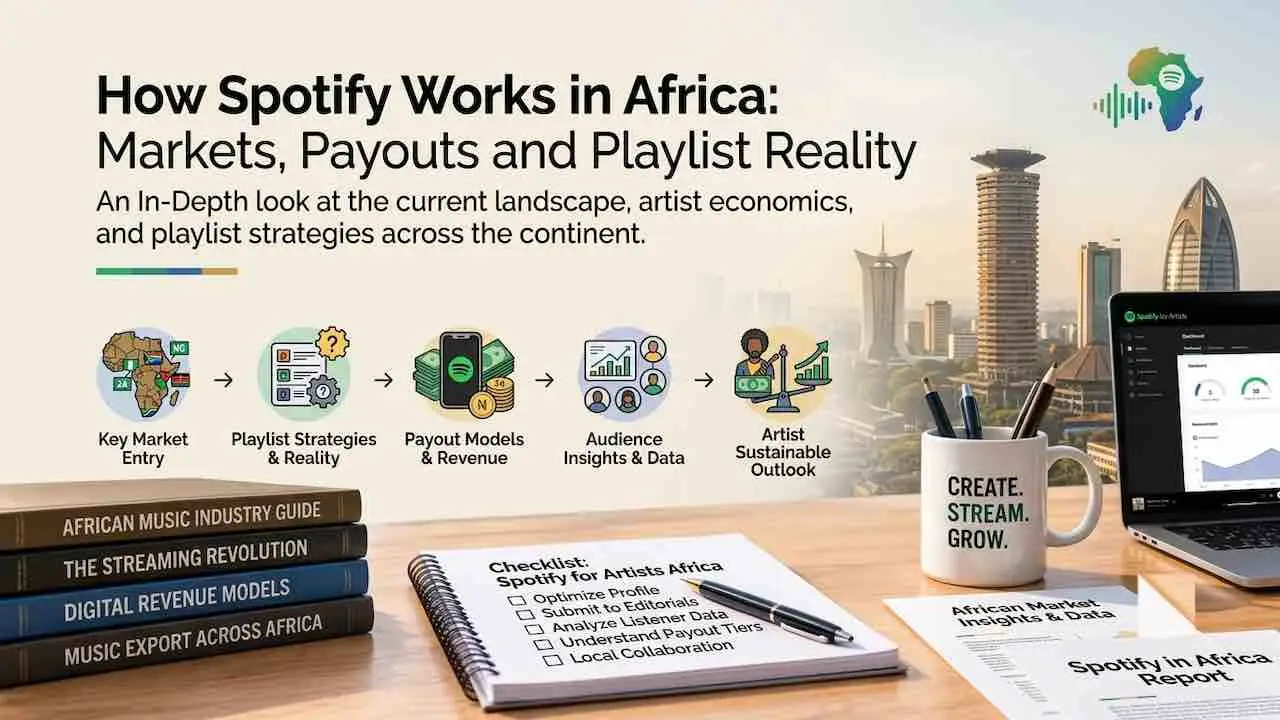
Spotify is available across most of sub-Saharan Africa and pays royalties through its StreamShare model, where your earnings depend on your share of total streams in a given market, not a flat rate per play. Nigerian artists earned over $42 million from Spotify in 2025. South African artists earned R504 million ($30.69 million) in the same period. Yet 1 million streams in Nigeria pays approximately $300 while the same million streams in Sweden pays up to $10,000. That 3,000% gap is the single most important fact about how Spotify works in Africa. This guide covers every mechanism behind it: market availability, payout structure, editorial playlists, algorithmic discovery, currency and tax reality, and how Spotify competes with Boomplay, Audiomack, and Mdundo in 2026.
Spotify Market Availability Across Africa
Spotify launched across 80 new markets in February 2021, bringing most of Africa online on the platform for the first time. Before 2021, only South Africa had Spotify access. The 2021 expansion included Nigeria, Ghana, Kenya, Tanzania, Uganda, Mozambique, Madagascar, Mali, Democratic Republic of Congo, and 30 additional African markets simultaneously. North African markets including Egypt, Morocco, and Tunisia also came online. Ethiopia has limited availability. Eritrea, South Sudan, and a small number of countries remain unavailable.
| Region | Key Countries | Spotify Available | Dominant Local Platform |
|---|---|---|---|
| West Africa | Nigeria, Ghana, Senegal, Ivory Coast, Cameroon | Yes (all) | Boomplay, Audiomack |
| East Africa | Kenya, Tanzania, Uganda, Rwanda, Ethiopia | Yes; Ethiopia limited | Mdundo, Boomplay |
| Southern Africa | South Africa, Zimbabwe, Zambia, Mozambique | Yes (all) | Boomplay, Deezer |
| North Africa | Egypt, Morocco, Tunisia, Algeria | Yes (all) | Anghami, Deezer |
| Central Africa | DRC, Congo, Gabon, Chad | Yes; via Orange telco partnership (DRC, Madagascar, Mali) | Deezer, Boomplay |
Being available in a country does not mean Spotify has equal infrastructure in that country. Spotify has dedicated editorial teams in Lagos and Johannesburg, the two largest African music markets. Other African territories rely on those same teams for editorial consideration. An artist in Nairobi, Accra, or Lusaka pitches through the same Spotify for Artists portal but receives editorial attention from a team that covers the continent from two offices. That geographic concentration of editorial resource shapes which genres and which markets receive the most playlist consideration.
How Spotify’s StreamShare Payment Model Works
Spotify does not pay a flat rate per stream. It pays a share of a royalty pool. Every month, Spotify collects subscription fees and advertising revenue into a single global pool. It keeps approximately 30% and distributes the remaining 70% to rights holders: labels, distributors, publishers, and PROs. Your royalty payment equals your share of total streams on the platform in a given period, multiplied by the total pool value for that period. This is called the StreamShare or pro-rata model.
The practical result: a Nigerian listener paying NGN 1,300 ($0.82) per month contributes far less to the global royalty pool than a US listener paying $12.99 per month. When more of your streams come from low-subscription markets, each stream generates less income even though the play itself is identical. Nigerian artists saw local consumption rise by 170% in 2025. That growth increased stream counts dramatically but pushed per-stream payouts down because more Nigerian streams from low-value subscriptions entered the mix. Nigerian artist payout grew 140% over three years but only 3.45% between 2024 and 2025, exactly because local growth outpaced subscription value growth.
Pro-Rata vs. User-Centric: The Debate That Affects African Artists
A user-centric payment system (UCPS) would route each listener’s subscription fee only to the artists they actually stream. African artists with loyal African fan bases would earn more per stream under UCPS, because those listeners’ fees would route entirely to African artists rather than diluting into a global pool dominated by Western catalog. Spotify has not implemented UCPS globally. Deezer tested it in France in 2023. The debate remains active and directly affects how African streaming growth translates into artist income.
The Geographic Penalty: African Streams Worth 3 to 4 Times Less
Spotify revenue per stream in most African countries is 3 to 4 times lower than in Europe or the United States, according to Ecofin Agency’s 2026 analysis. The gap is structural. It flows directly from subscription price differences between markets. These are the estimated earnings per 1 million streams by listener market in 2025 to 2026:
| Listener Location | Monthly Premium Price | Est. Payout Per 1M Streams | Tier |
|---|---|---|---|
| Norway | $12 to $15 | $6,000 to $8,000 | Tier 1 (highest) |
| Sweden | $11 to $13 | $7,000 to $10,000 | Tier 1 |
| United States | $12.99 | $3,500 to $4,430 | Tier 1 |
| United Kingdom | $11 to $12 | $3,000 to $4,000 | Tier 1 |
| South Africa | R60 to R80 ($3.30 to $4.40) | $600 to $1,200 | Tier 2 |
| Nigeria | NGN 1,300 ($0.82) | $300 to $500 | Tier 3 |
| Kenya | KSh 299 ($2.30) | $400 to $800 | Tier 2 to 3 |
| Ghana | GH₵ 30 to 35 ($2.00 to $2.40) | $350 to $700 | Tier 2 to 3 |
The solution Spotify’s Sub-Saharan Africa managing director Jocelyne Muhutu-Remy articulated in May 2026 is not to raise African subscription prices but to grow diaspora streaming. A Nigerian artist whose family streams them in Canada at $10.99/month generates 13 times the royalty income per stream as the same play in Lagos. Building global listeners is more financially impactful than building local listeners on a per-stream basis. The full comparison of Boomplay vs Audiomack vs Spotify payouts shows exactly how this dynamic compares across platforms.
The 1,000 Stream Threshold: What It Means for African Artists
Since April 2024, Spotify no longer pays royalties on tracks with fewer than 1,000 streams in a 12-month period. Any track that does not reach 1,000 streams in a year earns nothing, regardless of how many times it played. The royalties those tracks would have generated redistribute to tracks that do qualify. Spotify estimated this policy redirects approximately $40 million annually toward tracks that meet the threshold. That $40 million comes directly from the long-tail catalog that was previously paid fractions of cents.
For African independent artists building an audience, this threshold has real implications. An artist releasing 10 songs per year where only 3 clear 1,000 streams earns nothing from the other 7, even if those songs collectively accumulated 800 streams each. The strategic response is to release fewer songs, promote each one harder before moving to the next, and concentrate streaming efforts to push each track through the 1,000 stream threshold before the 12-month window closes. Quality over volume is not just an artistic principle for African artists on Spotify in 2026. It is a financial requirement.
Spotify Africa’s Editorial Playlist Ecosystem
Spotify’s editorial playlists are the platform’s most powerful discovery tool for African artists. A single placement cascades into Discover Weekly, Release Radar, Radio, and Autoplay queues across multiple continents. Fresh Finds Africa added Zaylevelten’s “Maye” on 4 June 2025; his monthly listeners grew 2,017% in the weeks that followed.
Spotify’s Official African Editorial Playlists
| Playlist | Saves or Reach | Genre Focus | Best For |
|---|---|---|---|
| African Heat | 1.8 million saves | Pan-African: Afrobeats, Afropop, Amapiano | Mid to established artists; single most important African editorial placement |
| Hot Hits Naija | 20 million+ global plays | Nigerian Afrobeats and Afropop | Chart-level Nigerian artists; top 3 playlist for Gen Z Afrobeats listeners globally |
| Gbedu | Top 3 globally for young Afrobeats listeners | Nigerian club and party Afrobeats | Rising to established Nigerian artists; diaspora UK and USA audiences |
| Street Energy | Active Gen Z Nigerian audience | Raw street Afrobeats; Lagos youth culture | Emerging to rising Nigerian artists with street sound |
| Fresh Finds Africa | Nigeria 44% of plays; Kenya 20% | Emerging artists: Afropop, Afrobeats, Afro R&B, Afro soul, alté | First editorial placement for emerging artists; strongest breakout mechanism on the platform |
| Global Afrobeats | International crossover audience | Commercially polished Afrobeats for non-African listeners | Artists targeting Western crossover markets |
| Amapiano Grooves | 500,000+ followers | South African Amapiano | South African Amapiano producers and DJs |
| Afro Adura | 51% average monthly plays growth year on year | Gospel and spiritual Afrobeats | Gospel and conscious Afrobeats artists |
| Alté Cruise | Lagos alternative scene | Experimental and alternative Nigerian sound | Alternative and art-driven Nigerian artists |
| New Music Friday Africa | Pan-African weekly release playlist | All African genres; new releases week of launch | Any African artist with a strong new release; pitched via standard pitch form |
In 2025, 3,550 South African artists were added to Spotify editorial playlists, reflecting the platform’s growing editorial investment across African markets.
Editorial vs. Algorithmic: How Discovery Actually Works on Spotify Africa
Spotify discovery operates through two separate systems that feed each other. Editorial playlists are human-curated by Spotify’s team in Lagos and Johannesburg. Algorithmic playlists (Discover Weekly, Release Radar, Radio, Autoplay) are machine-generated based on listener behaviour signals. The relationship between the two is sequential: editorial placement generates engagement data that triggers algorithmic distribution.
The Signal Chain for African Artists
- Editorial pitch submitted 4 to 6 weeks before release: Submitted through Spotify for Artists for unreleased tracks only; closes permanently on release day
- Editorial placement generates saves, streams, and completion rate data: These signals enter Spotify’s algorithm as indicators of listener approval
- Algorithm extends reach automatically: High save rate triggers Discover Weekly insertions for listeners with similar taste profiles, regardless of whether those listeners have heard the artist before
- Release Radar fires on release day for existing followers: Pre-save campaigns directly increase the follower count that triggers Release Radar notifications
- WhatsApp community heat precedes editorial consideration: Spotify’s Lagos editorial team monitors organic social momentum before placing unknown artists on major playlists; tracks already spreading through WhatsApp music groups carry visible engagement signals on the platform before the editorial pitch is even reviewed
Tracks that spread through African social networks before release are more likely to receive editorial consideration because the engagement data is already visible to the platform’s algorithm, per Chartlex’s April 2026 analysis of Spotify Africa promotion patterns. Building WhatsApp community presence, Nigerian music blog features, and South African culture account mentions before release is not just marketing. It is the pre-Spotify heat that editorial curators in Lagos use to identify which songs to prioritise. The full process for pitching correctly is covered in the step-by-step guide to getting on Spotify, Apple Music, and Boomplay.
Spotify for Artists: The Dashboard Every African Artist Must Use
Spotify for Artists at artists.spotify.com is the control panel for your entire Spotify presence. Without claiming it, you cannot submit editorial pitches, access listener analytics, or customise your profile. Every African artist with even one release on Spotify should claim their account within the first week the release goes live.
What Spotify for Artists Gives African Artists
- Editorial pitch tool: The only channel through which you can submit a track for official playlist consideration; available only for unreleased tracks; accessible only to verified Spotify for Artists account holders
- Real-time listener geography: Shows exactly which countries and cities your streams come from; the most reliable signal for where to invest touring, marketing, and brand deal pitching budget
- Demographic data: Age, gender, and listener type breakdown (active, casual, and programmed listeners); helps identify which audience segment is growing fastest
- Playlist tracking: Shows which playlists are driving streams; tells you whether your streams come from editorial, algorithmic, or user-generated playlists
- Artist profile customisation: Bio, profile image, artist picks, and social links; a blank profile reduces editorial consideration probability
- Milestone notifications: Alerts when you cross stream count milestones; useful for press and brand deal conversations
Currency, Tax and Withdrawal: How Money Reaches African Artists
Spotify pays rights holders through distributors, not directly to artists. Your distributor collects Spotify royalties on your behalf, deducts their fee (typically 0 to 20% depending on the service), and pays you through PayPal, ACH, wire transfer, or Payoneer. The currency your royalties arrive in depends on your distributor and your withdrawal method. Most African artists receive USD royalties that they then convert to local currency through a fintech service.
The Nigerian Currency and Tax Reality
Nigerian artists face a compounding currency challenge. Spotify calculates Nigerian royalties from a low-price subscription base, pays out in USD, and then the Naira’s recent devaluation means the USD converted to Naira produces a lower local currency value than historical figures suggest. Nigerian artists earned NGN 1.98 per stream in 2025. At the 2021 exchange rate, that same figure represented significantly more purchasing power than at the 2025 rate after the Naira lost over 60% of its value against the dollar since 2022.
- W-8BEN form: All distributors operating through the US require this form; without it, 30% of all royalties are withheld automatically; Nigeria has no US tax treaty so some withholding may still apply even with the form completed
- Payoneer withdrawal: TuneCore pays via Payoneer; set up a Payoneer account before your first royalty statement arrives
- Grey.co or Wise for Naira conversion: DistroKid pays via PayPal; transfer from PayPal to Wise to Grey.co for the most cost-effective Naira conversion, avoiding PayPal’s 3 to 5% FX spread
- South African Rand: Wise Rand accounts accept direct international transfers; the most straightforward conversion path for South African artists receiving USD royalties
Spotify vs. Boomplay, Audiomack, and Mdundo: The Competitive Reality
Spotify is not the dominant platform in Africa by user count. Boomplay has 90 million monthly active users across Nigeria, Ghana, Kenya, and Tanzania. Audiomack has 20 million monthly active users with strength in Nigeria and Ghana. Mdundo has 39 million monthly active users concentrated in East Africa. All three platforms carry African audiences that Spotify cannot yet match domestically, despite Spotify’s global reach advantage.
| Platform | African Users | Payout Per Stream | African Artist Strength |
|---|---|---|---|
| Spotify | Growing; significant diaspora reach | $0.00030 to $0.00050 from African listeners; up to $0.0044 from US listeners | Best for diaspora income; editorial playlists; global discovery |
| Boomplay | 90 million+ monthly active | $0.0064 average | Best for domestic African stream volume; direct editorial relationships |
| Audiomack | 20 million+ monthly active | Ad-share via AMP program | Best for early discovery; DJ repost culture drives virality |
| Apple Music | Growing African subscriber base | $0.01 globally; premium across all markets | Best per-stream payout; strong diaspora earnings |
| Mdundo | 39 million monthly active (East Africa) | Royalties via mobile money; targeting $1.2M total payouts by 2026 | Best for East African market penetration; M-Pesa direct payout |
| Deezer | Strong in francophone Africa | $0.0064 average; ACPS model in select markets | Best for Ivory Coast, Senegal, DRC, Cameroon audiences |
Distribute to Spotify and local platforms simultaneously. Spotify builds diaspora and international income. Boomplay and Audiomack build domestic African stream volume. Domestic virality on Boomplay creates the engagement signals Spotify’s Lagos team monitors when selecting artists for African Heat and Hot Hits Naija. For full per-stream data, read the Boomplay vs Audiomack vs Spotify payout comparison.
What African Artists Earned From Spotify: 2025 Data
These are the verified 2025 Spotify royalty figures for African artists, from Spotify’s Loud and Clear report and confirmed third-party sources:
| Market | 2025 Total Royalties | Year-on-Year Change | Key Fact |
|---|---|---|---|
| Nigeria | $42 to $44 million (NGN 60B+) | +3.45% from 2024; +140% over 3 years | 58% to independent artists; 30B streams total; 250M user playlists feature Nigerian artists |
| South Africa | R504 million ($30.69 million) | +28% from 2024; +56.25% from 2023 to 2024 | 74% from listeners outside South Africa; 1.6B new listener discoveries; 3,550 artists added to editorial playlists |
| Nigeria + South Africa combined | Approximately $70 to $75 million | Consistent double-digit growth | Two countries driving majority of Africa’s Spotify royalty total |
| Nigerian artists earning 10M NGN+ | Doubled year on year | Tripled since 2022 | Mid-tier artist income growing significantly |
| SA artists earning R100K to R500K | Doubled in 3 years | Steady growth at mid tier | Independent and label artists both growing at this band |
Spotify in Africa: What Is Coming in 2027
Spotify’s Africa strategy for 2026 and 2027 focuses on four specific structural changes that directly affect what African artists earn and how they are discovered.
- Premium price increases in African markets: Spotify raised US prices from $9.99 to $12.99 between 2024 and 2025, generating a 34% per-stream rate increase. Modest African price increases follow the same mechanism: more subscription revenue means higher royalty pool contributions per African stream
- Telco partnership expansion: Spotify partnered with Orange in 2023 for bundled streaming in DRC, Madagascar, and Mali. MTN, Airtel, and Safaricom bundle deals would bring millions of paying subscribers online without requiring credit card access
- Expanded Lagos and Johannesburg editorial teams: More editors mean more African playlists, wider genre coverage, and more artists reaching editorial consideration
- User-centric payment system pressure: As African Premium subscriber bases grow, the case for routing African subscribers’ fees directly to African artists strengthens; artists with dedicated African fan bases gain most from any UCPS implementation
For the full income picture beyond Spotify, the complete guide to how African musicians make money covers all 9 revenue streams including streaming, live performance, brand deals, and publishing. For rights registration that maximises Spotify royalty collection, the copyright and royalties guide for African artists covers ISRC codes, publishing administration, and PRO registration. African music industry growth data shows the full commercial context around Spotify’s expanding African operations. African music news and streaming updates on Tubidy Africa tracks platform changes and payout developments as they happen across all major DSPs.
FAQs: How Spotify Works in Africa
Approximately NGN 1.98 per stream ($0.00030 to $0.00050) from Nigerian listeners in 2025. The same stream from a US listener pays roughly $0.004, thirteen times more. Nigerian Premium subscriptions cost NGN 1,300 ($0.82) per month versus $12.99 in the US; the royalty pool value is proportional to subscription revenue per market.
Most of Africa following the February 2021 expansion into 80 new markets. Nigeria, Ghana, Kenya, Tanzania, South Africa, Uganda, Mozambique, DRC, Egypt, Morocco, and 40+ additional African countries all have Spotify. Ethiopia has limited availability. Eritrea and South Sudan remain unavailable.
Submit through Spotify for Artists at least 4 weeks before release, ideally 6 weeks. The pitch window closes permanently on release day. Target African Heat, Hot Hits Naija, Fresh Finds Africa, Amapiano Grooves, or Gbedu by genre. Use specific micro-genre tags and include cultural context about the song’s sound and audience.
Because Spotify’s royalty pool is funded by subscription fees and Nigerian subscriptions cost $0.82 per month versus $12.99 in the US. More Nigerian streams from low-value subscriptions means less income per play. Building diaspora listeners in premium markets is the fastest way to increase average per-stream income without leaving Africa.
They serve different purposes. Boomplay’s 90 million African users build domestic stream volume at $0.0064 per stream. Spotify builds diaspora income and editorial reach at up to $0.0044 per stream from Western listeners. Most African artists need both simultaneously.