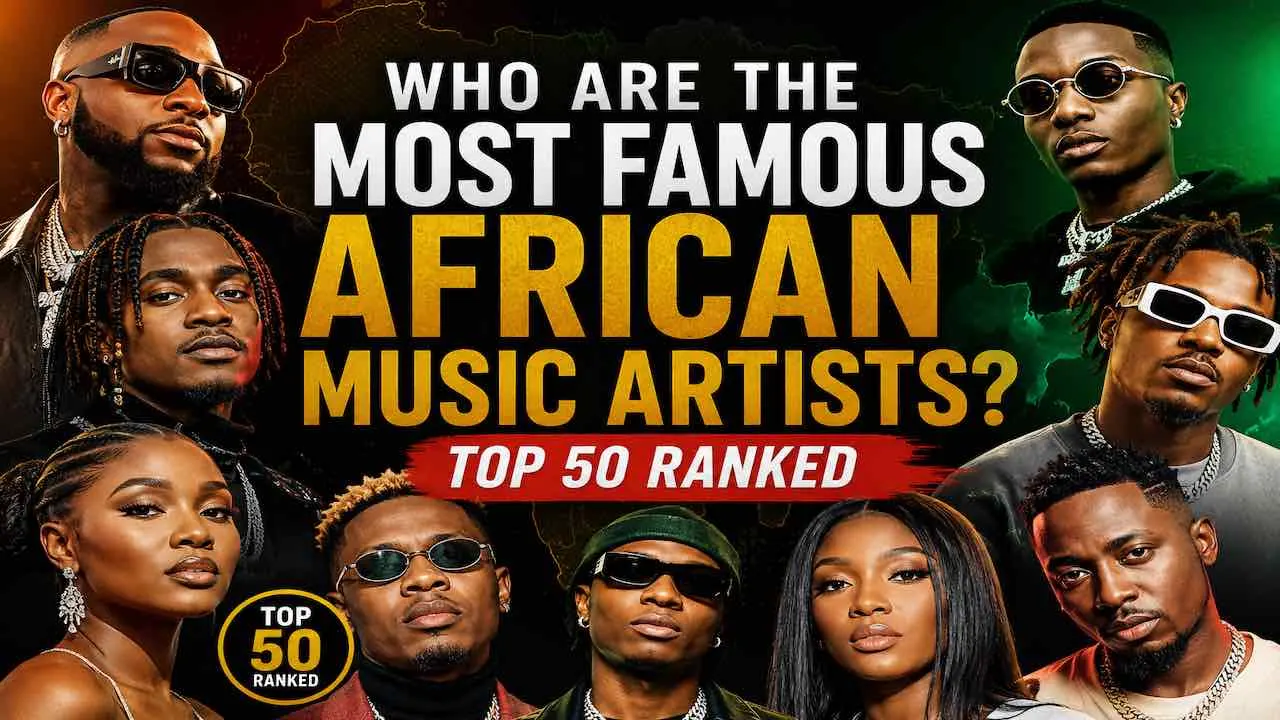
Fela Kuti is the most famous African music artist of all time. He built Afrobeat from Yoruba percussion, jazz horns and funk basslines, then used the sound as a weapon against a military government. Today Burna Boy, Wizkid, Tyla, Rema and Tems carry that sonic lineage into stadiums and streaming charts worldwide. This ranking covers the songs, albums and vocal styles behind all 50 names, not just their trophies.
African music sounds different depending on where you stand. A talking drum in Lagos speaks a different language than a log drum in Pretoria or a Wolof percussion pattern in Dakar. What unites the 50 artists below is a refusal to soften that difference for outside ears. The sound stayed African. The audience went global.
This list ranks legends, superstars and rising acts by musical footprint: the records they made, the styles they invented and the way their voices changed what African music could sound like on a world stage.
Top 50 Most Famous African Music Artists: Sound and Signature Songs
| # | Artist | Country | Signature Sound | Defining Song or Album |
|---|---|---|---|---|
| 1 | Fela Kuti | Nigeria | Afrobeat horns over 15-minute jazz-funk grooves | “Zombie” |
| 2 | Miriam Makeba | South Africa | Xhosa click-song phrasing over jazz backing | “Pata Pata” |
| 3 | Burna Boy | Nigeria | Afro-fusion blending dancehall bass with highlife guitar | No Sign of Weakness |
| 4 | Youssou N’Dour | Senegal | Mbalax polyrhythms driven by the sabar drum | “7 Seconds” |
| 5 | Wizkid | Nigeria | Minimalist Afrobeats built on space and falsetto hooks | Made in Lagos |
| 6 | Hugh Masekela | South Africa | Township jazz trumpet lines with soul phrasing | “Grazing in the Grass” |
| 7 | Tyla | South Africa | Amapiano log drum fused with R&B vocal runs | “Water” |
| 8 | Davido | Nigeria | Anthemic pop-Afrobeats built for stadium singalongs | “Fall” |
| 9 | Tems | Nigeria | Alt-R&B murmur vocals layered over sparse Afrobeats production | “Love Me JeJe” |
| 10 | Rema | Nigeria | Trap-Afrobeats hybrid with rock guitar textures | “Calm Down” |
| 11 | Angelique Kidjo | Benin | Beninese Yoruba chant fused with Afrobeat and funk | “Agolo” |
| 12 | Ali Farka Touré | Mali | Desert blues guitar circling Delta blues phrasing | Talking Timbuktu |
| 13 | Diamond Platnumz | Tanzania | Bongo Flava melodies over Swahili R&B hooks | “Jeje” |
| 14 | King Sunny Ade | Nigeria | Layered Juju guitar with talking-drum call and response | Juju Music |
| 15 | Franco (Luambo) | DR Congo | Congolese rumba guitar cycles stretched past 10 minutes | “Mario” |
| 16 | Salif Keita | Mali | Mande griot vocal tradition set to electric guitar | “Mandjou” |
| 17 | Brenda Fassie | South Africa | Township bubblegum pop with belting vocal attack | “Weekend Special” |
| 18 | Asake | Nigeria | Fuji chant melodies over amapiano-Afrobeats percussion | “Lonely at the Top” |
| 19 | Tiwa Savage | Nigeria | Soul-trained vocals over Afropop and R&B production | “Somebody’s Son” |
| 20 | Ayra Starr | Nigeria | Sharp alto hooks over minimalist Afropop beats | “Rush” |
| 21 | Sarkodie | Ghana | Twi-language rap over Hiplife and highlife samples | “Adonai” |
| 22 | Fally Ipupa | DR Congo | Ndombolo guitar riffs layered with smooth R&B vocals | “Un Coup” |
| 23 | Oumou Sangaré | Mali | Wassoulou hunter’s harp against a defiant female voice | “Diaraby Nene” |
| 24 | Black Sherif | Ghana | Raspy melodic rap over Highlife-Afrobeats hybrid beats | “Second Sermon” |
| 25 | DJ Maphorisa | South Africa | Log drum production that defined amapiano’s low end | “Umsebenzi Wethu” |
| 26 | Kabza De Small | South Africa | Jazzy piano chords stacked over deep sub-bass | I Am the King of Amapiano |
| 27 | Olamide | Nigeria | Yoruba street rap over indigenous percussion loops | “Wo!!” |
| 28 | Master KG | South Africa | Afro-house piano loop built for global dance floors | “Jerusalema” |
| 29 | Yemi Alade | Nigeria | Highlife brass and Afropop melody with comedic delivery | “Johnny” |
| 30 | CKay | Nigeria | Emo-Afrobeats blending whispered vocals with piano loops | “Love Nwantiti” |
| 31 | Nasty C | South Africa | Technical trap rap with rapid double-time flows | “Hell Naw” |
| 32 | Papa Wemba | DR Congo | Soukous guitar riffs paired with sapeur showmanship | “Le Voyageur” |
| 33 | Oliver Mtukudzi | Zimbabwe | Tuku Music blending mbira tones with township jit rhythm | “Neria” |
| 34 | Sauti Sol | Kenya | Four-part vocal harmony over Afro-pop and soul instrumentation | “Sura Yako” |
| 35 | Khaligraph Jones | Kenya | Sheng-language rap delivered over hard-hitting boom-bap beats | “Yego” |
| 36 | Bien | Kenya | Falsetto soul vocals over stripped-back Afropop arrangements | “Bald Men” |
| 37 | Khaled | Algeria | Raï accordion and synth lines under a soaring tenor | “Aïcha” |
| 38 | ElGrandeToto | Morocco | Darija rap over trap production with Gnawa touches | “MTM” |
| 39 | Soolking | Algeria | Raï-pop melodies fused with French trap cadences | “Guerilla” |
| 40 | Umm Kulthum | Egypt | Classical Arabic tarab with hour-long vocal improvisation | “Enta Omri” |
| 41 | Lucky Dube | South Africa | Roots reggae riddims sung in a warm baritone | “Prisoner” |
| 42 | Mr Eazi | Nigeria/Ghana | Banku Music blending Ghanaian highlife with Nigerian street slang | “Leg Over” |
| 43 | Adekunle Gold | Nigeria | Highlife-soul guitar tones with gentle falsetto verses | “5 Star” |
| 44 | Stonebwoy | Ghana | Dancehall patois delivery layered over Afrobeats riddims | “Activate” |
| 45 | Seun Kuti | Nigeria | Classic Afrobeat horn arrangements carried by Egypt 80 | “Rise” |
| 46 | Uncle Waffles | South Africa | Amapiano DJ sets built around rolling log drum breakdowns | “Tanzania” |
| 47 | Nadia Nakai | Zimbabwe/South Africa | Bilingual rap flows over hip-hop and Amapiano beats | “Zulu” |
| 48 | Ali Kiba | Tanzania | Bongo Flava R&B melody with Swahili crooning | “Kibebe” |
| 49 | King Promise | Ghana | Melodic Afrobeats vocals over slow-burning R&B chords | “Slow Down” |
| 50 | Simi | Nigeria | Jazz-inflected soul vocals over Afropop guitar lines | “Joromi” |
The Foundational Legends: The Sound Before Afrobeats Went Global
These 6 artists invented the templates every modern act still borrows from. Their records still shape how producers build a beat today.
#1 Fela Kuti, Nigeria
Fela Kuti invented Afrobeat by stretching a single groove across 15 minutes of horns, call-and-response chants and protest lyrics. His band Africa 70 built songs like “Zombie” and “Water No Get Enemy” around interlocking guitar and bass lines that never repeat the same way twice. He sang mostly in pidgin English so factory workers and soldiers understood him directly. Rolling Stone placed him among the 200 Greatest Singers of All Time. The Recording Academy gave him a posthumous Grammy Lifetime Achievement Award, the first African artist to receive it.
#2 Miriam Makeba, South Africa
Miriam Makeba turned Xhosa click consonants into a global vocal signature. “Pata Pata” built its hook around a dance rhythm from Johannesburg townships, while “The Click Song” taught international audiences to hear her language as music. South Africa’s government banned her for 31 years after she spoke against apartheid abroad. She won the Grammy for Best Folk Recording alongside Harry Belafonte, the first African artist to win the award.
#4 Youssou N’Dour, Senegal
Youssou N’Dour built mbalax by layering the sabar drum’s sharp slaps under Cuban horn charts and Islamic devotional singing. His tenor moves between a conversational murmur and a full-throated wail within a single verse. “7 Seconds,” his duet with Neneh Cherry, carried that voice into European pop charts. He co-wrote the Grammy-winning Talking Timbuktu with Ali Farka Touré, pairing Senegalese percussion against Malian desert guitar.
#6 Hugh Masekela, South Africa
Hugh Masekela’s trumpet lines carried township jazz onto a US pop chart for the first time. “Grazing in the Grass” set a simple, whistled-sounding trumpet hook over a loose Afro-jazz shuffle, and it topped the Billboard Hot 100 in 1968. His later work fused Southern African mbaqanga rhythm with bebop phrasing, turning his horn into a voice for the anti-apartheid movement.
#14 King Sunny Ade, Nigeria
King Sunny Ade stacked up to 8 guitars and multiple talking drums into a single Juju arrangement without losing the groove. His 1982 album Juju Music introduced pedal-steel guitar and dub-style echo into a fundamentally Yoruba sound. The talking drum in his band does not just keep time, it speaks proverbs mid-song, a technique Western audiences had never heard before.
Africa’s Global Superstars: The Sound Behind the Big 6
These 6 artists lead African music on world stages today. Each built a signature sound that outside audiences now recognize instantly.
#3 Burna Boy, Nigeria
Burna Boy built Afro-fusion by layering dancehall bass and highlife guitar under a raspy, reggae-toned voice. His eighth studio album, No Sign of Weakness, pairs that sound with rock and hip-hop guests including Mick Jagger and Travis Scott, while keeping a Yoruba-inflected cadence at its center. Earlier albums like African Giant and Twice As Tall built his reputation on pan-African political themes layered over dub basslines. His new single “Dai Dai” with Shakira, made for the FIFA World Cup, fuses Afrobeats percussion with Latin rhythm guitar. He won the Grammy for Best Global Music Album with Twice As Tall and Album of the Year at the All Africa Music Awards for No Sign of Weakness.
#5 Wizkid, Nigeria
Wizkid stripped Afrobeats down to its bare essentials: a few percussion hits, open space and a floating falsetto. His album Made in Lagos treats silence as an instrument, letting his vocal glide over sparse guitar and log drum instead of dense production. That minimalism made “One Dance,” his feature with Drake, the first Nigerian-led song to top the Billboard Hot 100. Fellow Nigerian veteran Olamide once called him “the greatest Afrobeat artist ever after Fela,” a claim that still sparks continent-wide debate about vocal restraint versus vocal power.
#7 Tyla, South Africa
Tyla fuses amapiano’s log drum with R&B vocal runs, creating a sound she calls “Popiano.” “Water” set breathy, whispered verses over a rolling piano loop and became the first winner of the Grammy’s Best African Music Performance category. Her follow-up single “Push 2 Start” won her a second Grammy in the same category, making her the first artist to win it twice. Her upcoming second album, A*Pop, pushes further into pop and R&B territory with the single “Chanel” and a Zara Larsson collaboration, “She Did It Again,” while keeping amapiano’s rhythmic backbone intact.
#8 Davido, Nigeria
Davido writes Afrobeats built for crowd singalongs, stacking major-key piano chords under anthemic, shout-along hooks. “Fall” turned a simple repeated melody into one of the longest-charting Nigerian songs in US Billboard history. His album 5ive leaned into that same maximalist pop instinct, pairing Afrobeats percussion with amapiano and R&B textures across guest verses. He sold out all 20,000 seats at Madison Square Garden, translating that stadium-ready sound directly into a live show.
#9 Tems, Nigeria
Tems sings in a low, murmured alto that sits behind the beat instead of on top of it, a style she built inside Alte and alt-R&B circles before Afrobeats picked it up. “Love Me JeJe,” her Grammy-winning single, samples a 1980s Seyi Sodimu record and rebuilds it around her restrained phrasing. Her debut album, Born in the Wild, pairs that vocal tone with sparse, bass-heavy Afrobeats and alt-R&B production. She has become one of the most sampled vocal textures in current Afrobeats production, heard on records by Drake, Future and Beyoncé.
#10 Rema, Nigeria
Rema built Afro-rave by pushing trap hi-hats and rock guitar riffs into Afrobeats structure, a sound first heard on his breakout mixtape. “Calm Down” set a hypnotic, repeated vocal hook over a minor-key melody, and it became the first African-led song to cross 1 billion Spotify streams. His album HEIS doubled down on aggressive, distorted production, trading his earlier melodic sound for something closer to punk energy. That range, from the seductive glide of “Calm Down” to the raw scream on HEIS, won him Album of the Year at the Trace Awards.
Top African Music Artists by Region and Sound
Africa holds 54 countries and hundreds of distinct musical languages. These rankings group artists by the regional sound they carry worldwide.
West Africa: Nigeria and Ghana Export the Loudest Sounds
Nigeria’s Afrobeats scene now sets the tempo for pop production worldwide, and Lagos studios shape the genre’s evolving sound. Beyond the Big 6, these artists carry distinct sonic signatures from the region:
- Asake (Nigeria) chants Fuji-style vocal melodies over amapiano log drums, a hybrid he introduced on his debut album Mr. Money With the Vibe. His follow-up, Lungu Boy, kept that street-rooted chant style while adding gospel choir textures.
- Ayra Starr (Nigeria) sings sharp, punchy hooks over minimalist Afropop beats built around a single repeated synth line. “Rush” turned that formula into a global TikTok anthem through its instantly hummable chorus.
- Black Sherif (Ghana) raps and sings in the same raspy, half-broken tone across Highlife guitar and Afrobeats drum patterns. His album Iron Boy leans into that vocal grain to carry emotionally raw storytelling.
- Sarkodie (Ghana) raps in Twi over Hiplife and highlife samples, layering fast wordplay atop traditional Ghanaian percussion loops.
- CKay (Nigeria) built “Love Nwantiti” around a whispered vocal hook and a simple piano melody, a formula he calls Emo-Afrobeats. The song topped the first-ever US Afrobeats Songs Billboard chart.
- Olamide (Nigeria) raps almost entirely in Yoruba over indigenous percussion loops, a street-hop style that shaped the sound of artists he later signed, including Asake.
South Africa: Amapiano’s Log Drum Reshapes Global Dance Music
South Africa exports the most rhythmically distinct sound on the continent right now through amapiano. Born in Pretoria’s townships, the genre stacks jazzy piano chords over a deep, rolling log drum bassline.
- DJ Maphorisa and Kabza De Small built the genre’s core low end, layering sub-bass log drum hits under lounge-style piano runs.
- Master KG’s “Jerusalema” simplified amapiano into an Afro-house piano loop built for a global dance challenge, reaching over 500 million YouTube views.
- Uncle Waffles performs amapiano DJ sets as physical performance, dancing between mixing decks while building log drum breakdowns live.
- Nasty C raps in rapid double-time flows over trap and hip-hop beats, South Africa’s clearest hip-hop export outside the amapiano wave.
East Africa: Bongo Flava and Kenyan Afropop Carry the Region
East Africa built its own sound through Tanzania’s Bongo Flava and Kenya’s harmony-driven Afropop. These artists carry the region’s melodic identity worldwide:
- Diamond Platnumz (Tanzania) sings Swahili R&B melodies over Bongo Flava’s blend of hip-hop and dancehall drum patterns. His label, WCB Wasafi, exported that sound through artists like Rayvanny and Harmonize.
- Sauti Sol (Kenya) stacks four-part vocal harmony over soul-inflected Afropop guitar, a sound that won them 4 MTV Africa Music Awards.
- Bien (Kenya) carries that harmony tradition solo, singing in a falsetto soul register over stripped-back Afropop production.
- Khaligraph Jones (Kenya) raps in Sheng, a Nairobi street slang, over hard boom-bap beats, East Africa’s most technically dense rap flow.
Central Africa: Congolese Rumba’s Guitar Cycles Still Shape the Continent
The DR Congo built Soukous and Congolese Rumba around interlocking guitar cycles that stretch a single song past 10 minutes. Both genres still shape how West African producers build a groove.
- Franco (Luambo Makiadi), called “Le Grand Maître,” built rumba’s guitar template across more than 150 albums, layering call-and-response guitar lines under his orchestra TPOK Jazz for over 30 years.
- Papa Wemba pushed Soukous toward faster tempos and French pop melody, pairing his sapeur fashion sense with rapid guitar picking.
- Fally Ipupa smooths Ndombolo’s guitar riffs into R&B vocal delivery, becoming the genre’s current biggest global export.
North Africa: Raï’s Accordion and Desert Blues Guitar
North Africa carries musical traditions stretching back thousands of years, but Raï and desert blues define its current global sound.
- Umm Kulthum (Egypt) built hour-long vocal improvisations around classical Arabic tarab, a style Rolling Stone recognized at No. 61 on their 200 Greatest Singers list.
- Khaled (Algeria) set Raï’s accordion and synth lines under a soaring tenor voice, taking the genre from Algerian cabarets to European stadiums with “Aïcha.”
- ElGrandeToto (Morocco) raps in Darija over trap production with Gnawa percussion touches, the biggest streaming sound currently coming out of Morocco.
- Ali Farka Touré (Mali) circled Delta blues guitar phrasing back to its West African roots, a style UNESCO recognized as living heritage.
African Music Genres and the Sound Each One Built
Every genre below carries a distinct rhythm section, instrument choice and vocal style. Knowing the genre explains why each artist sounds the way they do.
Afrobeats
Afrobeats layers log drum or amapiano-style percussion under pop melody, built for radio and dance floors alike. The genre draws from highlife guitar, dancehall bass and R&B vocal phrasing. Burna Boy, Wizkid, Davido, Rema, Tems, Asake and Ayra Starr each bend that base sound differently, from Wizkid’s minimalism to Rema’s rock-leaning aggression.
Amapiano
Amapiano pairs jazzy piano chords with a deep, rolling log drum bassline, built in Pretoria’s townships. Producers layer sparse percussion under repeated piano loops, leaving room for vocal ad-libs and whistles. Kabza De Small, DJ Maphorisa and Uncle Waffles each push the tempo and density of that low end differently.
Afrobeat (original, no “s”)
Afrobeat fuses jazz horns, funk bass and West African percussion into extended, politically charged grooves. Fela Kuti built the template with Africa 70’s horn section. His son Seun Kuti carries the same arrangement style forward with the band Egypt 80.
Bongo Flava
Bongo Flava blends hip-hop drum patterns and dancehall bass with Swahili R&B vocal melody. Diamond Platnumz and Ali Kiba built the genre’s biggest global reach, singing over its signature slow, melodic groove.
Mbalax
Mbalax builds its rhythm from the sabar drum’s sharp slap pattern, layered under Islamic devotional vocal phrasing. Youssou N’Dour remains the genre’s clearest voice, moving between a conversational murmur and a full wail within one song.
Congolese Rumba and Soukous
Congolese Rumba layers 2 or 3 interlocking guitar parts into a single, extended groove, recognized by UNESCO as cultural heritage. Franco, Papa Wemba and Fally Ipupa each carry that guitar tradition into different tempos and vocal styles.
Desert Blues and Saharan Music
Desert blues circles Tuareg guitar phrasing back toward American Delta blues, built around a hypnotic, repeating riff. Ali Farka Touré and Tinariwen define the genre’s guitar tone, both from Mali.
Raï
Raï pairs accordion and synth lines with Bedouin vocal ornamentation, later absorbing French pop and flamenco guitar. Khaled remains its defining voice, while Soolking mixes the same accordion tone with trap and pop cadences.
Grammy-Winning African Music Artists and Their Winning Sound
| Artist | Country | Grammy Awards | Winning Song or Album |
|---|---|---|---|
| Angelique Kidjo | Benin | 4 | Best World Music/Best Global Music Album |
| Miriam Makeba | South Africa | 1 | Best Folk Recording, with Harry Belafonte |
| Youssou N’Dour | Senegal | 1 | Best Contemporary World Music Album, Egypt |
| Ali Farka Touré | Mali | 2 | Best World Music Album, Talking Timbuktu |
| Oumou Sangaré | Mali | 1 | Best Global Music Album |
| Burna Boy | Nigeria | 1 | Best Global Music Album, Twice As Tall |
| Tems | Nigeria | 1 | Best African Music Performance, “Love Me JeJe” |
| Tyla | South Africa | 2 | Best African Music Performance, “Water” and “Push 2 Start” |
| Fela Kuti | Nigeria | Lifetime Achievement | Posthumous Lifetime Achievement Award, first African recipient |
Tyla is the only artist to win Best African Music Performance twice. She won the category’s first edition for “Water” and won it again for “Push 2 Start,” beating nominees including Burna Boy, Davido and Ayra Starr. Fela Kuti received his Grammy Lifetime Achievement Award decades after his death, honoring the horn arrangements that defined Afrobeat.
African Music Artists on Rolling Stone’s 200 Greatest Singers List
Rolling Stone’s 200 Greatest Singers of All Time features 8 African artists, each recognized for a specific vocal technique rather than fame alone.
- Umm Kulthum (Egypt) ranked at No. 61 for hour-long tarab improvisation.
- Sade Adu (British-Nigerian) ranked at No. 51 for her restrained, jazz-inflected phrasing.
- Youssou N’Dour (Senegal), described by the magazine as commanding as the young Michael Jackson.
- Miriam Makeba (South Africa), praised for her vocal personality across Xhosa and jazz phrasing.
- Fela Kuti (Nigeria), recognized for chant-driven vocal leadership across Afrobeat’s long grooves.
- Burna Boy (Nigeria), described as having a raspy, caramel-toned voice across Afro-fusion.
- Mahlathini (South Africa) ranked at No. 153 for his deep groaning bass vocal style in mbaqanga.
Most Famous African Female Music Artists by Vocal Style
Female African music artists now define several of the continent’s core vocal styles, from Xhosa click phrasing to Amapiano-R&B fusion. The list below ranks the most influential female voices by sound and current global reach:
- Miriam Makeba (South Africa), click-song phrasing over jazz, the first African Grammy winner.
- Tems (Nigeria), murmured alt-R&B vocals set behind the beat, 2-time Grammy winner.
- Tyla (South Africa), Amapiano log drum fused with R&B vocal runs, 2-time Grammy winner.
- Angelique Kidjo (Benin), Yoruba chant over Afrobeat and funk, 4-time Grammy winner.
- Oumou Sangaré (Mali), Wassoulou hunter’s harp against a defiant vocal tone.
- Tiwa Savage (Nigeria), soul-trained vocals over Afropop and R&B, “Queen of Afrobeats.”
- Yemi Alade (Nigeria), Highlife brass and comedic vocal delivery on “Johnny.”
- Ayra Starr (Nigeria), sharp alto hooks over minimalist Afropop production.
- Brenda Fassie (South Africa), belting township bubblegum pop vocal attack.
- Nadia Nakai (Zimbabwe/South Africa), bilingual rap flows across hip-hop and Amapiano beats.
African Music Artists With the Biggest Streaming Sound
Streaming numbers point to which sound audiences keep replaying. These records lead all African-made music on major platforms:
- Burna Boy’s catalog of Afro-fusion records, from “Ye” to “TaTaTa,” holds over 70 billion career streams according to his tour press materials.
- Wizkid’s minimalist Afrobeats sound made him the first African artist in Spotify’s Billions Club.
- Rema’s “Calm Down” hook, built on a single hypnotic vocal loop, crossed 1 billion Spotify streams first among African-led tracks.
- Diamond Platnumz’s Bongo Flava melodies became the first African music catalog to pass 1 billion YouTube views.
- Master KG’s “Jerusalema” piano loop passed 500 million YouTube views through its global dance challenge.
- CKay’s whispered “Love Nwantiti” hook generated billions of TikTok plays and led to a major label deal.
- Tyla’s “Water” topped streaming charts in over 30 countries after her first Grammy win.
Rising African Music Artists to Watch
These artists are shaping new sounds right now, building on the genres above while pushing them in fresh directions.
- Chella (Nigeria) sings “My Darling” over a stripped street-pop beat, blending raw Lagos slang with a romantic melody that became the most Shazamed song in the world at one point.
- Seyi Vibez (Nigeria) layers gritty, half-sung street vocals over sparse Afrobeats percussion on his project Loseyi Professor.
- Mawhoo (South Africa) sings “Bengicela” over classic amapiano log drum, earning multiple AFRIMA nominations for her vocal tone within the genre.
- King Promise (Ghana) pairs melodic Afrobeats vocals with slow R&B chords on “Paris 2.0,” keeping West Africa’s romantic wave alive.
Frequently Asked Questions About Famous African Music Artists
Fela Kuti is the most famous African music artist of all time. He created Afrobeat by fusing jazz horns, funk bass and Yoruba percussion into extended protest songs. The Recording Academy gave him a posthumous Grammy Lifetime Achievement Award, the first African artist to receive that honor.
Burna Boy and Rema currently lead African music by sound and global reach. Burna Boy’s Afro-fusion catalog holds over 70 billion career streams and his album No Sign of Weakness won Album of the Year at the All Africa Music Awards. Rema’s “Calm Down” was the first African-led song to cross 1 billion Spotify streams. Tyla ranks close behind after becoming the first artist to win the Grammy for Best African Music Performance twice.
Nigeria produces the most globally famous African music artists. Burna Boy, Wizkid, Davido, Tems, Rema, Asake, Ayra Starr, Olamide and Fela Kuti all built their sound there. South Africa ranks second through Tyla, DJ Maphorisa, Kabza De Small, Master KG and Brenda Fassie. Tanzania leads East Africa through Diamond Platnumz and Ali Kiba.
Angelique Kidjo from Benin has won 4 Grammy Awards, more than any other African music artist. Tyla has won 2, both for Best African Music Performance. Tems, Burna Boy, Ali Farka Touré, Youssou N’Dour, Oumou Sangaré and Miriam Makeba have each won 1. Fela Kuti received a posthumous Lifetime Achievement Award.
Miriam Makeba is the most famous female African music artist historically, winning the first Grammy awarded to an African artist in 1966. Among current artists, Tems and Tyla lead globally by vocal influence. Tyla won the first-ever Grammy for Best African Music Performance and became the only artist to win it twice. Angelique Kidjo remains the most Grammy-decorated female African artist with 4 wins.