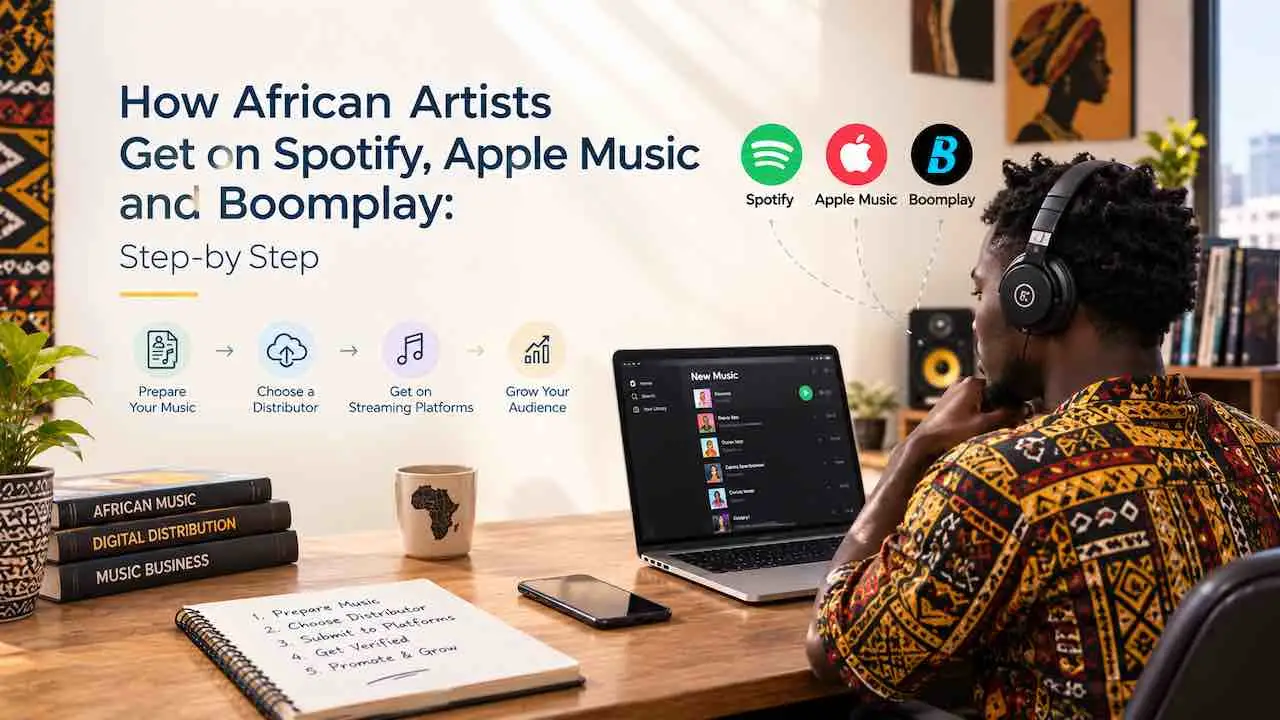
African artists get on Spotify, Apple Music, and Boomplay through a licensed digital distributor. No platform accepts direct artist uploads. You upload your music to a distributor like DistroKid, TuneCore, or Africori, select your platforms, set a release date, and the distributor delivers your files, metadata, and ISRC codes to every store simultaneously. This guide covers each step in order: choosing the right distributor for Africa, preparing files to exact platform spec, completing metadata correctly, setting your release timeline, pitching Spotify and Apple Music editorial playlists by name, claiming your Boomplay artist page, getting your music on TikTok, and actually withdrawing your money from Nigeria, South Africa, Kenya, or Ghana. Tubidy Africa tracks distributor changes, platform updates, and African DSP developments so artists always have current information.
Before You Start: The African Payment Reality
Most guides skip the practical obstacles African artists hit before they even choose a distributor. Nigerian, Ghanaian, and Kenyan debit cards regularly fail on international payment pages. Many Nigerian banks block Naira card transactions for international subscriptions. Ghanaian cards face limited cross-border support. South African cards carry high foreign transaction fees. Kenyan cards frequently fail international payment gateways.
These are the payment methods that actually work for African artists paying distributor subscriptions in 2026:
- Virtual dollar card (Nigeria and Ghana): EverTry, Grey.co, and Chipper Cash issue virtual USD Visa or Mastercard funded from your Naira or Cedi balance. Fund with a local bank transfer, spend internationally. This is the most reliable solution for paying DistroKid, TuneCore, and CD Baby subscriptions from Nigeria or Ghana
- Grey.co dollar account (Nigeria, Ghana, Kenya): Creates a real US bank account number and routing number in your name. Fund in local currency, pay subscription in USD with no card decline
- Payoneer prepaid Mastercard (all African countries): TuneCore pays out via Payoneer, which issues a prepaid card you can use to pay other services. This creates a loop where your streaming income funds your distribution cost
- Wise virtual card (South Africa, Kenya): Load Rand or Shilling, get a virtual card that processes international payments with transparent FX fees
- PayPal balance (where available): DistroKid pays out via PayPal; if you receive royalties to PayPal, you can fund a PayPal balance and use it to renew your subscription
Solve the payment method before choosing a distributor. Losing access to your DistroKid account because your card expired and you cannot renew takes your music offline across all platforms simultaneously.
Step 1: Choose the Right Distributor
Your distributor determines which platforms carry your music, how fast it gets there, what percentage you keep, and which withdrawal methods work in your country. In 2026, the market splits into global aggregators that accept African signups and Africa-focused distributors with direct DSP relationships on the continent. Most African artists starting out need the global reach of DistroKid or TuneCore paired with the African DSP depth of a platform like Africori or Freeme Digital.
Full Distributor Comparison for African Artists in 2026
| Distributor | Annual Cost | Royalty Keep | Boomplay | TikTok | Withdrawal for Africa |
|---|---|---|---|---|---|
| DistroKid | $24.99/year | 100% | Yes | Yes (opt-in at upload) | PayPal, ACH, wire transfer; NO Payoneer; location-dependent |
| TuneCore | $24.99/year (Rising Artist) | 100% streaming; keeps 20% social platforms | Yes | Yes | Payoneer (prepaid card, bank, PayPal); quarterly payments |
| CD Baby | $9.99/single; $14.99/album (one-time) | 91% | Yes | Yes | PayPal, ACH, wire; no annual renewal needed |
| ONErpm / OFFstep | Free (OFFstep basic: $12/year) | 85% (15% commission) | Yes | Yes | PayPal; monthly payments |
| UnitedMasters | $19.99/year (DEBUT+) | 100% | Yes | Yes | PayPal, ACH; real-time royalties for qualifying US-market tracks |
| TikTok SoundOn | Free | 100% first year; 80% after | No (TikTok only + 90 DSPs) | Direct TikTok upload | Available Nigeria, South Africa, Egypt; PayPal withdrawal |
| Africori | Application only | Negotiated | Direct partnership | Yes | Negotiated; Warner Music Group subsidiary |
| Freeme Digital | Application only | Negotiated | Direct partnership | Yes | Africa-specific payment routes |
| InterSpace Distribution | Application only | Negotiated | Yes; plus Mdundo, Anghami, Joox | Yes | Africa-specific |
Which Distributor to Choose Based on Where You Are
| Your Situation | Best Starting Choice | Why |
|---|---|---|
| First release, Nigeria or Ghana, no budget | TikTok SoundOn or ONErpm | Free entry; SoundOn is now live in Nigeria; no card needed for SoundOn signup |
| Releasing 3+ songs per year, any African country | DistroKid ($24.99/year) | Unlimited releases, 100% royalties, 24-72 hour Spotify delivery, Boomplay included |
| Publishing royalties are a priority | TuneCore | Bundles YouTube Content ID and connects to Payoneer for African payout |
| Releasing rarely; want permanent distribution without annual fees | CD Baby | One-time fee keeps music live permanently; no renewal risk |
| Established artist with catalog, Nigeria or South Africa | Apply to Africori or Freeme Digital | Direct Boomplay editorial relationship; publishing admin; Warner Music Group distribution network |
Step 2: Prepare Your Audio Files
Wrong file formats get your upload rejected before your music reaches any platform. Every distributor has technical requirements your audio must meet at submission. Fix these before opening any distributor dashboard.
Audio Requirements
| Requirement | Correct Spec | Common African Artist Mistake |
|---|---|---|
| File format | WAV (required by most); FLAC accepted by some | Uploading MP3 exported from a phone recording app |
| Bit depth | 16-bit or 24-bit (24-bit preferred) | Exporting at 32-bit float, which most distributors reject |
| Sample rate | 44.1 kHz minimum | Exporting at 22 kHz from voice memo or low-quality DAW setting |
| Loudness (mastering) | Between -14 and -9 LUFS for streaming normalisation | Over-compressed masters that sound crushed after Spotify turns down the volume |
| Silence at start | Maximum 2 seconds of silence before the song begins | Long intro silence that triggers early skips and drops completion rate |
Artwork Requirements
| Requirement | Correct Spec | Instant Rejection Trigger |
|---|---|---|
| Minimum size | 3000 x 3000 pixels | Any image below 3000 x 3000; rejected by all major distributors automatically |
| File format | JPG or PNG; JPG preferred | GIF, WebP, TIFF, or any animated format |
| Colour mode | RGB | CMYK (print colour mode that displays incorrectly on screens) |
| Prohibited content | No watermarks, DSP logos, URLs, QR codes, or third-party brand logos | Spotify or Apple Music logos on cover art; automatic rejection across both platforms |
| Text on artwork | Must match the exact track title in metadata | Artwork showing “Bad Vibe” when metadata says “Bad Vibes” |
Step 3: Complete Your Metadata Before Uploading
Metadata is the information every DSP uses to pay the right person, route the song to the right audience, and place it in front of the right editorial team. Missing or incorrect metadata creates royalty gaps, duplicate artist profiles, and editorial rejections that cannot be fixed after release without pulling the song down and re-uploading it.
Every Metadata Field That Matters
| Field | What to Enter | What Goes Wrong If You Skip It |
|---|---|---|
| Artist name | Exact stage name; same spelling across every platform | Duplicate artist profiles split your follower count and stream history permanently |
| Track title | Exact title with correct capitalisation; no extra punctuation | Mismatch between artwork text and metadata causes rejection or creates two different song entries |
| Genre and sub-genre | Most specific genre available: Afrobeats, Amapiano, Highlife, Afropop, Bongo Flava, Afrofusion, Kizomba, Alté | Wrong genre tag routes Spotify pitch to wrong editorial desk; an Amapiano track tagged “Electronic” reaches a team that does not curate African music |
| ISRC code | Auto-assigned by distributor; one per recording, one per alternate version | Missing ISRC means streams generate royalties attributed to no account; money enters the black box |
| UPC or EAN code | Auto-assigned by distributor; one per album, EP, or single package | Release cannot be identified as a product in digital retail systems |
| Songwriter credits | Full legal names of all co-writers; IPI numbers if PRO-registered | Publishing royalties cannot be paid to uncredited writers; performance royalties go uncollected |
| Producer credits | Producer name and role | Producers cannot claim neighbouring rights from international radio and TV broadcast |
| Language | Primary language of the lyrics | Wrong language routing sends the track to editorial teams in the wrong region |
| Explicit flag | Mark explicitly if the song contains strong language | Incorrectly unflagged content gets removed from family playlists or blocked in specific territories |
African-Language Metadata: Yoruba, Swahili, Zulu, Twi, and Hausa
Songs written in Yoruba, Swahili, Zulu, Twi, Hausa, Igbo, or any other African language need specific metadata handling that most guides skip entirely. Here is what to do for each field:
- Track title in African language: Enter the title exactly as it appears in the native language using Latin characters where the language does not use a different script. For Yoruba, include tone marks if your distributor field supports Unicode. If not, use the simplified Latin romanisation consistently across every platform
- Language code: Select the correct ISO 639 language code. Yoruba is “yo”, Swahili is “sw”, Zulu is “zu”, Twi is “ak”, Hausa is “ha”, Igbo is “ig”. Do not default to “English” for a song sung entirely in Yoruba because the hook or ad-libs include one English line
- Songwriter name transliteration: Legal name fields should use the name on your government ID. Stage names in local scripts should be romanised consistently in all distributor and PRO registration fields so royalty matching works correctly
- Artist bio for editorial: Write a short English-language context paragraph alongside your African-language pitch. Spotify’s editorial team in Lagos reads English. Explaining the cultural meaning of a Yoruba phrase or a Swahili lyric gives the curator the context they need to place the song in the right editorial collection
Step 4: Set Your Release Date Correctly
Upload timing is where most African artists permanently lose their editorial playlist window before the song is even live. Uploading 3 days before your intended release date means Spotify’s editorial team never sees your pitch. Their review cycle runs 4 to 6 weeks in advance.
The Correct Release Timeline Working Backwards from Release Day
| When | Action | Why This Date Matters |
|---|---|---|
| 6 weeks before release | Upload to distributor; submit Spotify for Artists editorial pitch immediately after upload confirms | Gives Spotify’s Sub-Saharan Africa editorial team (based in Lagos and Johannesburg) maximum review time; Chartlex data shows Afrobeats releases in December to January peak period need early submission |
| 4 weeks before release | Absolute minimum for Spotify editorial pitch; verify Apple Music delivery is confirmed | Spotify’s stated minimum for editorial consideration is 7 days; their actual recommendation is 28 days (4 weeks); anything less goes to deprioritised queue |
| 3 weeks before release | Confirm music is live in distributor system; check all ISRC codes are assigned; start Boomplay artist page claim if music is already confirmed delivered | Spotify algorithm needs 21 days to audio-analyse the track and route it to the correct genre recommendation engine |
| 2 weeks before release | Start pre-save campaign; pitch independent African playlist curators; submit to Apple Music for Artists pitch tool | Pre-saves trigger Release Radar notifications to existing followers on release day; Release Radar runs automatically only if music was uploaded with enough lead time |
| 1 week before release | Final check: all platforms confirmed live, pre-save link working, social content ready | DistroKid’s own minimum is 1 to 2 days but recommends several weeks; at 7 days you have lost editorial consideration permanently for that track |
| Release day | Push pre-save converts to stream; post across TikTok, Instagram Reels, and YouTube Shorts simultaneously | First 24 to 72 hours of streaming velocity signals relevance to Spotify, Apple, and Boomplay algorithms; high save rate in this window triggers automatic playlist insertion |
Afrobeats listeners grew 22% globally in 2025, with December to January identified as the highest-engagement period for the genre. Afrobeats tracks releasing in that window with a 6-week lead time submission compete during peak algorithmic discovery. Artists releasing in October with a 6-week runway hit that window correctly. Releasing in December with a 3-day upload is the most common missed opportunity among Nigerian independent artists. The full picture of African music growth across platforms and genres shows exactly why timing strategy matters at this scale.
Step 5: Upload and Select Your Platforms
Inside your distributor dashboard, platform selection is where most African artists leave money on the table by defaulting to Spotify and Apple Music only. The correct African platform selection for 2026 includes these stores at minimum:
- Spotify: Global reach; primary discovery engine for diaspora listeners in UK, USA, Europe
- Apple Music: Highest per-stream payout at $0.01; growing African subscriber base; strong diaspora income
- Boomplay: 90 million+ African users; dominant in Nigeria, Ghana, Kenya, Tanzania; non-negotiable for any artist targeting home market
- Audiomack: 20 million+ monthly active users; top discovery platform in Nigeria, Ghana, Kenya; DJ repost culture drives viral discovery
- YouTube Music: Delivers to both YouTube Music streaming and YouTube Content ID for user-generated video income
- Deezer: Dominant in francophone Africa; Ivory Coast, Senegal, DRC, Cameroon; essential for French-speaking African markets. Different African music genres have distinct stronghold platforms across regions
- TikTok: Select as a separate store during upload (not the same as SoundOn); your song becomes a licensed TikTok sound available in the TikTok sound library across all countries
- Amazon Music: Growing in South Africa and Kenya; useful for diaspora listeners on Amazon Echo devices
- Mdundo: 39 million monthly active users; dominant in Tanzania and East Africa; delivers royalties via mobile money
- Anghami: Dominant in North Africa and Arab world; relevant for artists in Egypt, Morocco, Tunisia
Step 6: Get Your Music on TikTok as a Licensed Sound
TikTok and Spotify require separate delivery steps. Most African artists do not know this. Selecting “TikTok” as a store in DistroKid makes your song available as a licensed sound in TikTok’s sound library globally. That is different from posting a video on TikTok yourself. When your song is a licensed TikTok sound, every creator worldwide who uses it in their video generates a licensing royalty back to you.
Option 1: Deliver to TikTok Through Your Existing Distributor
In DistroKid, tick TikTok in the “Services” section of the upload form. For previously uploaded releases, go to the album page in your DistroKid dashboard, click “Add to more stores,” select TikTok, and click add. Releases appear in the TikTok sound library within 1 to 3 weeks of submission. Your song becomes searchable by name in TikTok’s sound panel. Every video that uses it credits your artist name and links to your profile. TuneCore and CD Baby both handle TikTok delivery through the same platform-selection process during upload.
Option 2: TikTok SoundOn (Direct Upload, Now Available in Nigeria, South Africa, and Egypt)
SoundOn is TikTok’s own distribution platform. It launched in Nigeria, South Africa, and Egypt in 2024, making it the first option where African artists can upload directly to TikTok without needing a separate distributor. SoundOn distributes to TikTok first and to 90+ other streaming services including Spotify, Apple Music, and Boomplay. It pays 100% royalties in the first year, dropping to 80% after year one. SoundOn is the only distributor where an African artist can sign up without needing an international card, because the SoundOn registration process does not require upfront payment for the basic tier.
TikTok Sound Metadata Rules
When your song is a licensed TikTok sound, creators see the track title and artist name in the sound library. Keep your TikTok-delivered track title short, under 40 characters, because longer titles get cut off in the sound panel display. Use your exact artist name from your other DSP profiles to build a consistent searchable identity across all platforms. For Afrobeats and Amapiano tracks, a short hook from the chorus as a secondary title note (entered in the “description” field, not the title) helps TikTok’s recommendation engine place the sound in relevant creator feeds.
Step 7: Get on Spotify Correctly
Getting on Spotify has 3 phases: delivery through your distributor, claiming your profile, and submitting the editorial pitch. Phase 3 is the one that determines whether your music reaches new listeners beyond your existing followers.
Phase 1: Delivery
DistroKid delivers to Spotify in 24 to 72 hours. TuneCore averages 1 to 5 business days. After delivery, Spotify sends your distributor a Spotify URI for the release, which you use in Phase 2. Do not wait for this URI before claiming your profile. Go to artists.spotify.com and claim your artist profile as soon as your first release is visible on Spotify by searching your artist name. The verification process takes 3 to 7 business days.
Phase 2: Claim and Complete Your Spotify for Artists Profile
A complete Spotify for Artists profile signals to editorial curators that an active artist stands behind this music. An empty bio and a blank profile photo gets rejected at the editorial review stage before a curator even listens to the song. Complete every field:
- Artist bio in English (200 to 400 words explaining who you are, your sound, your cultural background, and your audience); write a shorter bio in your home language as a secondary bio if the field allows
- Profile photo at minimum 750 x 750 pixels; professional or high-quality phone photo, not a screenshot
- Artist pick (pin your latest release or most representative song at the top of your profile)
- Social links for Instagram, TikTok, and YouTube connected
- Concert dates if you have any upcoming shows
Phase 3: The Spotify Editorial Pitch for African Genres
The pitch tool appears inside Spotify for Artists under your unreleased song. You can only pitch one song per release, and only before the release date. Once the song goes live, the editorial window closes permanently for that track.
Spotify’s Sub-Saharan Africa editorial team is based in Lagos and Johannesburg. The senior editor for the region is Benewaah Boateng, who oversees African Heat, Hot Hits Naija, Gbedu, Fresh Finds Africa, and Global Afrobeats. These editors respond to African cultural framing, not generic music industry language. A pitch that says “this Afrobeats song is inspired by Lagos street culture and written in Yoruba with English hook” gives the editor everything they need. A pitch that says “this is a high-energy song with catchy melodies” tells them nothing.
Spotify’s Official African Editorial Playlists to Target in Your Pitch
| Playlist Name | Genre Focus | Audience | Discovery Tier |
|---|---|---|---|
| African Heat | Pan-African dance, Afrobeats, Amapiano | Global Afrobeats listeners; Gen Z internationally | Mid to established artists; high monthly plays |
| Hot Hits Naija | Nigerian Afrobeats, Afropop, street sounds | Nigerian and diaspora; 20 million+ global plays | Chart-level Nigerian artists |
| Gbedu | Nigerian Afrobeats; party and club sounds | Nigerian youth; diaspora in UK and USA | Rising to established Nigerian artists |
| Street Energy | Nigerian street Afrobeats; raw Lagos sound | Nigerian youth; street culture listeners | Emerging to rising Nigerian artists |
| Fresh Finds Africa | Emerging African artists; Afropop, Afro R&B, Afro soul, alté | Nigeria (44% of plays), Kenya (20%); discovery-oriented listeners aged 18 to 29 | First editorial break for emerging artists; Zaylevelten gained 2,017% monthly listener growth after placement |
| Global Afrobeats | Afrobeats crossover; international appeal | Global non-African listeners discovering the genre | Commercially polished Afrobeats with crossover appeal |
| Amapiano Grooves | South African Amapiano; log drum, jazz piano | South Africa primary; growing international audience; 500,000+ playlist followers | South African Amapiano artists; Kabza De Small style production |
| Afro Adura | Afrobeats gospel, spiritual, conscious sounds | Faith-driven Afrobeats listeners; 51% monthly plays growth year on year | Gospel and conscious Afrobeats artists |
| Alté Cruise | Nigerian alté; experimental, art-driven Afropop | Lagos alternative scene; diaspora listeners aged 20 to 30 | Alternative and experimental Nigerian artists |
| New Music Friday Africa | All African genres; new releases week of launch | Pan-African listeners; discovery-focused | Any African artist with a strong new release; pitched via the standard pitch form |
What to Write in the Pitch Form
The pitch form has 5 fields. Fill every one specifically, not generically.
- Genre: Use the exact micro-genre, Afrobeats, Amapiano, Afropop, Highlife, Alté, Bongo Flava, Kizomba, Afrofusion. Never use “Pop” or “R&B” for an African genre song
- Instrumentation: List every element present: talking drum, shekere, log drum, guitar, 808, brass, afrobeats percussion, Afrobeat horns, jazz piano, bass guitar. Curators build playlists by sonic texture
- Mood: Choose from Spotify’s mood options (party, chill, workout, devotional, road trip); pick the one that matches how your target listener will use this song
- Cultural context: Write 2 to 3 sentences explaining the song’s cultural meaning, the language it is sung in, the Nigerian or South African cultural reference points, and the audience it is for. “This song is in Yoruba with a Pidgin hook, inspired by Lagos nightlife culture, targeting Nigerian students and UK diaspora aged 18 to 28” is exactly the framing Spotify’s Lagos editorial team needs
- Promotion plans: List every real marketing activity happening around release: music video release date, radio stations pitched, PR firm engaged, live shows booked, TikTok campaign planned, diaspora events
Step 8: Get on Apple Music Correctly
Apple Music pays $0.01 per stream, the highest per-stream rate of any major platform. Delivery happens through the same distributor you used for Spotify. Apple Music does not have a separate artist upload process. After delivery, claim your Apple Music for Artists account at artists.apple.com using the same email as your distributor account to verify identity.
What Apple Music for Artists Gives You
- Country-by-country play data showing exactly which African and international territories drive your Apple Music income
- Shazam recognition data showing where and when listeners first identify your song, a unique signal no other platform provides
- Artist profile customisation including bio, profile image, and featured playlists visible to listeners browsing your artist page
- Editorial playlist pitch access; Apple Music Africa editorial team oversees playlists including Best of the Week, New Music Daily Africa, African Hits, and genre-specific collections for Afrobeats and Amapiano
Apple Music Pre-Add Setup
DistroKid includes automatic Apple Music pre-add. Fans who click your pre-add link get a notification and automatic library add on release day. Run your Apple Music pre-add campaign at the same time as your Spotify pre-save campaign. Both generate first-day library adds that boost your release in the algorithmic new releases feed of existing followers. Pre-adds are one of the few free tools that directly lift first-day stream numbers without any paid promotion.
Apple Music Country Availability Across Africa
| Country | Apple Music Available | Dominant Local Alternative |
|---|---|---|
| Nigeria | Yes | Boomplay, Audiomack |
| South Africa | Yes | Boomplay, Deezer |
| Kenya | Yes | Boomplay, Mdundo |
| Ghana | Yes | Boomplay, Audiomack |
| Tanzania | Yes | Mdundo, Boomplay |
| Côte d’Ivoire | Yes | Deezer (dominant), Boomplay |
| Senegal | Yes | Deezer (dominant) |
| DRC | Yes | Deezer, Boomplay |
| Ethiopia | Limited availability | YouTube dominant; Boomplay growing |
| Egypt | Yes | Anghami (dominant), Spotify |
Step 9: Get on Boomplay Correctly
Boomplay has no self-upload artist portal. Every track reaches Boomplay exclusively through an approved distributor. Once your distributor delivers to Boomplay and your music goes live, three things happen: the song appears in Boomplay’s catalog, it becomes eligible for Boomplay editorial playlists, and you can claim your Boomplay artist account.
How to Claim Your Boomplay Artist Account
- Go to boomplay.com and search your artist name
- Open your artist profile page and click “Claim Artist Page”
- Submit your verification request with distributor confirmation email, government ID, and social media links proving you are the artist
- Boomplay artist page claims typically process within 5 to 10 business days
- After claiming, you gain access to the Boomplay Artist Dashboard showing stream counts, listener geography, and follower data
Boomplay Editorial Playlists for African Artists
Boomplay’s editorial team manages genre-specific playlists covering Afrobeats, Amapiano, Bongo Flava, Highlife, Kizomba, and Afropop, plus weekly update playlists like Boomplay Weekly, Trending Nigeria, Top South Africa, and Top Kenya. Unlike Spotify, Boomplay does not have a self-service editorial pitch tool. Placement consideration comes through:
- Direct contact with Boomplay’s artist partnership team via the contact form on boomplay.com after your music is live
- Working with an Africa-specialist distributor like Africori or Freeme Digital, which has direct editorial relationships with Boomplay’s regional teams
- Organic algorithmic placement driven by streams, shares, and adds from listeners on the platform in the first 72 hours after release
The Boomplay Artist Program
Boomplay runs an artist development program for musicians with growing audiences on the platform. The program provides verified artist badges, editorial consideration priority, promotional campaign support, and direct access to the Boomplay Africa team for playlist pitching. Apply through the Boomplay artist portal after your artist page is claimed and you have at least 3 releases live on the platform. Artists on Africa-specialist distributors with direct Boomplay relationships receive program consideration faster than artists on global aggregators. Read how Boomplay compares to Audiomack and Spotify for African artist payouts to understand where each platform sits in your income stack.
Step 10: Get Paid Correctly as an African Artist
Getting your music live is step one. Getting your money out is where African artists hit the second wall. Each distributor has different payout methods, minimum withdrawal thresholds, tax form requirements, and processing timelines. Know these before your first royalty statement arrives. For a deeper understanding of the full income picture beyond just streaming payouts, read how African musicians make money across all 9 revenue streams.
Withdrawal Methods by Distributor for African Artists
| Distributor | Payout Methods | Minimum Withdrawal | Payment Schedule | African Artist Notes |
|---|---|---|---|---|
| DistroKid | PayPal, ACH, wire transfer, eCheck, paper check (via Tipalti); NO Payoneer | $6 | On-demand; process 1 to 14 days after request | PayPal is fastest (often 48 hours); available methods depend on your country; not all options available in all African territories |
| TuneCore | Payoneer (prepaid card, bank deposit, PayPal) | $0 (no minimum stated) | Quarterly (Q1 earnings arrive mid-May; 45-day delay after quarter closes) | Payoneer available in Nigeria, Ghana, Kenya, South Africa; set up Payoneer account before you need to withdraw |
| CD Baby | PayPal, ACH, wire transfer, paper check | $10 | Monthly (approximately 45 to 60 days after streaming month closes) | PayPal works widely across Africa; wire transfer available for larger withdrawals |
| ONErpm | PayPal, wire transfer | $25 | Monthly | PayPal accessible across Africa; wire transfer available with higher minimum |
| SoundOn | PayPal | TikTok-specific; varies | Monthly | Straightforward for Nigeria, South Africa, Egypt; PayPal coverage needed |
The Cheapest Way to Withdraw from DistroKid as an African Artist
DistroKid does not offer Payoneer. For African artists who cannot receive ACH (a US bank account required), the most affordable path is: set DistroKid to pay to PayPal, then transfer from PayPal to a Wise multi-currency account, then convert to local currency. Wise charges transparent, low FX fees typically between 0.5% and 1.5%, versus PayPal’s direct-to-local-bank withdrawal which can charge 3% to 5% in FX spread plus fixed fees. For South African artists, Wise Rand accounts work directly. For Nigerian artists, Wise does not currently offer Naira accounts, so a Grey.co USD account receiving the Wise USD transfer is the bridge to Nigerian bank accounts.
Tax Forms for African Artists
Every distributor operating through the US requires foreign artists to submit a tax form declaring their non-US status. Without completing this form, distributors withhold 30% of your royalties automatically.
- W-8BEN form: For individual African artists; declares you are a non-US person; reduces or eliminates US withholding tax depending on whether your country has a tax treaty with the USA
- Nigeria: Nigeria does not have a US tax treaty, so the standard 30% withholding rate may still apply even with a completed W-8BEN. Complete the form anyway to confirm your non-US status
- South Africa: South Africa has a tax treaty with the US that reduces withholding to a lower rate for qualifying royalties; claim this by completing the W-8BEN and referencing the treaty
- Kenya: No US tax treaty; complete W-8BEN to establish non-US status; standard withholding may apply
- Complete this form as early as possible; withheld royalties are not automatically refunded once deducted by the distributor. The full breakdown of what you own and how royalties flow is covered in the copyright and royalties guide for African artists
The 8 Mistakes That Kill African Artists’ Streaming Launches
- Uploading less than 3 weeks before release: Spotify’s editorial window closes permanently; Release Radar does not generate; algorithmic processing is incomplete
- Using an inconsistent artist name across platforms: “Kofi Music” on Boomplay and “Kofi_Music” on Spotify creates two separate profiles that split every follower and stream permanently
- Not selecting TikTok as a delivery store: Your song is not a licensed TikTok sound; creators who use it in videos generate ad revenue for TikTok but nothing for you
- Wrong genre tag in the Spotify pitch: An Amapiano track tagged “Electronic” reaches an editor in Amsterdam who does not curate African music
- Not claiming Boomplay artist page after delivery: Your profile stays unclaimed, your streams untracked, and your editorial pitch option unavailable
- Submitting no tax form to the distributor: 30% of every royalty payment is withheld automatically until the W-8BEN is filed
- Skipping African-language metadata details: A Yoruba song tagged in English, with no language code and no cultural context in the pitch, reaches the wrong editorial team and the wrong algorithmic audience
- Buying stream botting services or guaranteed playlist placements: Spotify’s fraud detection flags the account permanently; all subsequent editorial pitches auto-reject; algorithmic reach collapses across every release that follows
FAQs: How African Artists Get on Spotify, Apple Music and Boomplay
No. Both platforms require delivery through a licensed distributor. Use DistroKid, TuneCore, CD Baby, Africori, or TikTok SoundOn. The distributor delivers your files, metadata, and ISRC codes to every platform simultaneously and collects royalties on your behalf.
TikTok SoundOn requires no upfront payment and is available in Nigeria, South Africa, and Egypt. For paid distributors, use a virtual dollar card from EverTry or Grey.co to pay DistroKid or TuneCore subscriptions without Nigerian or Ghanaian card declines.
Only through an approved distributor. Boomplay has no direct artist upload option. After your distributor delivers to Boomplay and your music goes live, claim your Boomplay artist page at boomplay.com to access analytics and editorial consideration. Africa-specialist distributors like Africori have direct Boomplay editorial relationships that global aggregators lack.
Pitch through Spotify for Artists at least 4 weeks before release, ideally 6. Target African Heat, Hot Hits Naija, Gbedu, Fresh Finds Africa, Amapiano Grooves, or Alté Cruise based on your genre. Use micro-genre tags and include specific cultural context about your sound, language, and target audience in the pitch form.
DistroKid pays on demand with a $6 minimum; processing takes 1 to 14 days after request. TuneCore pays quarterly via Payoneer with a 45-day delay after each quarter closes. Streaming platforms report earnings 2 to 3 months after streams occur, so expect your first royalty statement roughly 3 months after your release goes live.