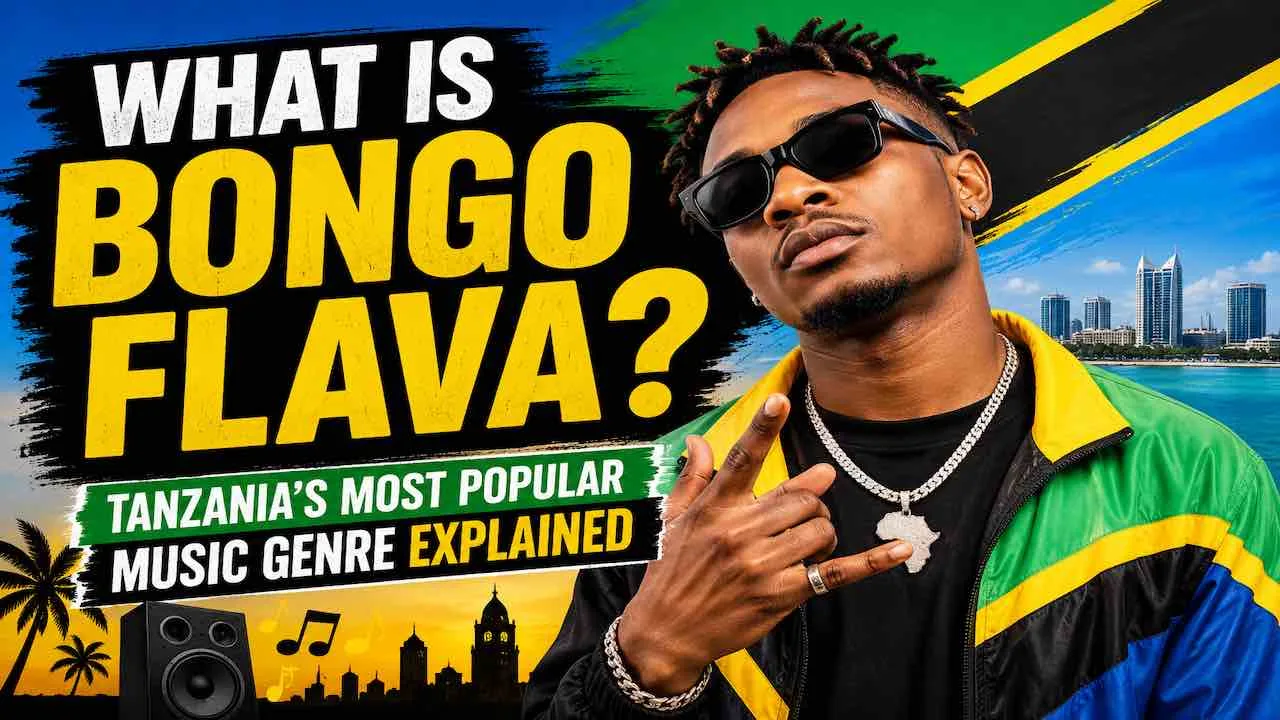
Bongo Flava is Tanzania’s signature music genre, a sound built in Dar es Salaam during the early 1990s by mixing American hip hop with native styles such as taarab and dansi. Swahili lyrics, melodic hooks, and touches of dancehall and Afrobeats give Bongo Flava its identity across East Africa and the wider African diaspora today.
Bongo Flava Meaning: Where the Name Comes From
The name Bongo Flava comes from two simple words with a clever local twist. “Bongo” is Swahili slang for Dar es Salaam, drawn from “ubongo,” the Swahili word for brain, since surviving city life there takes sharp thinking. “Flava” is a stylized spelling of flavor, a nod to American hip hop slang that early Tanzanian rappers borrowed and made their own. Put together, the name signals music with brains and a distinct local taste, made by and for the people of Dar es Salaam and, by extension, all of Tanzania.
Bongo Flava Origin: How a Genre Grew Out of Dar es Salaam
Bongo Flava started in the early 1990s when middle class youth in Dar es Salaam’s Kinondoni District began rapping over American hip hop instrumentals in Swahili instead of English. A rapper named Saleh J recorded an early breakthrough track over the instrumental of Vanilla Ice’s “Ice Ice Baby” around 1991, and the Swahili lyrics made him a local star almost overnight. That single recording proved Tanzanian audiences wanted rap in their own language, not copies of American songs.
Local radio gave the new sound a home soon after. Hosts such as Taji Liundi, also known as Master T, and Mike Mhagama played tracks from fledgling local artists on shows like the DJ Show, turning a street level movement into a genre with real reach. Early acts including Mr II (also called II Proud), Gangwe Mobb, Dola Soul, and Professor Jay built on that foundation, writing lyrics about poverty, politics, and daily struggle in a city that was growing fast and changing faster.
Bongo Flava Sound: The Musical Styles That Shape It
Bongo Flava sound comes from layering several distinct musical traditions on top of each other rather than copying any single style. Hip hop supplies the rhythmic vocal delivery and beat driven structure, while taarab and dansi (muziki wa dansi) bring melodic, horn led patterns rooted in coastal Tanzanian and Swahili culture. Later additions from R&B, dancehall, reggae, and Afrobeats rounded out a sound that keeps evolving with every new generation of producers.
| Influence | What It Added to Bongo Flava |
|---|---|
| American hip hop | Rhythmic rap delivery, sampled beats, urban storytelling |
| Taarab | Arabic inflected melody and poetic, romantic lyricism |
| Dansi (muziki wa dansi) | Dance band rhythms, horn sections, live instrumentation |
| R&B | Melodic hooks and smooth, romantic vocal lines |
| Dancehall and reggae | Bounce, energy, and call and response phrasing |
| Afrobeats | Modern synths, log drum bass, continent wide crossover appeal |
Bongo Piano: The Newest Branch of Bongo Flava
Bongo Piano (often written Bongopiano) is a recent fusion of Bongo Flava with South African amapiano, blending Bongo Flava’s melodic, Swahili driven songwriting with amapiano’s log drum bass and lounge groove. Artists such as Diamond Platnumz, Alikiba, Marioo, Harmonize, Nandy, Jux, Mbosso, and Zuchu, along with newer names like Natasha and Pride Boy 4Real, have all released Bongo Piano tracks, pushing the wider Bongo Flava sound into fresh territory while keeping Swahili lyrics front and center.
Saxophone and Live Instrumentation Return to Bongo Flava
Live saxophone has made a noticeable comeback inside otherwise digital, synth heavy Bongo Flava production. Session musicians such as G Saxx, a regular player in Diamond Platnumz’s WCB band, and veteran saxophonist Saleh “King Maluu” add brass lines to hit records, connecting today’s electronic sound back to the dance band horn sections that shaped Tanzanian music decades ago.
Bongo Flava Artists: From Pioneers to Today’s Biggest Stars
Bongo Flava artists span three clear generations, each one pushing the genre further outside Tanzania’s borders. The pioneers proved Swahili rap could work commercially, the 2000s generation turned it into a regional sound, and the current generation has carried it onto global streaming charts.
| Era | Key Artists | Known For |
|---|---|---|
| Pioneer era (early to mid 1990s) | Saleh J, Mr II, Gangwe Mobb, Dola Soul | First Swahili rap hits, underground rap battles |
| Breakthrough era (2000s) | Professor Jay, Ray C, Ali Kiba | Chart hits like “Cinderella,” first major international features |
| Global era (present) | Diamond Platnumz, Harmonize, Zuchu, Mbosso, Marioo, Rayvanny, Jay Melody, Nandy | Pan African collaborations, streaming charts, Bongo Piano |
Diamond Platnumz remains the genre’s biggest name, having built the WCB Wasafi label into one of the most influential music operations on the continent since his 2010 debut single “Kamwambie.” His collaborations with artists such as Davido, Rema, Ciara, and Koffi Olomide helped carry Bongo Flava into Nigerian, Ghanaian, and South African markets that had barely heard the genre before. Harmonize, Zuchu, Mbosso, Rayvanny, and Marioo now sit alongside him as the genre’s biggest present day draws, regularly trading collaborations and friendly chart rivalries that keep Bongo Flava in heavy rotation across East Africa.
Bongo Flava Themes and Language: What the Lyrics Are About
Bongo Flava lyrics center on everyday Tanzanian life, told almost always in Swahili with English phrases mixed in for rhythm and international reach. Love and relationships dominate today’s biggest hits, but the genre’s early songs leaned heavily on social commentary, addressing poverty, corruption, and the pressure of city life in Dar es Salaam. That mix of romance, cultural pride, and social observation is a big reason Bongo Flava resonates with listeners far beyond Tanzania, including Swahili speaking communities across Kenya, Uganda, and the wider diaspora.
Bongo Flava’s Reach Beyond Tanzania
Bongo Flava now travels well past Dar es Salaam, with strong followings in Kenya, Uganda, Nigeria, Ghana, and South Africa. Streaming platforms such as Spotify and Boomplay, plus constant TikTok activity, push new Bongo Flava singles to listeners who may never set foot in Tanzania. Live festivals such as Fiesta, organized by Clouds Media Group, and Sauti za Busara in Zanzibar keep building the genre’s audience inside East Africa as well.
Two closely related genres grew up alongside Bongo Flava and share much of its DNA. Genge, from Kenya, and Kapuka follow a similar formula of local language rap layered over hip hop and dancehall rhythms, proof that Bongo Flava’s blueprint reshaped East African pop music far beyond Tanzania’s own borders.
Bongo Flava Industry Challenges: Piracy and Royalties
Music piracy remains one of the biggest problems facing Bongo Flava artists, limiting how much money even chart topping musicians earn from recorded music. Weak enforcement of Tanzania’s Copyright Act and a Tax Stamp system meant to track licensed recordings have not fully solved the problem, so most artists still rely on live shows, brand endorsements, and business ventures outside music for steady income. Veteran performers with decades in the industry have openly said that streaming income only reaches a small circle of well connected artists, leaving newer acts to build their careers mostly through concerts and social media reach.
Bongo Flava FAQs
Bongo Flava is rooted in Tanzanian Swahili culture and built on a base of taarab and dansi mixed with hip hop, while Afrobeats grew out of Nigerian and Ghanaian highlife, juju, and dancehall traditions. The two genres now borrow production techniques from each other, but Bongo Flava keeps its Swahili lyrics and East African rhythmic identity at the center.
Bongo Flava is sung mostly in Swahili, with artists frequently mixing in English phrases for rhythm and wider appeal. Swahili lyrics are the main reason the genre connects so strongly with listeners across Tanzania, Kenya, Uganda, and the broader East African diaspora.
Rapper Saleh J is widely credited as an early spark for Bongo Flava after his Swahili language cover of “Ice Ice Baby” around 1991 inspired other young Tanzanian artists to rap in their own language. Pioneers such as Mr II, Gangwe Mobb, and Professor Jay then built the genre into a lasting movement through the rest of the 1990s.
Bongo Piano is a fusion genre that blends Bongo Flava’s Swahili songwriting with the log drum bass and groove of South African amapiano. Stars such as Diamond Platnumz, Harmonize, Zuchu, and Mbosso have all released Bongo Piano tracks as the sound spreads across East African playlists.
Bongo Flava tracks are widely available on streaming and download platforms such as Spotify, Boomplay, and African music sites that focus on Tanzanian and East African releases. New singles from artists like Diamond Platnumz, Zuchu, and Mbosso typically reach these platforms within days of their official release.