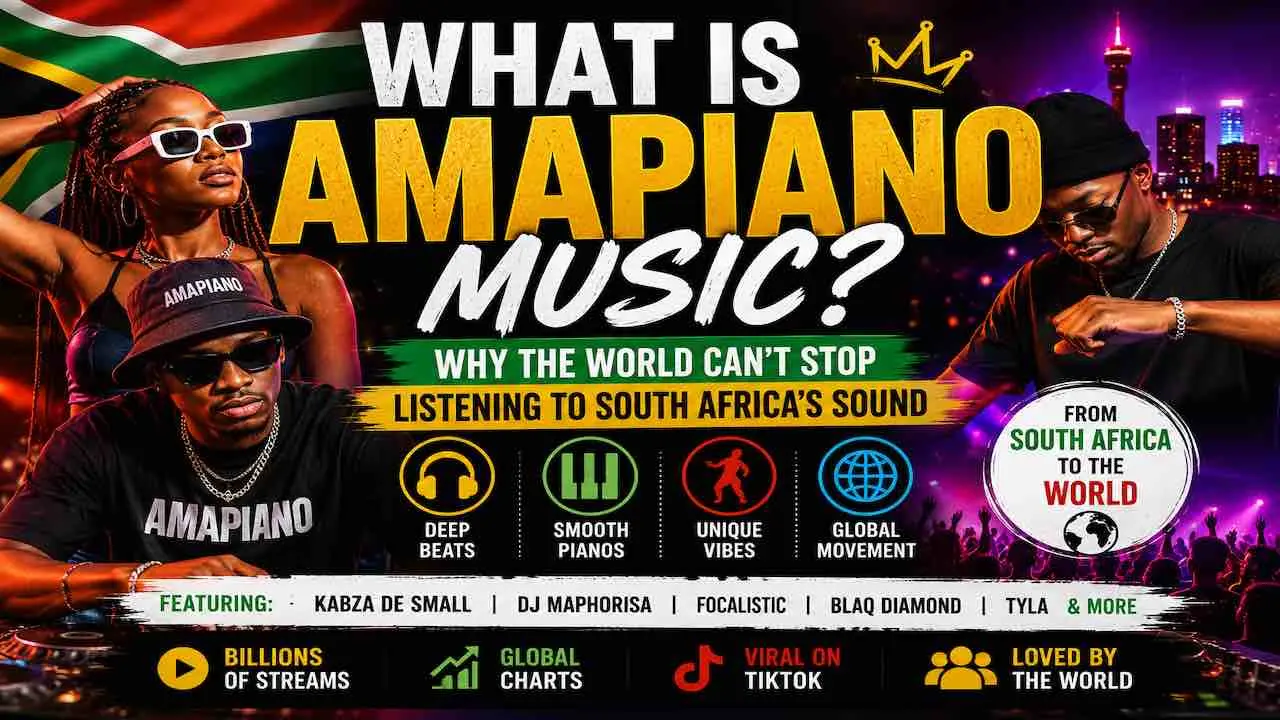
What Is Amapiano Music? Why the World Can’t Stop Listening to South Africa’s Sound

Amapiano is a South African music genre that blends deep house, jazz, kwaito, and lounge music around a synthesised log drum bassline and jazzy piano melodies. Its name means “the pianos” in isiZulu. It runs at 108 to 116 BPM. It was born in the townships of Gauteng Province, South Africa, in the mid-2010s. Today it fills festival stages in New York, Tokyo, London, and Lagos. The amapiano TikTok hashtag alone has crossed 10 billion views.

You have almost certainly heard it before you knew its name. That hollow knocking beat underneath the piano at the club. That South African track in the TikTok dance video that kept repeating on your phone. That groove at the Lagos restaurant that made everyone at the table stop talking at the same time. That was amapiano.

The Amapiano Sound: Log Drum, Piano, and a Beat That Does Not Rush

The log drum is the sound that identifies amapiano before anything else does. It is a synthesised percussion instrument that produces a deep, hollow knock anchored to the beat. Kabza De Small told Grammy.com that producer MDU aka TRP was the person who figured out the log drum sound and ran with it. He said: “Amapiano music has always been there, but he is the one who came up with the log drum sound.”

The log drum sits between the kick drum and the bassline. It creates a bouncing, hypnotic low-end pattern that locks the body into the groove before the piano even arrives. When you hear a log drum, you are listening to amapiano or something directly influenced by it. Nothing else in electronic music sounds like it.

Over that log drum comes the piano. Not the chord progressions you hear in gospel or pop. This is township jazz piano with extended chords, lazy melodic phrases that circle back, and runs that feel purposely unresolved. Calvin Fallo’s track “Yellow, Yellow” ran nearly 6 minutes of continuous piano riffing over a broken drum beat. That recording became one of amapiano’s founding reference points.

Then the vocals arrive. Artists like Sha Sha, Nkosazana Daughter, Young Stunna, Lady Du, and Daliwonga sing with a calm, unhurried delivery that matches the groove exactly. Nothing rushes. The music asks you to settle into it. That combination of insistent rhythm and relaxed vocal energy separates amapiano from every other genre sharing a dancefloor with it.

Amapiano Sound Profile at a Glance

ElementDetail
Name MeaningThe pianos (isiZulu)
OriginGauteng Province townships, South Africa. Mid-2010s.
Tempo108 to 116 BPM
Signature SoundLog drum bassline, jazzy piano chords, wide synth pads, shaker rhythms
Musical RootsDeep house, jazz, kwaito, lounge music, bacardi house, gqom
Log Drum PioneerMDU aka TRP
Genre NamingMFR Souls (Tumelo Nedondwe and Tshiamo Rantao)
Primary Production ToolFL Studio
MoodWarm, hypnotic, communal. Built for social spaces and dancefloors equally.
TikTok Reach10 billion+ views under the amapiano hashtag

Where Amapiano Started: Townships, Bluetooth, and Taxi Speakers

Amapiano did not start with a record deal. It started in the townships of Gauteng Province, specifically in areas like Soshanguve and Mamelodi in Pretoria. Young producers built the sound on affordable personal computers running FL Studio. They shared what they made over Bluetooth at house parties. Then through WhatsApp groups. Then via USB sticks that minibus taxi drivers loaded onto their van speakers. Commuters heard it every single morning.

Tubidy.africa :   Top Gyakie Albums Ghana Singer Showcase Her Vocal Talents

South African radio stations resisted. When producers tried to get amapiano playlisted, most stations said no. So the community built its own distribution channels instead. That is how a genre travels when the gatekeepers are closed: directly from creator to listener, without permission.

Before the genre had a name, producers and early fans called the sound “number.” Then MFR Souls, the duo made up of Tumelo Nedondwe and Tshiamo Rantao, gave it the name amapiano. Naming it gave the sound an identity. Producer Gaba Cannal was releasing tracks in the same period that helped cement what the genre’s sound actually was. Around the same time, bacardi house, a raw township house sound associated with heavy percussion and DIY production, fed directly into the amapiano template.

The Breakthrough Moments That Made Amapiano a Movement

De Mogul SA’s “Oe Batla Kae” became one of the first amapiano tracks to achieve commercial success. It got the artist booked for live shows and opened the commercial door for other amapiano producers to follow. Then Kabza De Small released “Umshove” featuring Leehleza, a track that put the log drum front and centre in a way earlier recordings had not. His Avenue Sounds album brought amapiano to a national mainstream audience for the first time.

After that, Semi Tee’s “Labantwana Ama Uber” featuring Kammu Dee and Miano confirmed amapiano had permanently left the underground. Y FM launched its Amapiano Hour, giving the genre a dedicated daily broadcast slot on national radio. The Scorpion Kings EP by Kabza De Small and DJ Maphorisa dropped. The Shaya documentary mapped the genre’s entire origin story for anyone who had missed the underground phase. Spotify launched the AMAPIANO GROOVES playlist. There was no going back.

The Artists Who Built Amapiano From the Streets

Kabza De Small: The King of Amapiano

Kabza De Small, born Kabelo Motha, is the most decorated amapiano artist alive. He calls himself the King of Amapiano and nobody seriously disputes it. He holds 10 South African Music Awards (SAMA), 3 AmaPiano Music Awards, and was named GQ South Africa Musician of the Year. Grammy.com confirmed he began his career as a DJ in 2009 and broke through nationally with Avenue Sounds. He told Grammy.com: “Amapiano is considered a raw, rough sound. To see people globally dancing and participating in TikTok challenges is thrilling.”

His collaboration album Isimo with Mthunzi hit 80 million streams on Spotify. He also performed at Red Bull Symphonic with a full orchestra, putting amapiano production in a classical concert setting. No amapiano artist has matched his catalogue, his award count, or his live performance range.

DJ Maphorisa: The Producer Who Opened West Africa

DJ Maphorisa, born Themba Sekowe, co-produced Drake’s global hit “One Dance” before amapiano went mainstream. He is one half of the Scorpion Kings alongside Kabza De Small. Rolling Stone confirmed his explanation of amapiano’s internal variations: “There is jazzy piano where it is just an instrumental. We have soulful amapiano with voices. And there is this one we call tech piano, like techno, with claps and snaps.”

His collaboration Sponono, which brought Wizkid and Burna Boy onto an amapiano beat, was the moment amapiano first reached a West African audience at scale through a single song. That crossover was deliberate and strategic.

Uncle Waffles: The Performance That Spread on Every Platform

Uncle Waffles became amapiano’s most internationally visible face through a single performance video that spread across every social platform simultaneously. She is a South African DJ who performs while dancing, which made her sets compelling visual content before she released any major music. That viral clip led to international festival bookings, brand deals, press coverage across Europe and North America, and Ibiza residencies. She represents the genre’s global takeover through the visual performance dimension alone.

MFR Souls, DBN Gogo, Focalistic, Vigro Deep, and Sam Deep

MFR Souls named the genre and pushed it into mainstream radio before any station wanted it. They released consistent work until the industry caught up. DBN Gogo from Durban is the genre’s leading female DJ and one of its most visible global ambassadors. Focalistic bridged amapiano and hip-hop, most powerfully on “Ke Star” featuring Davido (also released as “Champion Sound”), which brought amapiano-flavoured rap to Nigerian pop audiences through a face they already trusted.

Tubidy.africa :   Which African Female Artists Are Most Successful? Top 10 Women in Music 2026

Vigro Deep stands as one of the genre’s founding producers alongside Kabza De Small. Sam Deep has surpassed 2.1 billion streams across digital platforms, confirmed by Music In Africa, making him one of the highest-streaming amapiano producers ever. Mas Musiq, Major League DJz, DJ Shimza, Kelvin Momo, and Mr JazziQ all extended the genre into new sonic and geographic territories.

The Songs That Defined Each Phase of Amapiano’s Rise

PhaseSongArtistWhy It Mattered
FoundationYellow, YellowCalvin FalloNearly 6 minutes of piano riffing over a broken drum beat. One of the genre’s earliest defining recordings.
First Commercial HitOe Batla KaeDe Mogul SAFirst amapiano track to generate live show bookings. Opened the commercial door.
Log Drum EraUmshoveKabza De Small ft. LeehlezaPut the log drum at the centre. Established Kabza De Small as a national name.
Street AnthemLabantwana Ama UberSemi Tee ft. Kammu Dee, MianoConfirmed amapiano had permanently left the underground for good.
West Africa CrossoverSpononoKabza De Small ft. Wizkid, Burna BoyFirst major amapiano song with leading Nigerian artists. Introduced the sound to West African audiences at scale.
Rap BridgeKe Star (Champion Sound)Focalistic ft. DavidoBrought amapiano-flavoured rap to Nigeria through Davido’s existing audience.
Grammy LevelWaterTylaGrammy winner with deep amapiano influence. Introduced the log drum to Top 40 radio worldwide.
Second Grammy WinPush 2 StartTylaWon Best African Music Performance at the 2026 Grammys. Tyla became the first artist to win that category twice.
Streaming PeakIsimo albumKabza De Small and MthunziHit 80 million Spotify streams. Showed amapiano’s streaming ceiling keeps rising.

How Amapiano Left South Africa and Took Over the World

Amapiano reached global festival stages without a single major label international campaign driving it. It spread through 4 specific channels, each one building on the last.

Channel 1: TikTok Dance Videos

TikTok came first. Dance videos using amapiano tracks accumulated millions of views before Western music journalists had a word for the genre. Amapiano dance moves rooted in South African street culture, including Gwara Gwara, produced naturally compelling short-form video content. Nobody coordinated it. People danced and posted. The amapiano TikTok hashtag crossed 10 billion views and continues climbing. Amapiano is now the most shared dance genre on TikTok in several European countries, per recent reporting.

Yuvir Pillay, music operations manager at TikTok South Africa, told CNN: “We noticed a lot of our youth starting to use amapiano music to create their food videos, their dance videos, their fashion videos, their memes. And we really saw people embracing the genre and wanting to engage with it.”

Channel 2: COVID Lockdown Livestreams

When venues closed globally, amapiano moved to YouTube. DJ Shimza’s Lockdown House Party and Major League DJz’s Balcony Mix brought amapiano sets to European and North American audiences who had never attended a South African event. Those livestreams turned first-time viewers into Spotify followers. International listener bases on Spotify, Apple Music, Boomplay, and YouTube grew during that period in a way that had no precedent in African music history.

Channel 3: Strategic Collaborations with Nigerian Artists

Sponono by Kabza De Small brought Wizkid and Burna Boy onto an amapiano beat. Ke Star by Focalistic brought Davido. Both songs borrowed established Nigerian artists’ existing audiences and introduced them to amapiano without asking those audiences to abandon Afrobeats first. Smart music. Smart strategy. The crossover did not happen by accident. Rolling Stone confirmed that DJ Maphorisa acknowledged the deliberate cross-market approach. After Sponono and Ke Star, some listeners outside South Africa mistakenly assumed Nigeria was the genre’s birthplace. Red Bull Music confirmed that misunderstanding as a side effect of the crossover’s success.

Tubidy.africa :   Who Is Diamond Platnumz? East Africa's Biggest Music Superstar Explained

Channel 4: Tyla and the Grammy Stage

Tyla carried amapiano’s DNA into Western pop radio, streaming editorial playlists, and global awards stages. Her song Water introduced log drums to Top 40 audiences worldwide. She won the inaugural Grammy Award for Best African Music Performance at the 66th Grammy Awards. The Grammy Academy created that category specifically as African music’s global presence grew large enough to warrant its own recognition. Then Tyla won the same Grammy a second time with “Push 2 Start” at the 2026 Grammys, defeating Burna Boy, Davido, Omah Lay, Ayra Starr, and Wizkid. She became the first artist to win that category twice. Her debut album peaked at No. 24 on the US Billboard 200 in its first week, a historic result for a South African debut.

Grammy.com confirmed: “The genre’s rise to global dominance is a testament to the power of grassroots creativity and digital connectivity.” From WhatsApp groups in Soshanguve to the Grammy stage. From minibus taxi speakers in Mamelodi to festival main stages in New York, London, and Lagos.

Amapiano Subgenres: How the Sound Keeps Evolving

As amapiano grew globally, producers pulled the sound in different directions. Each subgenre keeps the log drum and the piano but pushes the energy somewhere new.

  • S’gija: the most energetic variant, with faster piano runs, more aggressive percussion, and higher energy designed for peak-hour club sets
  • Quantum Piano: named after the Toyota Quantum minibus taxis that spread the genre originally, raw and unpolished production that captures the sound of those early WhatsApp recordings
  • Private School Piano: the polished end of the spectrum, with refined melodies and professional mixing quality that sits comfortably next to mainstream pop
  • Bique: carries Mozambican musical influence into the amapiano framework, showing that the genre absorbs other cultures rather than resisting them
  • Bongopiano: the East African fusion of Bongo Flava from Tanzania with amapiano production, growing rapidly in Kenya, Tanzania, and Uganda
  • Afropiano: also called Nigerian amapiano, a blend of Afrobeats and amapiano that grew as Nigerian producers started integrating log drum patterns into charting Afrobeats tracks
  • Ojapiano: a further Nigerian fusion of Ojapiano culture with amapiano production elements
  • Popiano: amapiano-influenced pop production designed for mainstream chart penetration beyond African markets

The Bongopiano development in East Africa is one of the more significant recent expansions. Kabza De Small, DJ Maphorisa, and MFR Souls helped carry the sound across the continent. Local producers in Nairobi and Dar es Salaam then built their own version. Bongopiano now has a growing audience that is separate from the South African original.

Amapiano Is Not Just a Genre: It Is a Culture

Every musical movement that lasts this long becomes something bigger than the music itself. Amapiano has its own fashion vocabulary, its own dance language, its own production ethics, and its own way of marking belonging.

The bacardi house aesthetic association with certain production textures. The “shaya i-number” call-and-response culture at live performances. The specific way producers share works in progress for community feedback before any official release. The communal spirit that Kabza De Small’s manager David Ngoma articulated in the Shaya documentary: “It belongs to the townships of South Africa.”

That sense of ownership is the reason amapiano has lasted where other viral genres faded. It did not grow because a label decided it was commercially viable. It grew because a specific community of young South Africans in Gauteng Province built something entirely theirs. They shared it freely. Then they watched the world come to them.

Today amapiano plays in London clubs, Lagos dancefloors, New York festivals, Tokyo nightclubs, Berlin, Paris, and Bogota. The AMAPIANO GROOVES playlist on Spotify serves as a primary source for new releases globally. The amapiano TikTok community creates content in at least 30 countries. Sam Deep has surpassed 2.1 billion streams. Kabza De Small performed at Red Bull Symphonic with a full orchestra. Uncle Waffles books international festival slots and Ibiza residencies every season. Tyla has now won the Grammy for Best African Music Performance twice.

None of that came from a major label strategy meeting. All of it came from Bluetooth file sharing in Soshanguve and a community that believed in its own sound before anyone else did.

Frequently Asked Questions About Amapiano

How does amapiano music actually sound?

Amapiano sounds like deep house slowed to 108 to 116 BPM, with a log drum hitting like a hollow thud on every beat, jazzy piano chords layered above it, and smooth unhurried vocals floating on top. The log drum is the genre’s defining sound. When you hear it, you know immediately what you are listening to. Calvin Fallo’s “Yellow, Yellow” and Kabza De Small’s “Umshove” featuring Leehleza are the 2 best starting points for first-time listeners.

Where did amapiano music originally come from?

Amapiano came from the townships of Gauteng Province, specifically Soshanguve and Mamelodi in Pretoria, in the mid-2010s. Young producers built the sound on FL Studio and shared tracks via Bluetooth and WhatsApp before radio stations would play it. MFR Souls named the genre. MDU aka TRP pioneered the log drum sound. De Mogul SA’s “Oe Batla Kae” was its first commercial hit. Kabza De Small’s Avenue Sounds album brought it to a national mainstream audience.

Who are the biggest amapiano artists right now?

The biggest amapiano artists are Kabza De Small, DJ Maphorisa, Tyla, Uncle Waffles, DBN Gogo, Focalistic, Vigro Deep, MFR Souls, Sam Deep, Sha Sha, Young Stunna, Nkosazana Daughter, Lady Du, Daliwonga, Mas Musiq, Kelvin Momo, and Mr JazziQ. Kabza De Small holds 10 SAMAs and was named GQ South Africa Musician of the Year. Sam Deep has surpassed 2.1 billion streams. Tyla has won the Best African Music Performance Grammy twice.

Why did amapiano become a global hit without a major label push?

Amapiano spread globally through TikTok dance videos, COVID lockdown YouTube livestreams, and crossover collaborations with Nigerian artists like Wizkid, Burna Boy, and Davido. The log drum groove connects with listeners from any musical background. Sponono by Kabza De Small featuring Wizkid and Burna Boy opened West Africa. Ke Star featuring Davido reinforced it. Tyla’s Grammy-winning Water and Push 2 Start carried amapiano into Western pop radio. The genre spread without a single major label international campaign.

How many types of amapiano are there?

Amapiano has produced at least 8 recognised subgenres and fusion styles including S’gija, Quantum Piano, Private School Piano, Bique, Bongopiano, Afropiano, Ojapiano, and Popiano. Each keeps the log drum and piano structure but shifts the energy, tempo, or cultural influence. Bongopiano is the fastest growing in East Africa. Afropiano has taken hold across Nigeria as producers blend amapiano production with Afrobeats structures.